
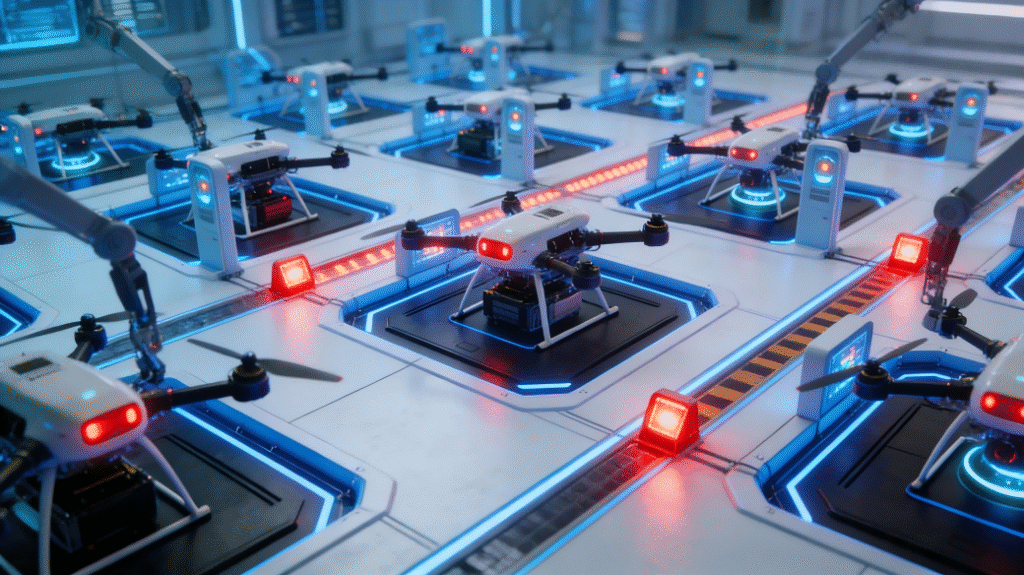
Introduction: The Real Profit Killer Isn’t the Drone — It’s the Battery
As drone operations scale across industries such as inspection, mapping, security, logistics, and counter-UAS, fleet-based deployment has become the norm. Yet when operators analyze their cost structures, many reach the same surprising conclusion:
The drone is not the most expensive asset — the battery is.
More precisely, it is batteries degraded prematurely by inefficient charging and poor lifecycle management that quietly erode profitability.
This article explores how viewing batteries as managed energy assets, rather than consumables, and adopting intelligent charging strategies can reduce total cost of ownership (TCO) by 20%–30% without sacrificing operational efficiency.
1. Batteries: Not Accessories, but High-Frequency Consumables
The True Cost of a Drone Battery
An industrial drone battery’s cost extends far beyond its purchase price:
-
Replacement frequency due to early aging
-
Reduced usable capacity from imbalance
-
Mission downtime and rescheduling losses
-
Safety risks and liability from battery failure
In real-world fleet operations, battery-related expenses often account for:
25%–40% of total operating costs
Why Traditional Charging “Kills” Batteries
Most batteries are not worn out by flight — they are worn out by charging:
-
Inconsistent charger parameters
-
Manual charging errors
-
Long-term storage at full SOC
-
No lifecycle tracking or rotation
The result:
-
20%–40% fewer effective cycles
-
Rapid degradation of consistency
-
Reduced flight endurance per mission
2. Centralized Charging Cabinets: From Manual Handling to System Control
What Is a Centralized Charging Cabinet?
A centralized charging cabinet is not just a power strip with slots. It integrates:
-
Multi-channel intelligent charging
-
Battery identification
-
Real-time SOC/SOH monitoring
-
Closed-loop control of temperature, voltage, and current
Its core value lies in standardization, automation, and data visibility.
How It Reduces Cost
Centralized charging:
-
Prevents overcharge and overheating
-
Minimizes human error
-
Extends battery lifespan by 15%–30%
For fleets managing dozens or hundreds of batteries, lifespan extension alone delivers substantial annual savings.
3. Cloud-Based Battery Management: Let Data Drive Dispatch
Charging cabinets solve how to charge.
Cloud platforms solve which battery should fly.
With cloud-based battery management, operators gain:
-
Full lifecycle traceability
-
Predictive SOH analytics
-
Early fault detection
-
Mission assignment based on battery condition
For example:
-
High-SOH batteries → heavy-load missions
-
Aging batteries → training or short flights
The result:
-
Fewer aborted missions
-
Higher daily sortie rates
-
Better fleet utilization
4. Battery Leasing Models: Turning CAPEX into OPEX
For large or fast-growing fleets, upfront battery investment can be a heavy burden.
The Leasing Logic
Under battery leasing:
-
Ownership stays with the provider
-
Operators pay per use or cycle
-
Maintenance, testing, and retirement are outsourced
Benefits include:
-
Lower initial investment
-
Improved cash flow
-
Reduced technology upgrade risk
Synergy with Intelligent Charging Systems
When leasing is combined with:
-
Centralized charging cabinets
-
Cloud battery management
Providers can:
-
Accurately assess depreciation
-
Optimize inventory
-
Offer more competitive pricing
Operators gain:
Predictable, transparent, and controllable energy costs
5. Why a 30% Cost Reduction Is Realistic
In real deployments, fleets that implement:
-
Standardized intelligent charging
-
Data-driven battery rotation
-
Predictive retirement strategies
-
Leasing or hybrid asset models
Typically achieve:
-
20%–35% fewer battery replacements
-
15%–25% reduction in unplanned downtime
-
10%–20% lower labor management costs
Combined, these translate into:
A 20%–30% reduction in total fleet TCO
Conclusion: Smart Energy Management Wins the Fleet Game
In today’s drone industry, competition is no longer about whose aircraft is better — it’s about:
Who can fly more missions with lower energy cost per hour.
Intelligent charging solutions are no longer optional infrastructure; they are core operational capabilities.
Those who transform batteries from consumables into managed assets will lead the next phase of scalable, profitable drone operations.