
Introduction: Safety Is Not a Feature — It Is the Foundation
In the battery industry, performance numbers often dominate conversations: higher energy density, longer endurance, faster charging. Yet experienced engineers and system integrators know a simple truth:
Every performance metric only has value when it stands on an unshakable foundation of safety.
At our company, safety is not a slogan, nor a line item in a datasheet. It is a measurable commitment.
The data presented below is not marketing language — it is the silent evidence of how seriously we take our responsibility to customers, end users, and the industries that depend on reliable energy.
1. A Full View of “Destructive” Safety Testing
Real safety cannot be proven under ideal conditions. It must be validated under abuse, misuse, and worst-case scenarios — the situations batteries are never supposed to encounter, yet inevitably do in the real world.
1.1 Thermal Abuse Testing: When Heat Becomes the Enemy
Thermal runaway remains one of the most critical failure risks for lithium-based batteries, particularly in high-energy-density applications such as drones, robotics, and mobile platforms.
Test method
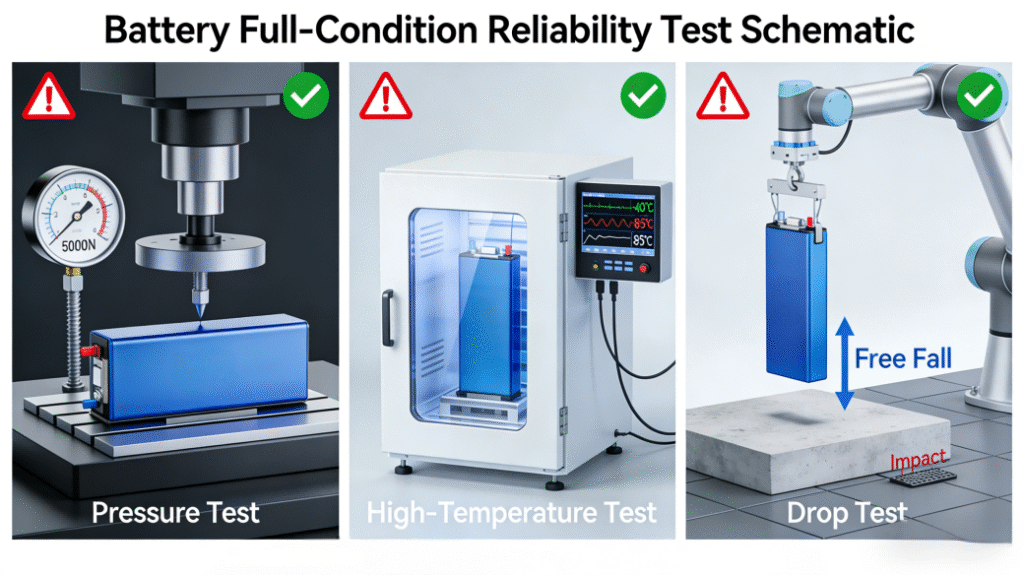
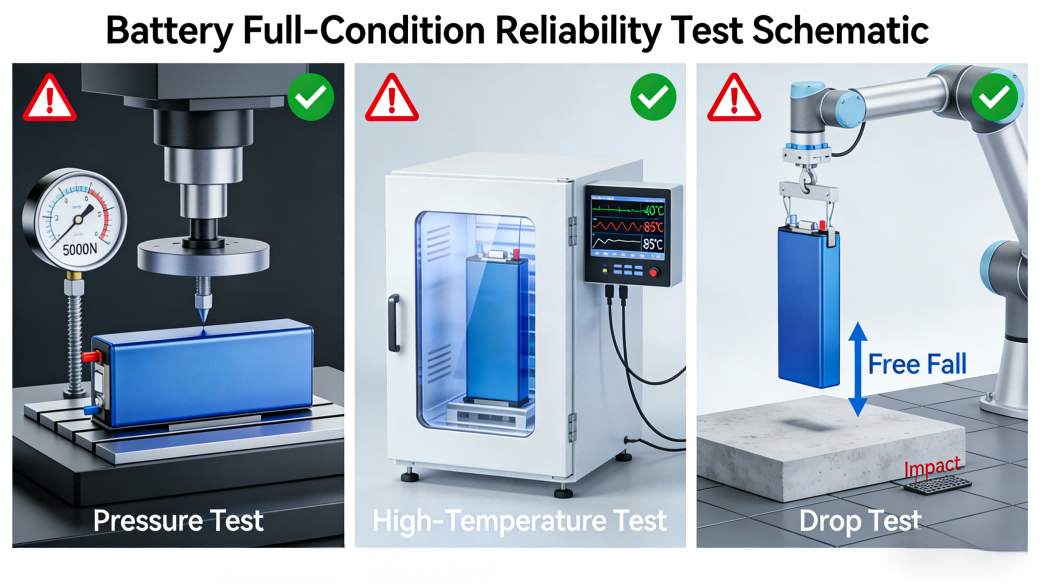
Cells and packs are placed in a high-temperature oven and gradually heated to 130°C, well beyond normal operating limits, while monitoring:
-
Surface temperature
-
Internal pressure
-
Gas release
-
Ignition or explosion events
Key results
-
Sustained thermal exposure without fire or explosion
-
Controlled venting behavior where applicable
-
No chain reaction between adjacent cells
These results demonstrate that thermal stability is engineered into the cell chemistry, structure, and pack design, not left to chance.
1.2 Overcharge and Over-Discharge Protection: Precision Under Extremes
Overcharging and deep over-discharging are among the fastest ways to damage a battery — and one of the most common causes of field failures.
Test focus
-
BMS voltage threshold accuracy
-
Response time under rapid current changes
-
Cut-off behavior under extreme conditions
Observed performance
-
BMS intervention occurs within tightly defined voltage windows
-
Response times measured in milliseconds
-
Clean, repeatable cut-off without voltage oscillation or latch-up
These tests confirm that protection systems do not merely exist — they act decisively and predictably when conditions cross safety boundaries.
1.3 Nail Penetration and Crush Testing: Confronting the Worst-Case Scenario
Few tests are more visually dramatic — or more revealing — than nail penetration and mechanical crush testing.
Test procedure
-
Steel nail penetration through the cell core
-
Controlled mechanical compression simulating external impact
Key evaluation criteria
-
Peak temperature after penetration
-
Presence or absence of thermal runaway
-
Flame, explosion, or delayed ignition
Results
-
Maximum surface temperatures remain within controlled limits
-
No sustained combustion
-
No propagation to neighboring cells
These outcomes demonstrate that even in catastrophic mechanical failure scenarios, the battery system is designed to fail safely, not violently.
2. Reliability Stress Testing: Simulating the Real World, Repeatedly
Safety is not only about extreme abuse — it is also about consistency over time, under fluctuating environments and mechanical stress.
2.1 High- and Low-Temperature Cycling: Stability Across Extremes
Batteries used in drones, outdoor robotics, and industrial equipment routinely face harsh temperature swings.
Test conditions
-
Thermal cycling from -20°C to +60°C
-
Multiple cycles to simulate long-term exposure
Performance indicators
-
Capacity retention
-
Internal resistance change
-
Voltage stability
Results
-
High percentage of capacity retention after cycling
-
Minimal resistance growth
-
Stable discharge profiles
This confirms that performance degradation is gradual and predictable, not abrupt or unsafe.
2.2 Vibration and Shock Testing: Designed for Motion and Impact
In real applications, batteries are rarely stationary. Drones experience vibration and hard landings; robots endure repetitive motion and occasional collisions.
Test scenarios
-
Random vibration across multiple axes
-
Mechanical shock simulating drops and impacts
Post-test evaluation
-
Structural integrity of the pack
-
Connector and weld stability
-
Electrical performance consistency
Outcomes
-
No structural deformation
-
No internal disconnection or short circuit
-
Electrical parameters remain within specification
Reliability here means more than survival — it means no hidden damage that could evolve into a delayed failure.
3. Quality Systems: Where Data Becomes Repeatable Reality
Test results only matter if they are consistently reproduced, not selectively achieved. This is where quality systems play a decisive role.
3.1 IQC: Incoming Quality Control
Every batch of raw materials and cells undergoes verification against defined safety and performance benchmarks before entering production.
3.2 IPQC: In-Process Quality Control
Critical parameters — from welding consistency to insulation integrity — are monitored throughout manufacturing to prevent deviation before it becomes a defect.
3.3 OQC: Outgoing Quality Control
Final products are validated to ensure they meet the same safety performance reflected in our test data — not just once, but every shipment.
This closed-loop system ensures that laboratory data translates into real-world reliability, not isolated test success.
Conclusion: Safety Is Our Non-Negotiable Baseline
In an industry driven by speed, power, and innovation, it is tempting to treat safety as a constraint. We see it differently.
Safety is the baseline that makes all innovation meaningful.
By openly standing behind rigorous testing data, we make a clear statement:
-
To our customers: your systems deserve dependable power
-
To the industry: safety must be proven, not assumed
-
To ourselves: there is no room for compromise
Because in the end, performance may impress —
but safety earns trust, and trust is what sustains long-term partnerships.