
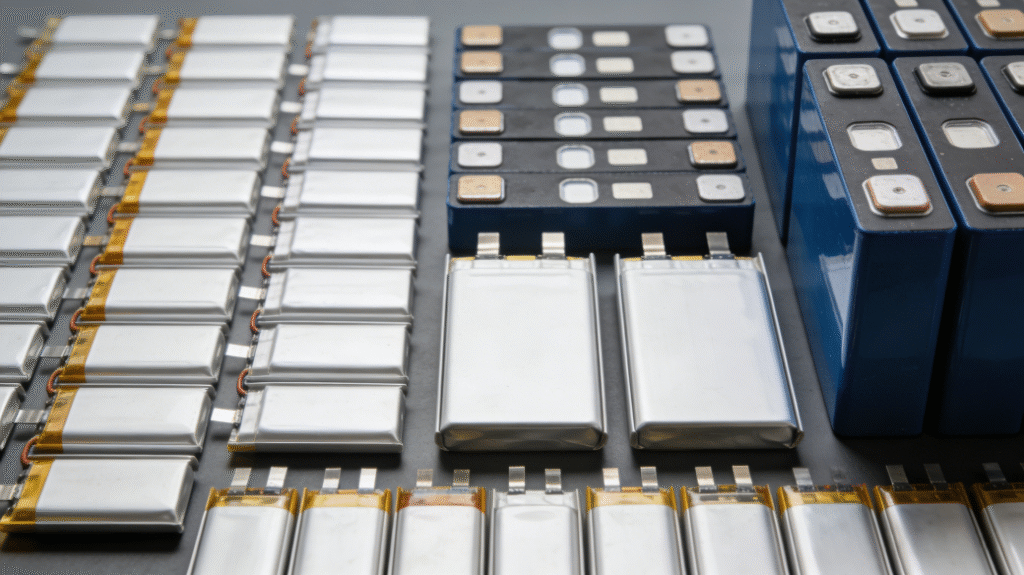
— Why “500 Cycles” or “800 Cycles” Can Be Misleading
In the fields of drones, robotics, and new energy systems, battery cycle life is one of the most frequently quoted parameters during product selection.
Yet in reality, it is also one of the most misunderstood metrics in the entire battery industry.
This article explains cycle life from an engineering perspective and helps you understand:
-
What battery cycle life really means
-
What “800 cycles” in a datasheet actually represents
-
Why batteries with the same rated cycle life can age very differently
-
How different battery chemistries compare in cycle performance
-
Why drones and robots must interpret cycle life in fundamentally different ways
1. What Is a “Cycle”? Don’t Take the Term Literally
Many people assume:
One full charge + one full discharge = one cycle
This is not entirely correct.
The accurate definition is:
One cycle equals the cumulative energy throughput of 100% of the battery’s rated capacity.
Examples:
-
100% → 0% → 100% = 1 full cycle
-
100% → 50% → 100% = 0.5 cycle
-
80% → 30% → 80% = 0.5 cycle
👉 Cycle count measures energy throughput, not charging events.
2. What Does “500 / 800 / 1,000 Cycles” in a Datasheet Really Mean?
When a datasheet states:
Cycle Life: 800 cycles @ 80% capacity retention
It means:
Under specified laboratory conditions,
after 800 equivalent full cycles,
the battery retains at least 80% of its initial capacity.
Key details often overlooked:
-
❌ It does not mean the battery stops working at 800 cycles
-
❌ It does not reflect all real-world usage scenarios
-
❌ It is not a failure threshold
📌 Cycle life is a reference point on a degradation curve—not a “death sentence.”
3. Test Conditions Define the Meaningfulness of Cycle Life
1️⃣ Ambient Temperature
Most cycle-life tests are conducted at:
-
25°C (±2°C)
-
Controlled laboratory environments
In real-world applications:
-
High temperatures dramatically accelerate degradation
-
Low temperatures increase internal resistance and reduce usable capacity
2️⃣ Charge and Discharge Rate (C-Rate)
Typical test conditions:
-
0.5C or 1C charge/discharge
Real applications:
-
Drones and robots often operate at 5C–20C discharge rates
👉 Higher C-rates significantly reduce actual cycle life
3️⃣ Depth of Discharge (DoD)
One of the most critical factors affecting cycle life.
| Depth of Discharge | Relative Cycle Life |
|---|---|
| 100% DoD | Baseline |
| 80% DoD | +30%–50% |
| 60% DoD | 2–3× |
| 40% DoD | 4–6× |
📌 This is why commercial drones, industrial robots, and energy storage systems intentionally avoid full depletion.
4. Cycle Life Is Not the Same as Service Life
Three different concepts must be clearly separated:
| Term | Meaning |
|---|---|
| Cycle life | Degradation to a defined capacity threshold |
| Calendar life | Aging over time, even without use |
| Service life | The combined result of both |
Even if a battery:
-
Is used only 50 cycles per year
-
Is stored at full charge
-
Operates in a high-temperature environment
👉 Capacity degradation will still occur.
5. Why Two Batteries Rated at 800 Cycles Can Age Very Differently
The answer lies beyond the datasheet—in manufacturing quality.
1️⃣ Material System
-
Cathode material stability
-
Electrolyte decomposition resistance
-
Separator thermal tolerance
2️⃣ Cell Consistency
-
Capacity deviation
-
Internal resistance variation
📌 Poor consistency leads to:
The weakest cell aging first—
dragging down the entire battery pack.
3️⃣ Process Control
-
Coating uniformity
-
Compaction density control
-
Welding and interconnection reliability
📌 Cycle life is not just designed—it is manufactured.
6. How to Use Cycle Life Correctly in Drone Applications
Instead of asking:
How many cycles can this battery last?
Ask:
-
Under my mission profile
-
With my discharge rate, DoD, and temperature conditions
-
What is the annual replacement cost?
📌 More meaningful metrics include:
-
Effective energy per mission
-
Cost per flight over the full lifecycle
-
Consistency retention over time
7. Practical Ways to Extend Real-World Cycle Life
✅ Avoid deep discharge (<20%)
✅ Avoid long-term storage at full charge
✅ Use matched, intelligent chargers
✅ Minimize high-temperature operation and charging
✅ Implement battery rotation and tracking systems
8. Cycle Life Across Different Battery Chemistries
— Why Application Context Matters More Than Cycle Count
Cycle life is defined by chemistry limits and shaped by system design.
In real engineering applications:
-
Robot batteries commonly use Lithium Iron Phosphate (LFP), Nickel Manganese Cobalt (NMC), Lithium Cobalt Oxide (LCO), and in specialized cases, Lithium Titanate (LTO)
-
Drone batteries overwhelmingly rely on high-energy-density NMC or NCA lithium polymer cells
1️⃣ Lithium Iron Phosphate (LFP) — The Longevity Champion
-
2,000–5,000 cycles
-
Up to 6,000+ cycles at moderate DoD
-
Widely used in robots, energy storage, and industrial systems
📌 Strengths: Exceptional safety and durability
📌 Limitations: Low energy density, unsuitable for flight
2️⃣ Ternary Lithium (NMC / NCA) — The Drone Industry Standard
-
500–1,200 cycles under test conditions
-
In real drone operations:
-
300–600 cycles are typical
-
600–800 cycles achievable with disciplined management
-
📌 Core tradeoff:
Cycle life is sacrificed to achieve maximum energy density and mission performance
3️⃣ Lithium Cobalt Oxide (LCO)
-
300–500 cycles
-
Used mainly in low-capacity robots and consumer electronics
4️⃣ Lithium Manganese Oxide (LMO)
-
500–1,000 cycles
-
Often blended with NMC to enhance high-rate performance
5️⃣ Lithium Titanate (LTO) — Nearly Indestructible
-
10,000–20,000 cycles
-
Chosen for extreme safety, longevity, and fast-charging applications
-
Not viable for drones due to very low energy density
9. Final Takeaways: An Engineer’s Perspective on Cycle Life
| Chemistry | Cycle Life | Energy Density | Typical Applications |
|---|---|---|---|
| LFP | ⭐⭐⭐⭐☆ | ⭐⭐ | Robots, energy storage |
| NMC / NCA | ⭐⭐☆ | ⭐⭐⭐⭐ | Drones, high-power systems |
| LCO | ⭐⭐ | ⭐⭐⭐ | Lightweight electronics |
| LMO | ⭐⭐☆ | ⭐⭐☆ | High-rate support |
| LTO | ⭐⭐⭐⭐⭐ | ⭐ | Extreme longevity |
The bottom line:
Cycle life is not a promise that a battery will last exactly “X cycles.”
It is an indicator of how fast degradation progresses under defined conditions.
A professional interpretation always considers:
-
Test conditions
-
Capacity retention thresholds
-
Cell consistency and manufacturing quality
-
The actual application environment
