
1. Understanding the Concept: “Anode-Free” Does Not Mean “No Anode”
The term anode-free lithium battery is often misunderstood.
An anode-free battery does not eliminate the anode as an electrode.
Instead, it means:
There is no pre-deposited active anode material (such as graphite or silicon) at manufacturing.
During the first charge, lithium ions are extracted from the cathode and plated directly onto the anode current collector (typically copper), forming a lithium metal anode in situ.
In short:
-
The anode structure exists
-
The active anode material forms only after the first charge
2. How Anode-Free Batteries Differ from Other Lithium Batteries
1️⃣ Versus Conventional Lithium-Ion Batteries
| Aspect | Conventional Li-ion | Anode-Free |
|---|---|---|
| Anode material | Graphite / Silicon | None (initially) |
| Lithium source | Cathode + anode | Cathode only |
| Energy density limit | Moderate | Very high |
| Cycle life | Mature | Very limited |
The key difference lies in eliminating excess anode material and lithium inventory.
2️⃣ Versus Lithium Metal Batteries
Anode-free batteries are often confused with lithium metal batteries, but they are not the same.
| Item | Lithium Metal Battery | Anode-Free Battery |
|---|---|---|
| Anode | Lithium foil | Copper foil |
| Pre-deposited lithium | Yes | No |
| Dendrite risk | High | Even higher |
An anode-free battery can be viewed as a lithium metal battery without a safety buffer.
3️⃣ Versus Silicon Anode Batteries
-
Silicon anodes enhance lithium-ion batteries incrementally
-
Anode-free designs fundamentally redefine electrode architecture
3. Why Is the Industry Pursuing Anode-Free Batteries?
The answer is simple:
Pushing the theoretical limit of energy density
By removing the anode active material:
-
More cathode material can be packed
-
Weight and volume efficiency are maximized
-
Theoretical energy density exceeds 450–600 Wh/kg
This is why anode-free concepts frequently appear in solid-state battery roadmaps.
4. Key Advantages
✅ Ultra-High Energy Density Potential
This is the single most compelling advantage.
✅ Simplified Electrode Structure (in theory)
Fewer materials, fewer layers — though not easier manufacturing.
✅ Natural Compatibility with Solid-State Batteries
Most anode-free research is tightly coupled with solid-state electrolyte development.
5. Critical Challenges and Limitations
❌ Lithium Dendrite Formation
Non-uniform lithium plating leads to dendrites, short circuits, and thermal runaway.
❌ Extremely Limited Cycle Life
-
Typically 50–200 cycles to 80% capacity
-
Even slight lithium loss causes irreversible degradation
❌ Extreme Manufacturing Sensitivity
Surface defects, moisture, current density distribution — all become critical.
❌ Minimal Safety Margin
Very narrow operating window and limited BMS intervention space.
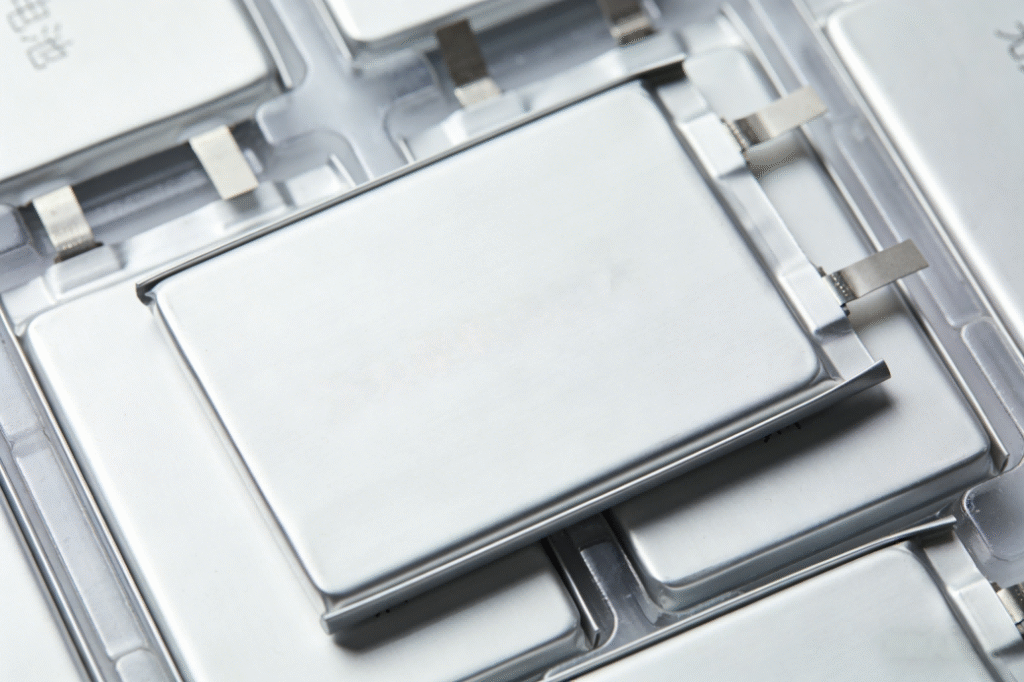
6. Cell Formats: Why Pouch Cells Dominate
Currently, pouch cells are the dominant form:
-
Better pressure control
-
Higher stacking precision
-
Greater experimental flexibility
Prismatic and cylindrical formats remain largely impractical for anode-free designs.
7. Application Scenarios
Suitable Applications
-
Aerospace and defense
-
One-time or low-cycle missions
-
Solid-state battery prototypes
Why Not Drones or Robots?
Drones and robots prioritize:
-
Safety
-
Power capability
-
Cycle life
-
Predictable degradation
Anode-free batteries fail to meet these requirements today.
8. Final Takeaway
Anode-free lithium batteries trade durability and safety for maximum energy density.
They are not a near-term replacement for conventional batteries, but a bold stepping stone toward future solid-state systems.