
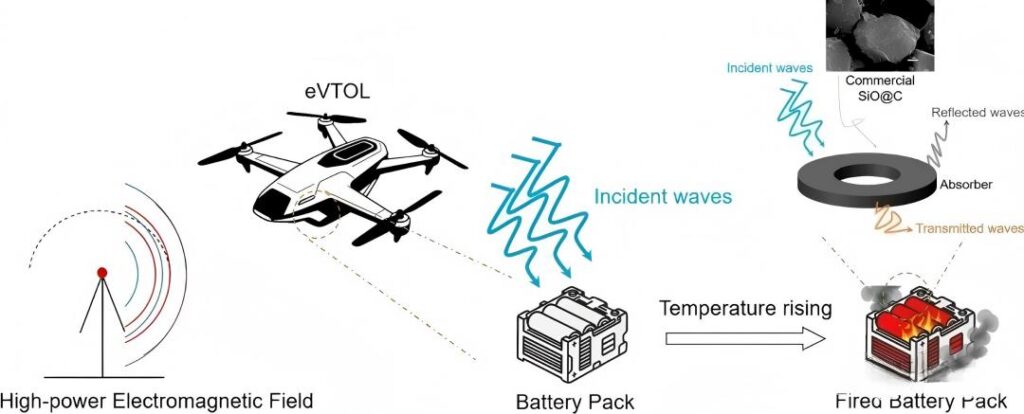
As the drone and eVTOL industries push toward longer flight times and higher energy density, most discussions around battery safety focus on thermal runaway, fast charging, overcurrent, or mechanical damage.
But what if your battery is heating up without being charged, discharged, or physically stressed?
Recent research from researchers at Huazhong University of Science and Technology (HUST), published in Sustainable Materials and Technologies, highlights an emerging issue that deserves more attention: electromagnetic (EM) radiation-induced heating inside high-energy lithium batteries.

For industries developing eVTOL aircraft, industrial UAVs, autonomous robots, and defense platforms, this may become an important consideration in future battery design.
Why Electromagnetic Fields Matter
Modern electric aircraft and intelligent robots increasingly operate in environments filled with electromagnetic radiation:
- Radar systems
- 5G and future 6G communication infrastructure
- High-power wireless communication equipment
- Military electronic warfare environments
- Industrial automation facilities
Traditionally, engineers reduce electromagnetic interference (EMI) by adding metallic shielding around battery packs.
However, shielding comes with a significant trade-off:
- Additional weight
- Larger battery volume
- Lower system energy density
For aviation applications where every gram matters, adding more metal is rarely the ideal solution.
High-Energy Silicon-Carbon Anodes: A Double-Edged Sword
Silicon-carbon (SiO@C) anodes are widely considered one of the most promising next-generation lithium battery technologies.
Compared with conventional graphite, silicon offers dramatically higher theoretical capacity, making it highly attractive for:
- eVTOL aircraft
- Long-endurance UAVs
- Embodied AI robots
- High-performance electric mobility
But there is another side to the story.
According to the HUST study, silicon-carbon anodes can also absorb high-frequency electromagnetic waves, converting part of that electromagnetic energy into heat.
In other words:
The battery itself can become an unintended microwave absorber.
The Research Findings
The researchers investigated three commercial silicon-carbon anode materials with different silicon particle sizes:
- 3 nm
- 4 nm
- 5 nm
across frequencies ranging from 2 GHz to 18 GHz.
Their findings revealed several important mechanisms:
- Conductive loss is the dominant mechanism behind electromagnetic absorption.
- Debye relaxation and interfacial polarization provide additional contributions.
- Material conductivity strongly influences microwave-induced heating.
Simply put:
Higher electrical conductivity allows more electromagnetic energy to be converted into heat.
Material Structure Matters More Than Expected
One particularly interesting discovery came from COMSOL simulations.
The researchers found that the spatial distribution of graphite inside the electrode may influence electromagnetic heating even more than the material composition itself.
When highly conductive graphite becomes concentrated inside certain regions, it creates conductive pathways that generate:
- higher current density
- localized Joule heating
- thermal hotspots
This means battery thermal behavior is not determined solely by chemistry—but also by electrode architecture.
Bigger Conductivity Isn’t Always Better
Battery engineers have traditionally pursued higher electrical conductivity because it improves:
- power capability
- charging performance
- internal resistance
However, this research suggests that in strong electromagnetic environments, excessive conductivity can actually increase unwanted heating.
This creates a new engineering balance:
Instead of maximizing conductivity at all costs, designers may need to optimize it for both electrochemical performance and electromagnetic safety.
The Best Performer: 3 nm Silicon Particles
Among the three samples, the material with 3 nm silicon particles demonstrated the most balanced performance.
Although it wasn’t the strongest electromagnetic attenuator, it achieved the best impedance matching, allowing electromagnetic waves to enter and dissipate efficiently without creating excessive localized heating.
Its measured performance included:
- Reflection loss below −40 dB
- Effective absorption bandwidth of 4.08 GHz
- Peak performance near 15.84 GHz

These results provide valuable insight for future high-energy battery material design.
Why This Matters for the Drone Industry
As someone working in the UAV battery industry, I believe this research highlights an important trend.
Future drone batteries won’t compete solely on:
- Energy density
- Cycle life
- Fast charging
- Weight
They will also need to withstand increasingly complex operating environments.
Industrial UAVs, military drones, eVTOL aircraft, and autonomous robotic platforms often operate close to:
- communication infrastructure
- surveillance systems
- radar installations
- electronic warfare equipment
Understanding how batteries behave under electromagnetic exposure may become another critical aspect of system reliability.
Looking Ahead
The next generation of battery innovation will likely require multidisciplinary optimization:
- Advanced electrochemistry
- Thermal management
- Electromagnetic compatibility (EMC)
- Material science
- Battery Management Systems (BMS)
- Intelligent battery modeling
As the low-altitude economy and electric aviation continue to grow, battery safety is expanding beyond traditional electrochemical challenges.
Sometimes, the greatest threat isn’t what we can see.
It may be the invisible electromagnetic energy surrounding us.
What do you think?
As drones, eVTOL aircraft, and embodied AI robots become increasingly common, should electromagnetic compatibility become a standard consideration in future lithium battery design, alongside energy density and thermal safety?
