
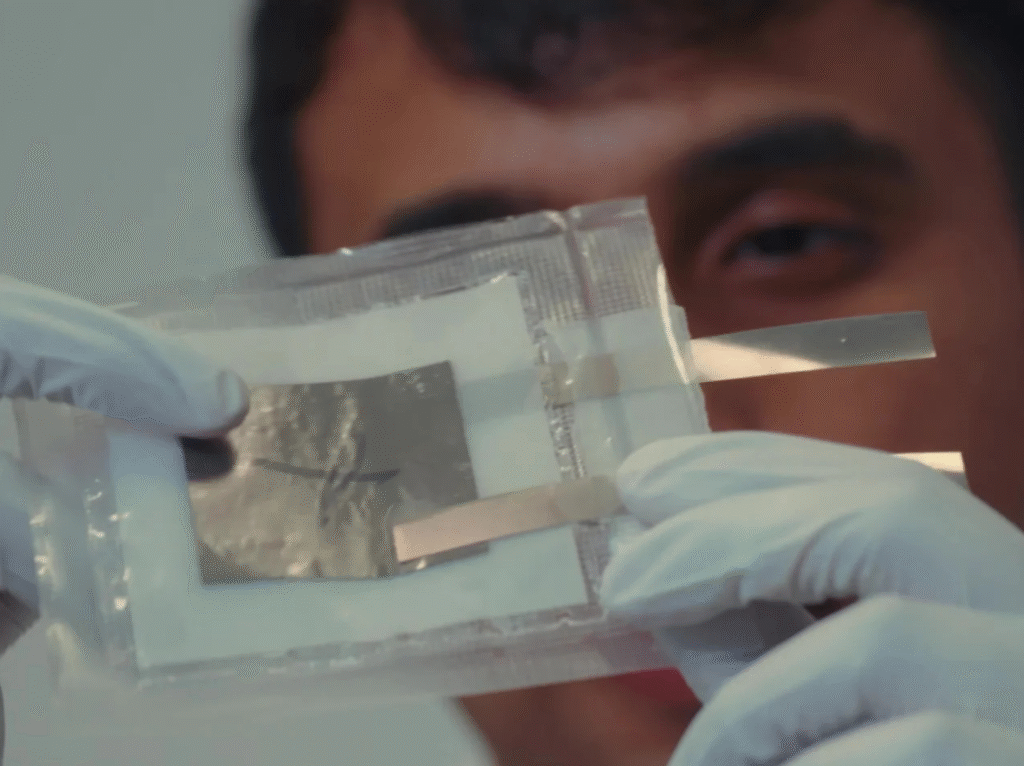
“What if you could cut a battery with scissors while it was powering a device—and nothing caught fire?”
That sounds like science fiction. Yet this is exactly what Singapore-based startup Flint has demonstrated.
In recent demonstrations, a battery continued powering a fan after being cut with scissors. It was also exposed to direct flame without exploding or entering thermal runaway. Instead of smoke and fire, it simply kept delivering power.

For anyone working in batteries, drones, robotics, or electric aviation, this is more than an impressive demonstration—it represents a completely different way of thinking about battery chemistry.
As someone working in the drone battery industry, I believe Flint’s technology deserves attention—not because it will replace lithium-ion batteries tomorrow, but because it highlights how battery innovation is expanding beyond simply chasing higher energy density.
Why Conventional Lithium Batteries Catch Fire
To understand why Flint’s battery is attracting global attention, we first need to understand why lithium-ion batteries sometimes fail.
Most lithium-ion batteries contain:
- Lithium-based electrodes
- Organic electrolyte
- Polymer separator
Under abuse conditions—such as puncture, overheating, crushing, or internal short circuits—the organic electrolyte can ignite. Once the temperature reaches a critical point, thermal runaway begins, creating a chain reaction that can be difficult to stop.

This is why battery safety has become one of the most important topics in industries such as:
- eVTOL aircraft
- Industrial drones
- Energy storage systems
- Electric vehicles
- Medical devices
Safety is no longer just a feature—it is becoming a competitive advantage.
Flint Chose an Entirely Different Chemistry
Instead of improving lithium-ion technology, Flint redesigned the battery from the ground up.
Its paper battery uses:
- Cellulose fibers as the structural framework
- Zinc as the anode
- Manganese dioxide as the cathode
- Water-based hydrogel electrolyte
Notably, the battery contains:
❌ No lithium
❌ No cobalt
❌ No nickel
❌ No PFAS chemicals
Because the electrolyte is water-based rather than flammable organic solvent, the battery behaves very differently under mechanical damage.
Cut it.
Burn it.
Pierce it.
The battery can continue operating without the violent thermal runaway typically associated with lithium-ion systems.
That represents a major shift in battery safety philosophy.
Safety Is Only Part of the Story
According to publicly available information, Flint’s rechargeable paper battery achieves approximately:
- 226 Wh/kg energy density
- 4.2V output voltage
- Around 70% capacity retention after 1,000 cycles
- Operating temperatures from -15°C to 80°C
These figures won’t immediately outperform the highest-energy lithium batteries used in premium EVs or long-endurance UAVs.
But they are already competitive for many applications, including:
- Wireless peripherals
- IoT devices
- Smart sensors
- Wearables
- Medical electronics
- Consumer electronics
For these markets, users often value safety, sustainability, and cost more than achieving the absolute highest energy density.
Commercial Validation Matters More Than Lab Results
Many battery technologies look promising inside research laboratories.
Very few find commercial customers.
Flint has already crossed that important milestone.
Logitech selected Flint through its Future Positive Challenge and has begun pilot programs using Flint’s AAA paper batteries in wireless keyboards and mice.
The startup has also participated in programs involving Amazon through climate innovation initiatives.
Even more importantly, Flint’s pilot production line began operating in Singapore in early 2026.

That changes the conversation from:
“Can this technology work?”
to
“Can it scale?”
Those are two very different questions.
Manufacturing Could Become Flint’s Biggest Advantage
One fascinating aspect of Flint’s approach is manufacturing compatibility.
Rather than requiring completely new factories, Flint says many existing battery production lines can be adapted to manufacture its batteries with relatively modest modifications.

If this proves true at industrial scale, commercialization could happen much faster than many next-generation battery technologies.
Manufacturing compatibility is often overlooked, but history shows it can determine whether a technology succeeds commercially.
A great battery that cannot be manufactured economically rarely changes the market.
What Does This Mean for the Drone Industry?
As a professional focused on drone battery solutions, I don’t expect paper batteries to replace today’s high-performance lithium packs for heavy-lift drones or long-endurance UAVs anytime soon.
Current drone platforms still require:
- Extremely high power output
- High discharge rates
- Lightweight designs
- Long flight endurance
Lithium-based batteries remain the best solution for these demanding requirements.
However, Flint’s technology could eventually find opportunities in areas such as:
- Drone remote controllers
- Ground control stations
- IoT sensor nodes
- Portable monitoring equipment
- Emergency backup power
- Low-power autonomous devices
Battery technology doesn’t always move through direct replacement.
Sometimes entirely new chemistries create new markets instead.
Beyond Performance: A New Definition of Battery Value
For decades, battery innovation has largely focused on one question:
How can we store more energy?
Flint asks a different question:
How can we make batteries safer, simpler, and more sustainable?
Those priorities matter increasingly as industries face growing demands for:
- ESG compliance
- Supply chain resilience
- Reduced dependence on critical minerals
- Lower carbon footprints
- Improved product safety
Sometimes the biggest innovation isn’t creating the most powerful battery.
It’s creating the battery that solves the right problem.
Final Thoughts
Flint’s paper battery will not replace lithium-ion batteries overnight.
Its current production capacity is tiny compared with the global battery market, and lithium chemistry will remain essential for high-performance applications such as electric aircraft, industrial drones, and electric vehicles.
But Flint demonstrates something much bigger.
It proves that battery innovation is no longer limited to improving existing lithium chemistry.
Instead, researchers and startups are exploring entirely new material systems that prioritize safety, sustainability, manufacturing flexibility, and supply-chain resilience.
From a university laboratory and a simple kitchen mixer to a pilot production line supplying global brands—that journey alone is remarkable.
The future of energy storage may not belong to one chemistry.
It may belong to many.
And that’s exciting for everyone working across batteries, drones, robotics, and electric aviation.
What do you think?
Will alternative chemistries like zinc-based paper batteries become an important complement to lithium-ion technology over the next decade, or will lithium continue to dominate most applications?
I’d love to hear your perspective.
#BatteryTechnology #PaperBattery #EnergyStorage #DroneBattery #LithiumIon #ZincBattery #BatteryInnovation #eVTOL #Robotics #CleanEnergy #Sustainability #FutureTech
