
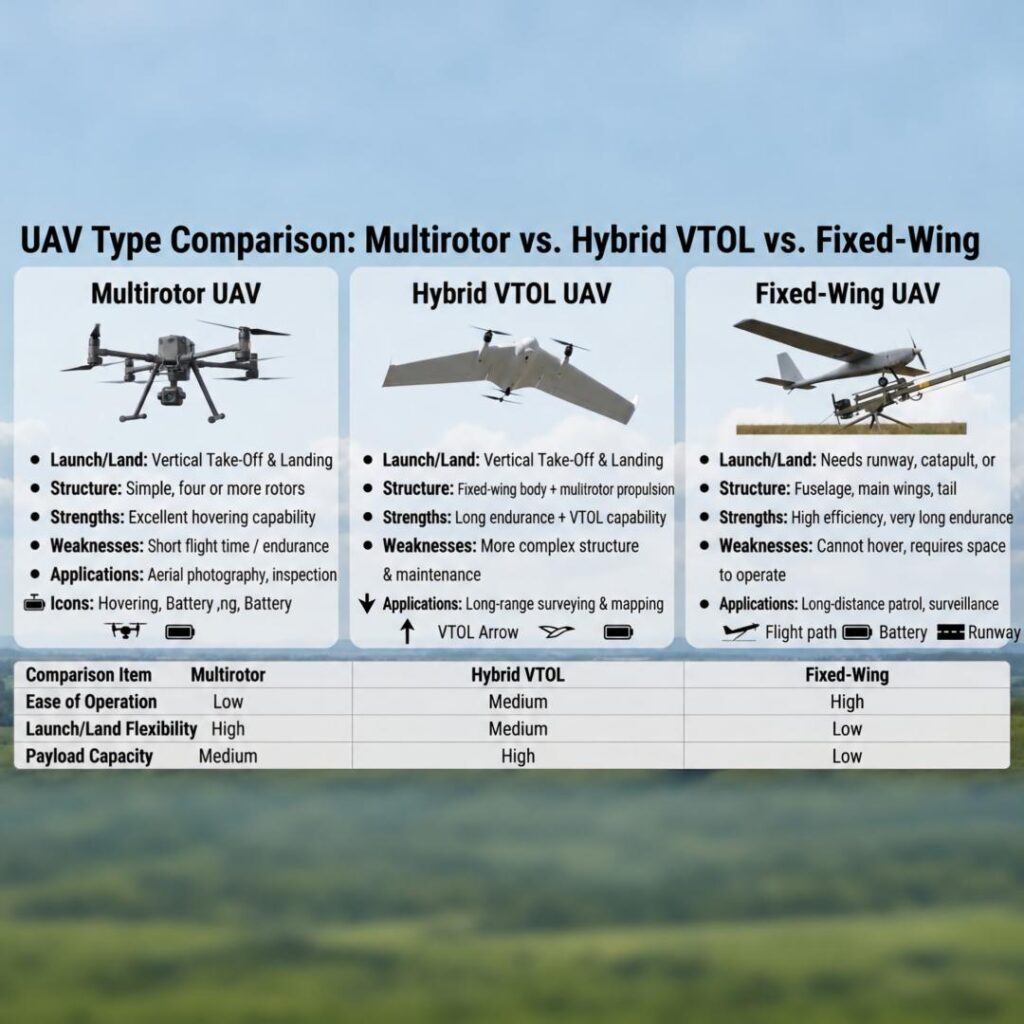
Choosing the Right Drone Is Not About Finding the Most Advanced Aircraft — It’s About Finding the Best Match for Your Mission, Budget, and Operating Requirements.
Not all drones are created equal.
Although multirotor drones, VTOL fixed-wing drones, and conventional fixed-wing drones are all classified as UAVs, their flight characteristics, endurance, operating costs, and applications can be dramatically different.
Choosing the wrong configuration can lead to unnecessary expenses, inefficient operations, or even mission failure.
So, which drone configuration should you choose?
The answer can be summarized in one sentence:
Multirotor drones offer flexibility. VTOL fixed-wing drones offer a balance. Fixed-wing drones offer efficiency.
There is no universally superior drone configuration. The best choice depends on what your mission actually requires.
1. Understanding the Three Main Drone Configurations
Multirotor Drones: Flexibility and Precision
Multirotor drones are among the most widely used UAV configurations, particularly in consumer and industrial applications.
Their greatest advantage is the ability to take off vertically, hover steadily, and maneuver precisely.
Key characteristics:
- Vertical takeoff and landing (VTOL)
- Excellent hovering capability
- Relatively easy operation
- High maneuverability in confined spaces
- Generally shorter endurance and lower cruising efficiency
Many conventional battery-powered multirotor drones offer approximately 20–50 minutes of flight time, although actual endurance varies significantly with aircraft size, payload, battery capacity, and operating conditions.
Typical applications:
- Aerial photography and videography
- Infrastructure inspection
- Agricultural spraying
- Drone light shows
- Short-distance urban delivery
- Search and rescue operations
Multirotor drones also offer the widest price range, from relatively inexpensive consumer models to sophisticated industrial platforms costing tens of thousands of dollars or more.
Best suited for: Missions requiring precise positioning, hovering, and frequent takeoff and landing.
VTOL Fixed-Wing Drones: Combining Flexibility and Endurance
VTOL fixed-wing drones combine vertical takeoff and landing with efficient wing-borne forward flight.
Many hybrid configurations use dedicated lift motors for takeoff and landing, then transition to fixed-wing cruise.
This allows them to operate without a conventional runway while achieving greater cruising efficiency than typical multirotor aircraft.
Key characteristics:
- Vertical takeoff and landing
- Efficient fixed-wing cruising
- Longer endurance than many comparable multirotor drones
- Greater operational range
- More complex propulsion and flight-control systems
- Higher maintenance and integration requirements
Typical applications:
- Long-distance infrastructure inspection
- Oil and gas pipeline monitoring
- Large-area surveying and mapping
- Emergency response
- Regional logistics
- Environmental monitoring
The main trade-off is complexity.
VTOL fixed-wing aircraft may require additional propulsion components, transition control systems, and more demanding maintenance procedures.
Best suited for: Missions requiring long-distance flight without access to a runway.
Conventional Fixed-Wing Drones: Maximum Cruising Efficiency
Fixed-wing drones generate lift primarily through their wings during forward flight.
Unlike multirotor drones, conventional fixed-wing aircraft generally cannot hover.
However, their aerodynamic efficiency makes them particularly attractive for long-distance operations.
Key characteristics:
- High cruising efficiency
- Generally longer flight endurance
- Higher cruising speeds
- Efficient large-area coverage
- No stationary hovering capability
- Require a suitable launch and recovery method
Depending on the aircraft, takeoff may involve a runway, hand launch, or catapult system.
Landing may require a runway, net, parachute, or another recovery arrangement.
Typical applications:
- Large-scale aerial mapping
- Long-duration environmental monitoring
- Agricultural surveying
- Long-range reconnaissance
- Regional cargo transportation
Best suited for: Missions where range, area coverage, and energy efficiency are more important than hovering.
2. Multirotor vs. VTOL Fixed-Wing vs. Fixed-Wing: Comparison Table

Note: These are general comparisons. Actual performance depends on aircraft design, propulsion technology, payload, operating conditions, and mission profile.
What About Battery Requirements?
The three configurations also have different power demands.
Multirotor drones continuously rely on their propulsion systems to generate lift.
Their batteries must support sustained power delivery, especially during hovering, climbing, and high-payload operations.
VTOL fixed-wing drones have different power requirements during vertical takeoff, transition, cruise, and landing.
Battery selection must account for both high-power VTOL phases and the energy needed for the overall mission.
Conventional fixed-wing drones generally benefit from lower cruise power requirements relative to comparable hovering aircraft.
This can allow longer endurance with an appropriately designed battery system.
However, actual battery performance depends on aircraft weight, aerodynamic efficiency, propulsion design, and flight conditions.
The best battery is not simply the one with the highest capacity. It is the one that matches the aircraft’s power demand and mission profile.
3. Three Common Mistakes When Choosing a Drone Configuration
Mistake 1: Using a Multirotor for Long-Distance Missions
Imagine inspecting a pipeline extending hundreds of kilometers.
A conventional multirotor may require frequent landings, battery replacements, and repeated mission planning.
This can increase operating time and costs.
For long-distance inspection, a VTOL fixed-wing drone may be more efficient, especially when suitable runways are unavailable.
Lesson: If your mission prioritizes distance and area coverage, evaluate fixed-wing or VTOL fixed-wing platforms.
Mistake 2: Using a Fixed-Wing Drone for Tasks That Require Hovering
Consider a detailed inspection of power transmission equipment.
The operator may need to stop at specific positions, examine components closely, and capture images from multiple angles.
A conventional fixed-wing drone cannot remain stationary in the air.
Although it may perform certain inspections using suitable sensors and flight paths, it cannot provide the same hovering capability as a multirotor.
Lesson: If precise stationary observation is essential, multirotor drones are generally the better choice.
Mistake 3: Choosing VTOL Fixed-Wing Without Considering the Total Budget
VTOL fixed-wing drones offer attractive capabilities.
However, greater system complexity can also increase ownership costs.
Operators should consider:
- Initial aircraft purchase price
- Pilot training
- Maintenance requirements
- Spare parts
- Battery replacement
- Charging infrastructure
- Flight-control and transition-system support
For small teams, these costs can become significant.
Lesson: Do not choose a more complex aircraft simply because it offers longer endurance. Make sure your mission volume and business model justify the investment.
4. Drone Selection Recommendations for Different Users
Individual Pilots and Aerial Photographers
Recommended configuration: Multirotor
For recreational flying, photography, and general aerial video production, multirotor drones are usually the most practical starting point.
They offer straightforward operation, precise hovering, and a wide selection of affordable models.
Startups Providing Inspection or Mapping Services
Recommended configuration: Start with Multirotor, Then Evaluate VTOL Fixed-Wing
For a startup entering the drone service market, a multirotor platform can be an effective way to establish operations.
It allows the team to gain experience, validate customer demand, and develop reliable operating procedures.
As project scale increases, particularly for long-distance inspection or large-area mapping, VTOL fixed-wing aircraft may become economically attractive.
The decision should depend on actual customer requirements rather than aircraft specifications alone.
Professional Surveying and Logistics Operators
Recommended configuration: VTOL Fixed-Wing or Conventional Fixed-Wing
For large-area mapping, regional transportation, and long-distance monitoring, fixed-wing configurations often provide better mission efficiency.
VTOL fixed-wing aircraft are particularly useful when runway access is limited.
Conventional fixed-wing drones may offer advantages where suitable launch and recovery infrastructure is available.
Multirotor drones can still complement these platforms for detailed inspection and close-range operations.
5. Why Battery Selection Must Follow Aircraft Configuration
For UAV manufacturers and system integrators, aircraft configuration directly influences battery system design.
A battery optimized for a multirotor aircraft may not be the best solution for a VTOL fixed-wing platform.
Multirotor Battery Priorities
- Sufficient continuous discharge capability
- Stable voltage under high propulsion loads
- Appropriate energy density
- Weight optimization
- Reliable performance under repeated flight cycles
VTOL Fixed-Wing Battery Priorities
- High power capability during vertical takeoff and landing
- Sufficient energy for efficient cruise
- Stable performance across changing load conditions
- Appropriate battery management and monitoring
- Weight distribution and installation compatibility
Fixed-Wing Battery Priorities
- High usable energy relative to weight
- Efficient energy delivery during cruise
- Suitable discharge performance for takeoff and climbing
- Long-term reliability
- Compatibility with the aircraft’s operating voltage and propulsion system
For all three configurations, battery design must consider more than nominal capacity.
Voltage, current demand, pack weight, operating temperature, charging time, and safety requirements all influence the final selection.
For professional UAV platforms, these factors should be evaluated together during the aircraft design process.
Aircraft configuration determines the flight mission. The flight mission determines the power profile. The power profile helps determine the battery solution.
6. Final Thoughts: Choose the Mission First, Not the Aircraft
When selecting a UAV configuration, ask yourself one fundamental question:
Which is more valuable for my mission: flying farther or staying precisely in position?
If hovering and maneuverability are the priority, choose a multirotor drone.
If long-distance efficiency is the priority and suitable launch and recovery methods are available, consider a conventional fixed-wing drone.
If you need long-distance flight combined with vertical takeoff and landing—and your budget supports the additional complexity—consider a VTOL fixed-wing drone.
Ultimately, the best UAV is not necessarily the fastest, the most expensive, or the one with the longest advertised endurance.
It is the aircraft that completes the required mission reliably and economically.
Multirotor offers flexibility. VTOL fixed-wing offers balance. Fixed-wing offers efficiency.
The right choice begins with understanding your mission—not comparing specifications in isolation.
What’s Your Experience?
Which drone configuration are you currently using?
Have you ever selected a multirotor, VTOL fixed-wing, or conventional fixed-wing drone and later wished you had chosen differently?
Share your experience in the comments.
UniquePower | UAV Battery & Charging Solutions
Supporting UAV manufacturers and system integrators with lithium-ion cell selection, customized battery packs, BMS integration, and charging solutions.
Website: www.uniquepower.net Email: sales@uniquepower.net WhatsApp: +86 178 2175 0340
#MultirotorDrone #VTOLDrone #FixedWingDrone #UAVTechnology #DroneBattery #DroneEngineering #UAVApplications #DroneIndustry