
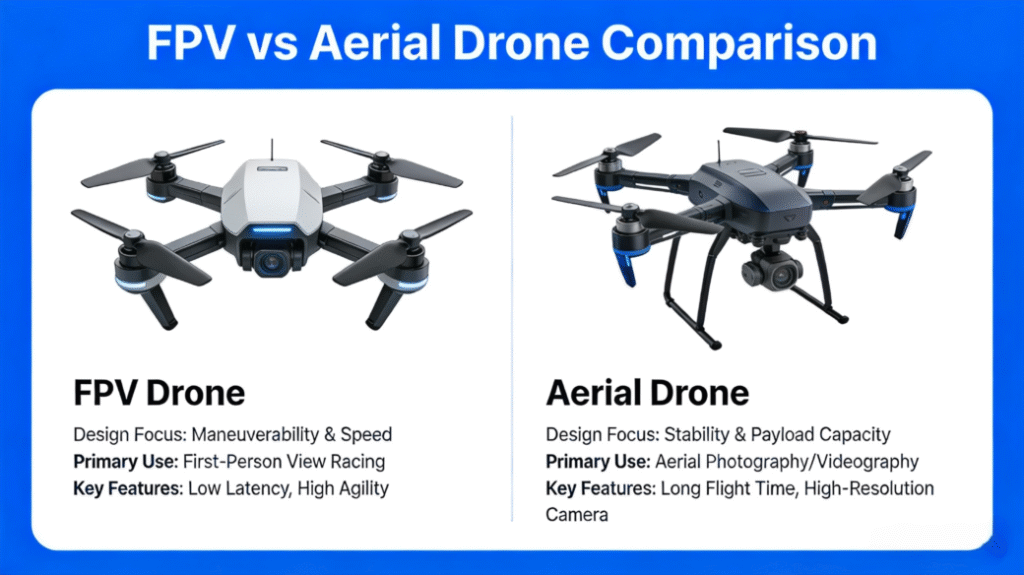
Whether you’re a complete beginner just stepping into the world of aerial devices, or a seasoned aerial photography enthusiast with years of flight experience, you’ve probably been puzzled by the same question recently:
If both are quadcopters flying in the sky, are FPV racing drones and conventional camera drones essentially the same thing?
Why do some people describe FPV drones as thrilling and addictive, while others warn that they are difficult to master and easy to crash?
With consumer flight devices gaining sustained attention and leading brands continuously investing in immersive flight segments, new product news keeps emerging. More people want to understand this niche yet highly technical category. Instead of being overwhelmed by fragmented explanations and player opinions, it’s better to systematically clarify everything—from definitions and structure to user experience and purchasing logic—in one comprehensive overview.
I. Clarifying the Core Concept: What Exactly Is an FPV Drone?
For many people, the first impression of an FPV drone is: “extremely fast, can fly through tight gaps, and you have to wear goggles.” However, few can clearly define its positioning.
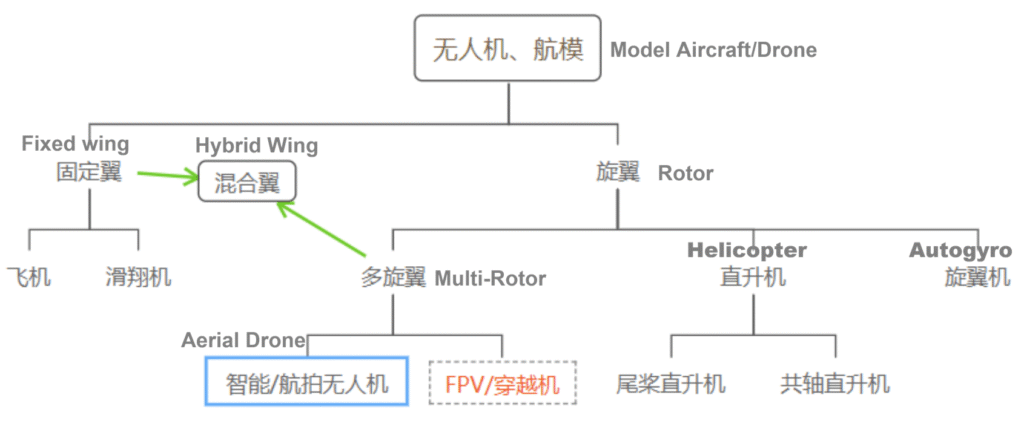
From a classification perspective, FPV drones belong to the broader category of multirotor aircraft, the same as camera drones. However, they follow an entirely different design philosophy.
The term “FPV” (First Person View) is the more internationally recognized name, while “racing drone” or “freestyle drone” are also commonly used abroad. The word “穿越” (literally “to traverse”) comes from user scenarios—these drones can pass through narrow doorways, forest gaps, and building spaces that conventional camera drones cannot access.
Unlike mainstream intelligent drones, traditional FPV drones are positioned closer to high-performance RC models. They typically lack:
-
Mature autonomous cruise systems
-
Intelligent obstacle avoidance
-
One-button return-to-home
They rely almost entirely on manual control, demanding a high level of piloting proficiency.
In recent years, however, consumer brands have entered this segment, integrating intelligent assistance systems that significantly lower the entry barrier and allow more users to experience immersive flight.
Visually, FPV drones are easy to distinguish. Traditional FPV models use exposed carbon fiber frames without fully enclosed shells. Their structure is compact, minimalistic, and lightweight—prioritizing durability and performance. In contrast, camera drones usually feature streamlined, enclosed bodies.
II. Core Structure and Functional Modules of an FPV Drone
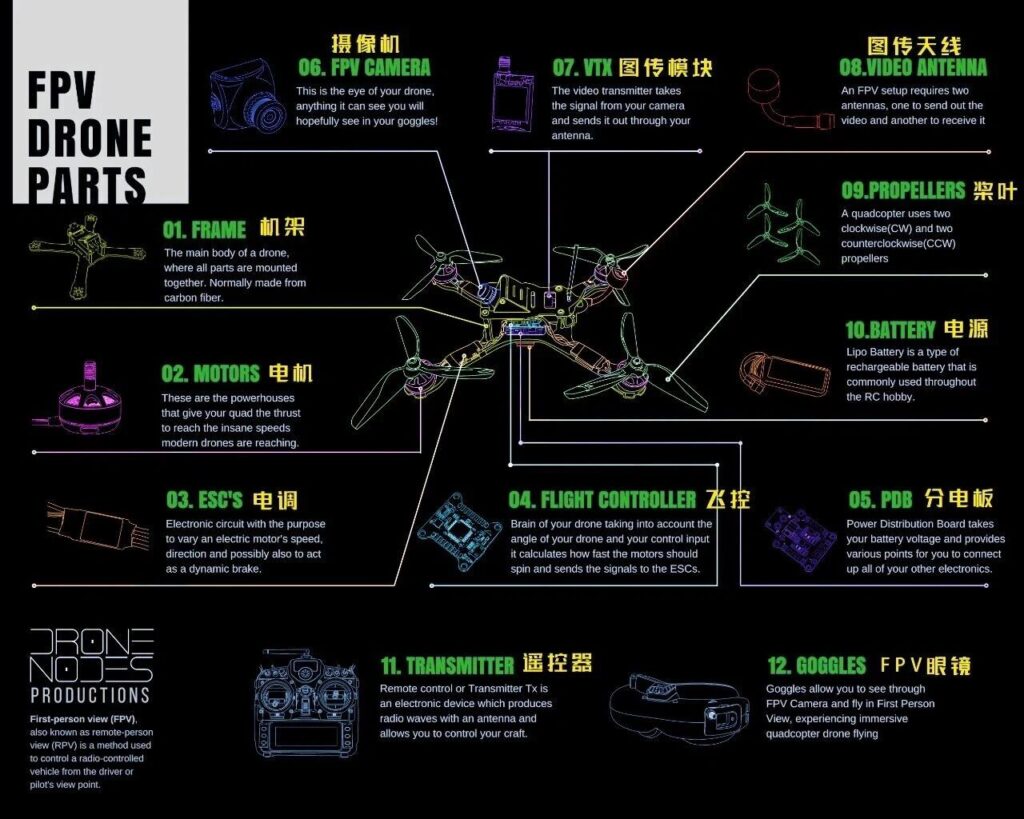
The performance characteristics and operational logic of an FPV drone are directly determined by its hardware architecture. A complete FPV system consists of five core modules:
1. Flight Controller (FC)
The flight controller is the central control unit. It:
-
Processes orientation data
-
Calculates attitude adjustments
-
Distributes power to motors
Equipped with gyroscopes and accelerometers, it continuously collects data such as tilt angle and angular velocity, dynamically adjusting motor speed to maintain balance.
Pilot commands are interpreted by the FC and translated into motor output signals for yaw, pitch, roll, and acrobatic maneuvers.
Traditional FPV flight controllers do not integrate GPS positioning or hover algorithms. As a result, they cannot autonomously hover or return home—this is the primary reason for their high operational difficulty.
2. Power System
The power system consists of:
-
Brushless motors
-
Electronic Speed Controllers (ESCs)
-
Propellers
ESCs regulate motor output based on FC signals. FPV drones use small-diameter, high-pitch propellers optimized for explosive thrust and rapid response rather than endurance or low noise.
This tuning allows for:
-
Ultra-high speeds
-
Rapid ascent and descent
-
Mid-air flips and freestyle tricks
However, it also results in:
-
High energy consumption
-
Significant noise
-
Short flight duration
3. Video Transmission System (FPV System)
The FPV system is the defining feature of these drones. It includes:
-
Onboard camera
-
Video transmitter (VTX)
-
Ground receiver
-
FPV goggles
The onboard camera captures real-time footage and transmits it via analog or digital signal to the pilot’s goggles, enabling immersive first-person flight.
This perspective fundamentally differs from the third-person screen-based control of camera drones and forms the core experiential value of FPV.
4. Frame and Power Supply System
Frames are typically constructed from carbon fiber composite materials, balancing structural strength and lightweight design.
Common frame geometries include:
-
Standard X
-
Wide X
-
Stretch X
Each configuration serves different scenarios such as racing, freestyle, or tight-space flying.
The open structure allows quick maintenance and component replacement.
Power is supplied by LiPo (Lithium Polymer) batteries, commonly labeled 2S, 3S, 4S, etc., indicating the number of series-connected cells. Voltage increases with cell count, directly influencing power output ceiling.
FPV batteries emphasize high discharge rates (C-rating). Under aggressive flying conditions, endurance typically ranges from 5 to 15 minutes.
5. Remote Control System
FPV transmitters prioritize:
-
Multi-channel precision
-
High responsiveness
-
Signal stability
Unlike camera drones, they do not offer:
-
Automated cinematic modes
-
One-tap orbit shots
-
Intelligent tracking
The control logic follows professional RC standards, requiring fine stick control and continuous practice.
III. Comprehensive Comparison: FPV Drone vs. Camera Drone
Although both belong to the multirotor category, their design objectives, use cases, and target users differ fundamentally.
Structural Design
-
FPV Drone: Open carbon fiber frame, no full enclosure, usually no mechanical gimbal
-
Camera Drone: Integrated enclosed body, standard three-axis mechanical gimbal, omnidirectional vision sensors
Control Logic
-
FPV: Primarily manual control; traditional models lack GPS hover and return-to-home
-
Camera Drone: Fully autonomous system with one-button takeoff, GPS hover, intelligent return, obstacle avoidance
Flight Performance
-
FPV: Extremely fast, highly agile, capable of acrobatics and tight-space traversal
-
Camera Drone: Stable flight, moderate cruise speed, optimized for steady hovering
Imaging Characteristics
-
FPV: High-impact dynamic visuals, flexible movement, no physical stabilization (natural shake)
-
Camera Drone: Mechanically stabilized footage, smooth imagery, professional camera parameters
Safety & Fault Tolerance
-
FPV: No obstacle avoidance, low tolerance for pilot error, higher crash risk
-
Camera Drone: Multi-sensor protection, active avoidance, low failure rate under normal conditions
Endurance
-
FPV: 5–15 minutes under aggressive flying
-
Camera Drone: 20–35 minutes for standard operations
Core Positioning
-
FPV: Immersive flight, racing, freestyle, extreme cinematic movement
-
Camera Drone: Aerial imaging, commercial photography, travel documentation
In essence:
A camera drone is an aerial imaging device that uses flight as a tool.
An FPV drone is a high-performance flying machine where imaging is secondary to control and experience.
IV. Application-Based Selection Logic
There is no absolute superiority—only scenario suitability.
Suitable Scenarios for Camera Drones
-
Travel photography and family documentation
-
Commercial aerial filming (real estate, engineering surveys, wedding filming)
-
Beginners without flight experience
-
Users prioritizing safety, ease of use, stable image quality, and low maintenance
Suitable Scenarios for FPV Drones
-
Immersive recreational flying
-
Freestyle tricks and racing competitions
-
Cinematic FPV shots and special effect sequences
-
Advanced users willing to invest time in practice and maintenance
Consumer-grade FPV models offer a balanced solution—retaining immersive experience while lowering operational risk—ideal for users curious about FPV but not ready for fully open-source, hardcore builds.
V. Industry Trends and Convergence
As technology advances and user needs diversify, the boundary between FPV drones and camera drones is gradually blurring.
-
Traditional camera drones are enhancing dynamic flight modes to expand creative possibilities.
-
Consumer FPV drones are integrating stabilization, digital transmission, obstacle avoidance, and endurance optimization to improve accessibility.
Long term, these categories will not replace each other. Instead, they will maintain distinct roles:
-
Camera drones as mainstream aerial imaging platforms
-
FPV drones as immersive and specialized creative tools
Hybrid models will continue to emerge, serving cross-functional users and accelerating standardization in both FPV and aerial imaging sectors.
VI. Conclusion
The confusion between FPV drones and camera drones fundamentally stems from misunderstanding their design objectives and core positioning.
A systematic understanding of their structural principles, performance differences, and application boundaries is essential for:
-
Rational purchasing decisions
-
Safe flight operations
-
Efficient content creation
Only by clearly distinguishing their logic can users choose the right tool for their intended purpose and fully unlock the value of aerial flight.
