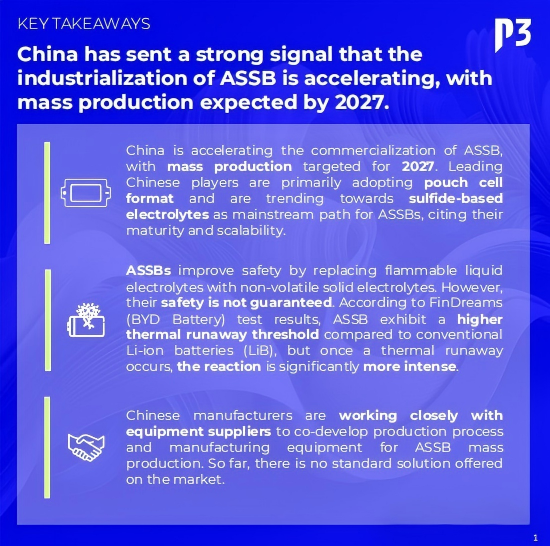
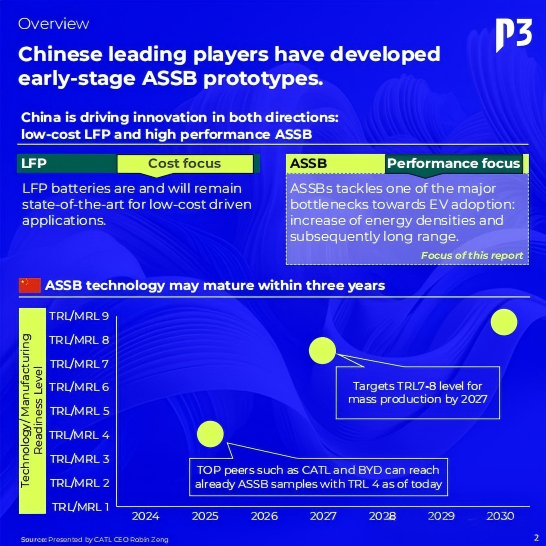
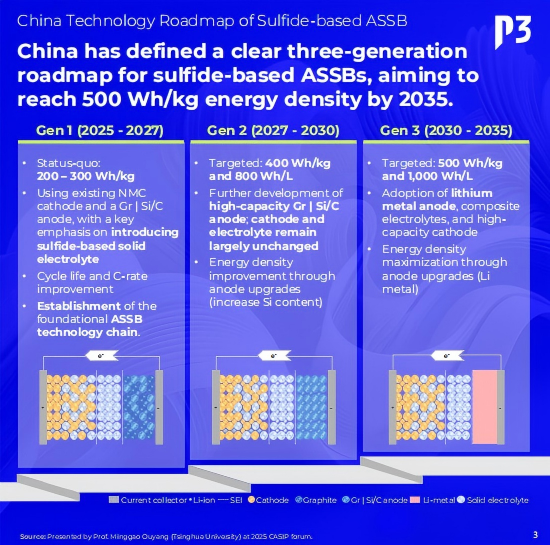
China’s industrialization process in the all-solid-state battery (ASSB) field is accelerating significantly, with large-scale mass production expected around 2027. A clear three-generation technology roadmap has been established, aiming to achieve a single-cell energy density of 500 Wh/kg by 2035.

Three-Generation Technology Roadmap (Primarily Sulfide-Based)
Key Corporate Strategies and Technological Directions
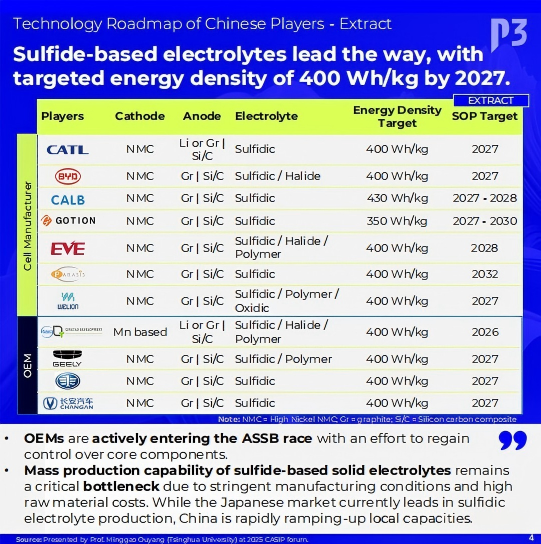
– Leading companies (such as CATL and other battery manufacturers/OEMs) generally focus on sulfide electrolytes combined with high-nickel NMC cathodes and graphite/silicon-carbon anodes.
– Several manufacturers have set targets to achieve an energy density of around 400 Wh/kg by approximately 2027.
– Automotive OEMs are actively engaging to secure control over the supply chain for critical components.
Key Bottlenecks and Challenges
1. Insufficient Mass Production Capacity for Electrolytes
– The production of sulfide electrolytes requires demanding conditions and is costly.
– Japanese companies currently lead in technology, but China is rapidly building domestic production capacity.
2. Immature Production Processes
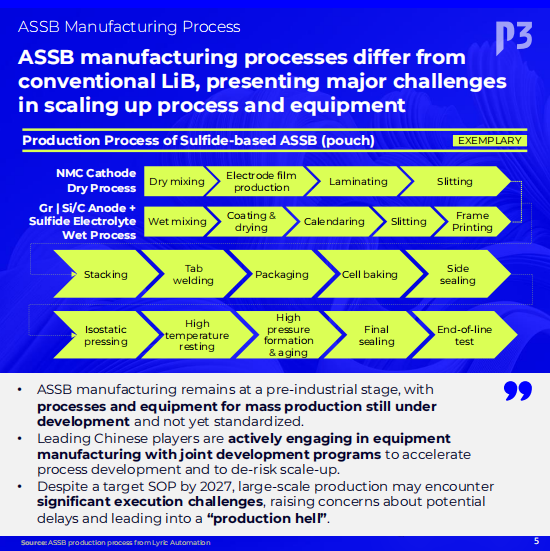
– ASSB manufacturing processes differ significantly from traditional lithium-ion batteries.
– Equipment and procedures are still under development, with low standardization levels.
– There is a risk of encountering “production hell.”
Safety Performance Characteristics
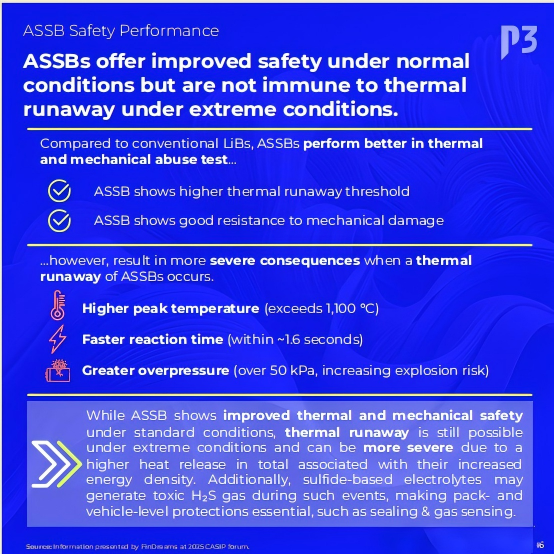
– Advantages:ASSBs demonstrate superior performance in thermal and mechanical abuse tests compared to liquid lithium-ion batteries.
– Risks:In the event of thermal runaway, reactions are faster, temperatures exceed 1100°C, and pressures are higher, increasing the potential risk of explosion.
International Competitive Landscape
– Globally, companies from Japan, South Korea, the United States, and Europe are actively advancing ASSB R&D and mass production plans.
– The competitive landscape remains unsettled, with no clear leader yet emerging.
Strategic Recommendations
– To maintain competitiveness, companies across countries should strengthen cooperation to jointly overcome mass production challenges.
– Collaborative development projects are needed to mitigate technology and scaling risks.
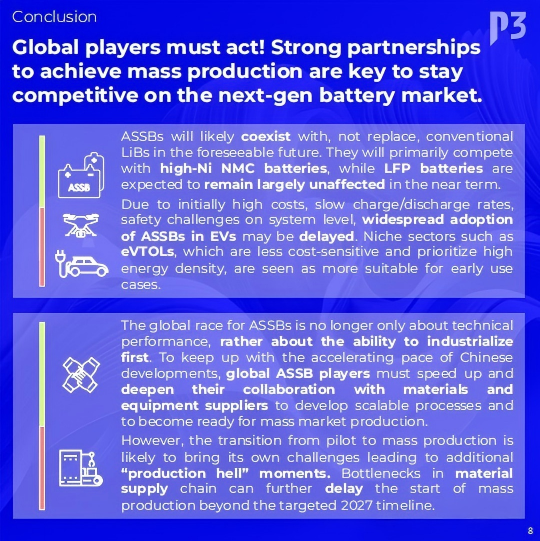
Conclusion
China has demonstrated strong momentum in ASSB technology R&D and industrialization, supported by a clear roadmap and corporate collaboration. Despite challenges in electrolyte mass production and process maturity, its target of mass production by 2027 and high-performance goals for 2035 underscore its ambition and execution capabilities in the next-generation power battery sector.
.png "all solid state batteries 8")