
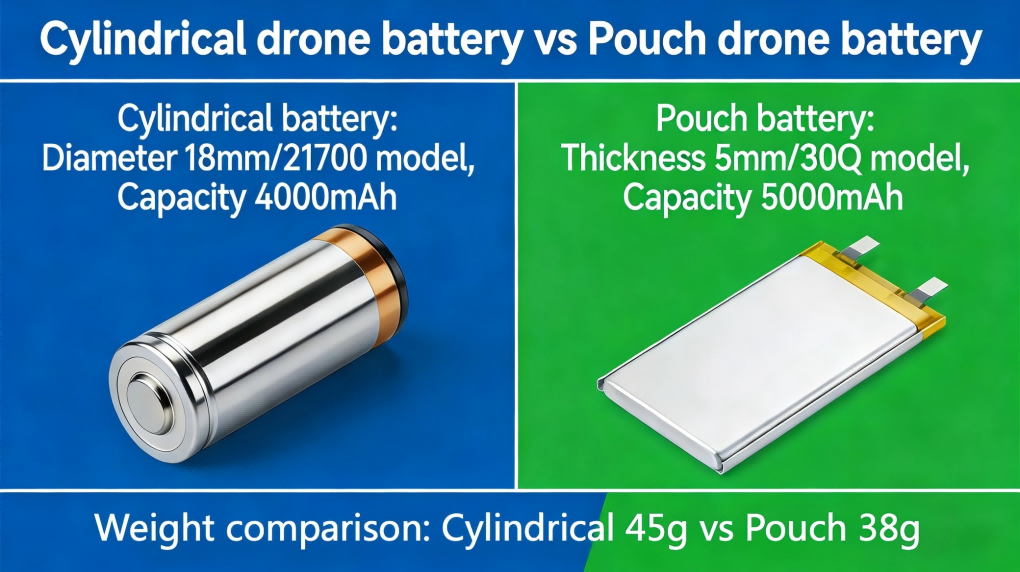
This is a critical but frequently misunderstood topic, especially when it comes to drone battery selection. Rather than stopping at superficial parameter comparisons, let’s break down the differences between cylindrical cells and pouch cells from an engineering and application-driven perspective.
1️⃣ Cell Form Factor Differences Define the System’s Performance Boundaries

👉 Cell form factor is not about “better or worse” — it’s about fitness for a specific mission profile.
2️⃣ Why Do Most Multirotor and Industrial Drones Use Pouch Cells?
The short answer:
A drone is not a power consumer — it is a weight- and power-constrained flying system.
✅ Core Advantages of Pouch Cells in Drone Applications
🔹 1. Superior Weight Efficiency (Wh/kg & Wh/L)
- No rigid metal enclosure
- Higher system-level energy density
- For the same usable capacity:
📌 For drones:
Every extra gram of battery directly reduces payload or flight time.
🔹 2. Native Support for High-Rate Discharge (10C–30C)
Typical drone operating conditions:
- High current peaks during takeoff
- Rapid and frequent power fluctuations
- Minimal energy recovery
Why pouch cells excel:
- Large electrode surface area
- Lower internal resistance
- Fast transient current response
📌 Cylindrical cells experience significantly accelerated degradation above ~5C discharge.
🔹 3. High Packaging Freedom for Aerodynamics and Structural Design
- Flat profiles
- Elongated geometries
- Fully custom dimensions
📌 This is critical for:
- Center-of-gravity optimization
- Embedded fuselage designs
- Quick-swap battery bays
3️⃣ Why Do Cylindrical-Cell Drone Battery Packs Still Exist?
Because they solve a different set of problems.
🧱 Key Advantages of Cylindrical Cells
🔹 1. Superior Consistency and Longer Cycle Life
- Highly automated manufacturing
- Low cell-to-cell variation (capacity & impedance)
- More gradual capacity degradation
📌 Typical cycle life (to 80% capacity retention):
- Cylindrical NMC: 800–1200 cycles
- Pouch-type NMC: 300–600 cycles
🔹 2. Higher Mechanical Safety Margin
- Rigid metal casing resists crushing
- Better puncture tolerance
- Reduced risk of cascading failures
📌 Particularly advantageous in:
- Ground robots and UGVs
- Industrial AMRs / AGVs
- Semi-fixed-wing UAV platforms
- Long-term outdoor deployments
🔹 3. Better Suited for Long Service Life, Low-C-Rate Missions
Typical examples include:
- Long-endurance, low-power fixed-wing UAVs
- Autonomous inspection platforms
- Backup or standby power systems
4️⃣ Same Chemistry, Different Cycle Life — Why?
Because cycle life is not a chemistry constant, but a consequence of operating conditions.
Real-World Operating Conditions of Drone Pouch Batteries
- Discharge rate: 10C–20C
- Depth of discharge: 80–100%
- Temperature rise: significant
- Highly dynamic load profiles
📌 The result:
Drone batteries intentionally sacrifice cycle life to achieve higher power density and lower mass.
This leads to the following reality:

5️⃣ When Should Pouch-Type Drone Batteries Be Avoided?
⚠️ Exercise caution in scenarios involving:
- Extremely high crash risk
- Prolonged high-temperature exposure
- Severe vibration or mechanical shock
- Mission profiles prioritizing lifespan over weight
In such cases:
👉 Cylindrical cells + modular design + system redundancy often provide a more robust solution.
6️⃣ One-Sentence Takeaway (for Decision-Makers)
Pouch batteries are performance-driven solutions for flight, while cylindrical batteries prioritize reliability and service life.
The real professional question is not:
❌ Which battery is better? But rather:
✅ What does my platform rely on to survive?
