
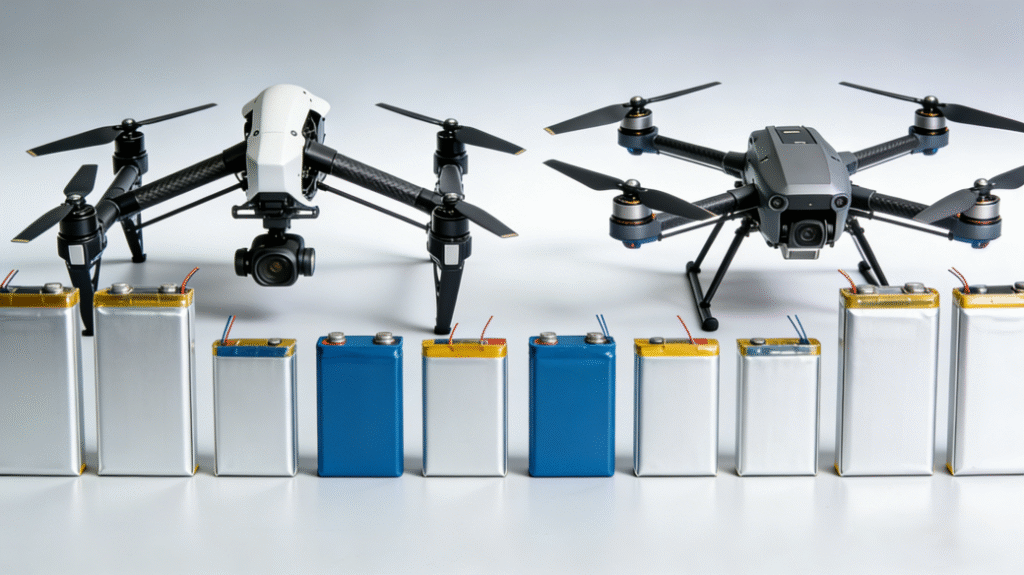
Over the past few years, as we have supplied medium- and large-class UAV batteries to the Middle East, Northern Europe, Southeast Asia, and South America, one conclusion has become increasingly clear:
UAV platforms may be globally standardized — batteries are not.
The same 12S 22,000mAh industrial UAV battery pack
operates in 55°C desert conditions in Dubai,
and in -25°C wind farm inspection sites in Norway —
yet the electrochemical challenges are fundamentally different.
For medium and large UAV systems used in logistics, inspection, surveying, and security,
extreme temperature performance (-30°C to 60°C) has become a defining technical barrier in overseas deployment.
🌡 Why Temperature Sensitivity Is More Critical for Medium & Large UAVs
Small consumer drones can often mitigate environmental stress through short flight durations and frequent battery swaps.
Medium and large industrial UAVs, however, typically operate with:
-
40–120 minutes per mission
-
Sustained high-rate discharge
-
Battery capacity exceeding 300Wh — often >1000Wh
-
Remote operation far from charging infrastructure
This means:
⚠ The battery must maintain voltage stability under extreme temperatures
⚠ Voltage sag during takeoff must be minimized
⚠ Thermal runaway risk must be tightly controlled in high-temperature environments
Failure is not merely a battery issue — it is a mission failure and potentially a flight safety event.
❄ Extreme Cold: Electrolyte Activity Decline and System-Level Impact
At temperatures below -20°C, the challenge goes far beyond capacity loss.
1️⃣ Increased Electrolyte Viscosity
Low temperature increases electrolyte viscosity:
-
Reduced lithium-ion mobility
-
Elevated internal resistance
-
Increased polarization
The result:
-
Rapid voltage drop during takeoff
-
Premature low-voltage cutoff by BMS
-
Significant reduction in usable flight time
Several Nordic inspection operators have reported:
A nominal 60-minute endurance drops to 25–30 minutes at -20°C.
2️⃣ Slower Lithium Intercalation Kinetics
At low temperatures:
-
Graphite anode lithiation slows
-
Risk of lithium plating increases
-
Long-term cycle life degradation accelerates
This is a primary reason cold-climate batteries experience faster capacity fade.
🧊 Our Cold-Climate Optimization Strategy
For -30°C-class applications, we implement a three-layer optimization approach:
✔ Materials Engineering
-
Low-temperature high-activity electrolyte formulation
-
Optimized solvent ratios to reduce freezing point
-
Additive systems to reduce polarization
✔ Structural & Cell Matching Optimization
-
Improved cell consistency control
-
Optimized electrode compaction density
-
Tight internal resistance matching
✔ Advanced BMS Algorithms
-
Low-temperature compensation algorithms
-
Dynamic discharge current limitation
-
Pre-heating management logic
-
Temperature-corrected SOC estimation models
Under -20°C test conditions, our cold-climate packs demonstrate:
-
20–30% improvement in usable discharge capacity
-
Significantly reduced takeoff voltage sag
-
More stable cycle degradation curves
These solutions are deployed in:
-
Nordic wind turbine inspection
-
Canadian forestry monitoring
-
High-altitude border patrol systems
🔥 High-Temperature Environments: The Real Risk Is Thermal Runaway
In Middle Eastern deployments, the challenge is fundamentally different.
Ambient ground temperatures of 50–60°C mean the battery is already near elevated thermal conditions before takeoff.
Many assume:
High temperature simply accelerates aging.
In reality, the more critical concern is thermal stability.
1️⃣ SEI Instability
At elevated temperatures:
-
Electrolyte decomposition accelerates
-
SEI layer undergoes repeated breakdown and reformation
-
Gas generation increases
Consequences:
-
Rising internal pressure
-
Increased swelling risk
-
Structural stress on cells
2️⃣ Reduced Thermal Runaway Threshold Margin
When ambient temperature exceeds 50°C:
-
Thermal headroom narrows
-
Heat dissipation efficiency decreases
-
Local short circuits can more easily trigger runaway reactions
For battery systems above 500Wh, this becomes a serious safety consideration.
🛠 Our High-Temperature Optimization Strategy
✔ Materials Optimization
-
High-temperature stable electrolyte systems
-
Heat-resistant separator materials
-
Cathode chemistries with enhanced thermal stability
✔ Structural Thermal Management
-
Optimized heat dissipation channels
-
Improved module-level thermal conduction paths
-
Enhanced enclosure thermal design
✔ Active BMS Thermal Management
-
Multi-point temperature sensing
-
Temperature gradient monitoring
-
High-temperature current derating strategies
-
Early anomaly detection and shutdown logic
Under 55°C environmental testing:
-
Discharge temperature rise remains more controlled
-
Thermal propagation speed is reduced
-
Safety margin is significantly improved
These solutions support:
-
Middle Eastern security patrol UAVs
-
Desert mapping operations
-
Oil & gas pipeline inspection platforms
🌍 Different Regions Demand Different Energy Solutions
Middle Eastern operators prioritize:
-
High-temperature stability
-
High discharge rates
-
Thermal safety margin
Nordic operators prioritize:
-
Reliable cold-weather takeoff
-
Stable cycle life
-
Capacity retention at low temperatures
They are not looking for the same 22,000mAh battery.
They require:
Climate-optimized energy systems.
🎯 Conclusion: Global UAV Deployment Requires Regional Battery Engineering
As medium and large UAV systems expand globally into:
-
Arctic climates
-
Desert environments
-
High-altitude regions
-
Humid tropical zones
The battery is no longer just a power module.
It is a primary determinant of system reliability.
If your UAV platform is expanding into:
-
The Middle East
-
Northern Europe
-
High-altitude Latin America
-
Or other extreme climate markets
Let’s connect.
We do not simply provide battery specifications.
We engineer environment-optimized energy solutions
