

As drones become increasingly accessible and affordable, low-altitude airspace is facing unprecedented challenges. Unauthorized, reckless, or malicious drones now pose real threats to airports, critical infrastructure, public events, border security, and military operations. In response, counter-drone drones—unmanned aerial vehicles designed to intercept and neutralize other drones—have emerged as one of the most flexible and effective solutions.
While much attention is often given to detection technologies, AI algorithms, and interception payloads, the true limiting factor of counter-drone drone performance is the battery system. In practice, counter-drone missions impose some of the harshest and most contradictory demands on batteries across the entire UAV industry.
This article provides a deep technical analysis of why counter-drone drones push battery systems to their absolute limits, and what performance characteristics are non-negotiable for real-world deployment.
1. Why Counter-Drone Missions Are Uniquely Demanding
Counter-drone drones operate under conditions that differ fundamentally from conventional UAV missions such as photography, inspection, or mapping. Their operational profile is defined by:
-
Unpredictable launch timing
-
Short response windows
-
High-speed pursuit of agile targets
-
Aggressive maneuvering
-
Operation over people and critical assets
-
Zero tolerance for mid-air failure
These conditions force the battery to deliver high peak power, stable voltage, long enough endurance, and exceptional safety—simultaneously. Any weakness in the battery system directly translates into mission failure or unacceptable risk.
2. Extreme Peak Power Output: The First Interception Barrier
Instantaneous Power Is Mission-Critical
The defining moment of a counter-drone mission is interception. To catch an intruding drone, the interceptor must rapidly climb, accelerate, and maneuver—often from a stationary or loitering state.
This requires:
-
Sudden current spikes far above average flight demand
-
Sustained high discharge during aggressive pursuit
-
Repeated bursts of power without voltage collapse
A battery that cannot support these demands will experience voltage sag, resulting in reduced motor thrust, slower response, and ultimately, a missed interception.
Battery Design Implications
To meet these requirements, counter-drone batteries must feature:
-
High C-rate cells with low internal resistance
-
Robust current collectors and tabs
-
Optimized electrode design for high-rate discharge
-
Strong thermal management at the cell and pack level
Unlike endurance-focused UAV batteries, peak power capability is not optional in counter-drone applications—it defines success.
3. Energy Density vs. Weight: A Tactical Balancing Act
Why Every Gram Matters
Counter-drone drones must be faster and more agile than their targets. Every additional gram of battery weight:
-
Reduces acceleration
-
Limits top speed
-
Degrades maneuverability
-
Reduces payload margin
At the same time, the drone must carry enough energy to:
-
Remain on standby or patrol
-
Execute pursuit
-
Potentially engage multiple targets
The Energy Density Challenge
This creates a fundamental contradiction:
-
High energy density is needed for endurance
-
Low mass is needed for agility
As a result, counter-drone systems demand batteries that achieve:
-
High gravimetric energy density
-
High power density at the same time
This combination pushes lithium battery technology to its practical limits and explains why only well-optimized chemistries and pack designs are viable.
4. Voltage Stability: Power Quality Equals Control Quality
Counter-drone drones rely on multiple power-sensitive subsystems:
-
Flight controllers
-
RF detection and jamming modules
-
Electro-optical sensors
-
Communication links
These systems require stable, clean voltage, even under extreme load.
Why Voltage Sag Is Dangerous
Poor voltage stability can cause:
-
Sensor malfunction
-
Communication dropouts
-
Flight control instability
-
Reduced effectiveness of electronic countermeasures
In high-speed interception, even milliseconds of instability can cause loss of positional advantage. Therefore, counter-drone batteries must maintain tight voltage regulation during peak discharge.
5. Safety: Zero Failure Tolerance in Sensitive Airspace
Operational Context
Counter-drone drones often operate:
-
Above urban areas
-
Near airports
-
Over crowds or critical infrastructure
In these environments, battery failure is not acceptable under any circumstances.
Safety Requirements for Counter-Drone Batteries
A mission-ready battery system must include:
-
Strong resistance to thermal runaway
-
Multi-layer overcurrent and overvoltage protection
-
Reliable cell balancing
-
Fire-resistant structural design
-
Predictable failure behavior
Advanced Battery Management Systems (BMS) are essential, providing:
-
Real-time monitoring of voltage, current, and temperature
-
Fault detection and isolation
-
Controlled shutdown in abnormal conditions
For counter-drone platforms, battery safety equals airspace safety.
6. Reliability and Consistency: Fleet-Level Performance Matters
Counter-drone systems are typically deployed as fleets, not single aircraft. Reliability is measured across hundreds or thousands of sorties.
Why Consistency Is Critical
Battery inconsistency leads to:
-
Unpredictable flight performance
-
Irregular interception capability
-
Increased maintenance burden
-
Higher operational risk
To avoid this, counter-drone batteries must exhibit:
-
Tight cell matching
-
Stable aging characteristics
-
Predictable degradation curves
-
Minimal performance spread between packs
One weak battery can compromise an entire defensive system.
7. Environmental Adaptability: Power Without Conditions
Counter-drone missions do not wait for favorable weather. Batteries must perform reliably in:
-
High-temperature environments
-
Cold, high-altitude regions
-
High humidity and salt-air conditions
-
Dusty or polluted urban environments
Environmental stress affects:
-
Internal resistance
-
Available capacity
-
Peak discharge capability
-
Long-term degradation rate
Counter-drone batteries must deliver consistent output across a wide temperature range, without sudden performance collapse.
8. High Operational Tempo and Fast Turnaround
In many scenarios, counter-drone drones must:
-
Land
-
Replace batteries
-
Relaunch within minutes
This requires batteries that can withstand:
-
Frequent high-rate charging
-
Rapid thermal cycling
-
Repeated high-stress discharge events
Batteries optimized only for gentle consumer use will degrade rapidly under real counter-drone operational tempo.
9. Why Counter-Drone Battery Requirements Are Among the Toughest in UAV Applications
Compared to other UAV use cases, counter-drone drones face a uniquely severe combination of demands:
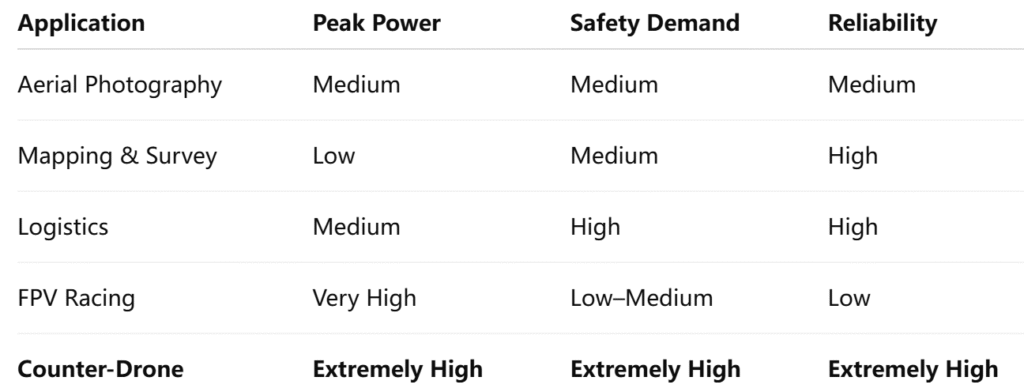
This combination places counter-drone batteries at the top tier of UAV energy system complexity.
Conclusion: Battery Capability Defines Counter-Drone Effectiveness
Counter-drone drones represent the frontline of modern low-altitude defense. Their effectiveness depends not only on detection algorithms, sensors, or interception mechanisms, but on a more fundamental factor:
🔋 a battery system capable of delivering extreme power, uncompromising safety, and absolute reliability—at the same time.
Any weakness in battery performance can result in:
-
Missed interceptions
-
Safety hazards
-
Loss of operational credibility
As counter-drone technologies continue to evolve, battery innovation will be one of the most decisive differentiators between experimental platforms and mission-ready systems.
In the future of low-altitude security,
the battle is not only fought in the air—but inside the battery.
