
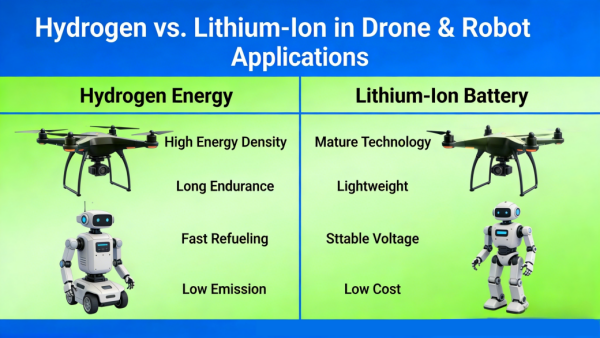
In the global energy transition and electrification era, the race for higher energy density has become the central narrative in the competition among power technologies.
Among contenders, two protagonists consistently headline:
🔋 Lithium-based batteries (especially emerging high-energy systems)
vs
🧪 Hydrogen energy technologies
A benchmark has emerged in public discourse — 600 Wh/kg — a symbolic threshold. Once the realm of far-off promise, 600 Wh/kg is increasingly cited in research as a point where battery systems begin to rival liquid fuels on a gravimetric basis. But against this backdrop, an important strategic question arises for systems designers, investors, and application owners (including UAV, robotics, eVTOL, automotive, and maritime markets):
In a world where hydrogen offers higher theoretical energy density, how deep is lithium’s competitive moat?
Let’s unpack that.
🔍 Why 600 Wh/kg Matters
Energy density — expressed in watt-hours per kilogram — directly shapes the range, endurance, payload, and structural design of mobile platforms.
-
Typical commercial Li-ion cells: ~250–300 Wh/kg
-
Advanced Li-ion / silicon-dominant prototypes: 350–450 Wh/kg
-
The aspirational 600 Wh/kg regime: closer to liquid fuels when combined with system optimizations
A jump toward 600 Wh/kg promises:
📈 Longer flight times for drones
📈 Greater payload capacity for robots
📈 Extended range for EVs / eVTOLs
📈 Lower battery weight fraction
📈 Reduced cooling and support systems burden
So if lithium systems can sustainably approach or breach this mark, the value proposition for battery electric platforms becomes even tougher for alternatives to disrupt.
🧪 Hydrogen’s Theoretical Advantages
Hydrogen does offer a much higher theoretical specific energy — around 1200–1400 Wh/kg (on a pure mass basis). At face value, this looks unbeatable.
However, understanding real-world competition means unpacking what that number actually means in systems:
🔹 1) Storage Penalties
Hydrogen must be stored either as:
-
High-pressure gas (350–700 bar)
-
Cryogenic liquid
-
Solid or chemical carriers (e.g., metal hydrides)
Each approach carries weight, volume, insulation, and safety penalties that dramatically reduce usable system density:
⚠ The result:
Practical system-level specific energy rarely exceeds 300–500 Wh/kg on a usable basis — closer to high-end batteries.
🔹 2) Conversion Inefficiencies
Hydrogen’s chemical energy must be converted into electricity via:
-
Fuel cells (electrochemical)
-
Turbine / engine systems (mechanical)
These add losses:
-
Fuel cell systems ~50–60% efficiency
-
Power trains incur additional conversion loss
Batteries, by contrast, exhibit ~90% round-trip efficiency in many use cases.
🔹 3) System Complexity
Hydrogen systems must integrate:
-
Tanks
-
Pressure regulators
-
Fuel reformers (in some cases)
-
Leak detection & safety systems
-
Thermal management for fuel cell stacks
All of which increase system mass, cost, and integration complexity.
Batteries — by comparison — are simpler, modular, and deeply industrialized.
🔋 Lithium’s True Moat: Beyond Peak Numbers
If theoretical specific energy were the only criterion, hydrogen might look irresistible. But real competitiveness is about total system value.
🔹 1) Industrial Ecosystem Scale
Lithium batteries benefit from a vast global manufacturing infrastructure:
-
Gigafactories in multiple continents
-
Mature cell chemistries and production lines
-
Standardized form factors and supply chains
-
Rapid iteration cycles in materials science
By contrast, hydrogen carriers, tanks, and fuel-cell stacks remain niche manufacturing sectors with far fewer economies of scale.
🔹 2) Safety & Regulatory Maturity
Lithium battery safety challenges are well mapped:
-
Thermal runaway mechanisms
-
BMS controls
-
Cell matching & grading
-
Standard testing protocols
Hydrogen introduces additional regulatory complexity:
-
High-pressure storage regulations
-
Cryogenic handling codes
-
Leak and embrittlement concerns
Batteries start with a more predictable safety landscape, reducing barriers to deployment.
🔹 3) Power Density and Dynamics
Hydrogen may offer better gravimetric energy, but power density matters too:
-
Batteries deliver high, instantaneous current
-
Precise control of discharge profiles
-
Better integration with electric powertrains
For applications like multirotor UAVs, robotics manipulators, or high-performance eVTOL motors, the ability to supply power rapidly and controllably is as important as total energy.
Hydrogen systems tend to be bulkier and slower to respond.
🔹 4) Cost Trajectories and Supply Chains
Battery costs have collapsed over the last decade — driven by:
-
Cathode and anode material innovation
-
Manufacturing scale
-
Recycling and second-life economies
Hydrogen systems are only beginning cost curves:
-
Electrolyzers are still expensive
-
Fuel cell stack costs remain high
-
Compression, storage and delivery infrastructure is nascent
On a $/Wh and $/mile basis, lithium remains fiercely competitive.
🛫 Where Hydrogen Still Makes Sense
Lithium’s moat isn’t impregnable — hydrogen has scenarios where it is arguably superior:
✔ Ultra-Long Endurance Platforms
-
Fixed-wing UAVs designed for 24–72 hour persistence
-
Maritime autonomous vehicles
-
High-altitude pseudo-satellite platforms
Hydrogen’s higher potential can offset infrastructure penalties in continuous operation environments.
✔ Heavy Industrial Mobility
-
Mining haul trucks
-
Port cargo movers
-
Heavy off-road vehicles
-
Rail shunting locomotives
Here, high payload and near-zero refueling time make hydrogen compelling.
✔ Large-Scale Grid Storage
Long-duration energy storage (10+ hours) favors hydrogen when:
-
Renewable curtailment is high
-
Seasonal energy shifts occur
-
Infrastructure is hydrogen-ready
However, this is a stationary domain, not a mobile one.
🔭 So How Deep Is Lithium’s Moat?
When we gauge competitiveness, we must look past raw Wh/kg numbers and consider:
📌 System efficiency
📌 Industrial maturity
📌 Cost curves
📌 Safety and regulation
📌 Power density and controllability
📌 Supply chain robustness
In mobile domains — especially those where weight, safety, and high power demand converge (such as drones, eVTOLs, robotics, and electric mobility) — lithium batteries continue to hold a significant practical advantage.
Hydrogen remains a complementary technology, not a wholesale replacement — at least in the medium term.
🧠 Final Takeaway
Energy density alone does not determine mobility system success.
It is only one dimension of a multidimensional design space that balances power, efficiency, safety, cost, and industrial readiness.
Lithium’s moat is not shallow — it is built on decades of ecosystem development. The approach of 600 Wh/kg doesn’t erase it — it reinforces where innovation is happening and where real competitive advantage lies today.
