
Two recent developments may seem unrelated—but together, they signal something much bigger:
- In 2026, the first batch of sodium-ion battery EVs rolled off production lines
- In laboratories, solid-state batteries have surpassed 5,000 charge cycles
This is not speculation.
This is already happening.
Meanwhile:
- Lithium prices have surged over 200% in three years
- Range anxiety is still unresolved
Against this backdrop, two fundamentally different technologies are accelerating:
One is driven by cost disruption The other by performance breakthrough
Both are targeting the same goal:
Challenging lithium-ion dominance
1. Two Technologies, Two Ambitions
⚡ Sodium-Ion Batteries: Redefining Cost
The logic is straightforward:
Abundant resources → Lower cost → Faster scalability
Current progress:
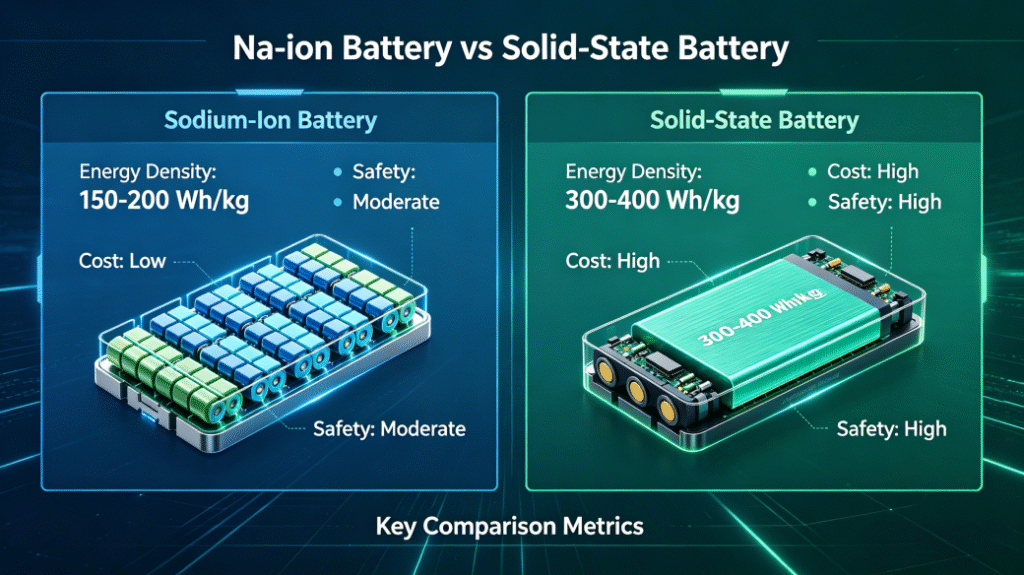
- Energy density: ~175 Wh/kg
- Low-temperature performance: >70% capacity at -20°C
- Manufacturing: Highly compatible with Li-ion lines
Which means:
Minimal disruption for mass production
Sodium-ion is not about being more advanced—
It’s about being cheaper, more stable, and easier to scale
⚡ Solid-State Batteries: Redefining Performance
A completely different approach:
Safety + Energy Density = New Upper Limit
Advantages:
- Theoretical energy density: 300–400 Wh/kg
- Near elimination of thermal runaway
- Significantly improved safety
Challenges remain:
- Interface resistance
- Ionic conductivity
- Manufacturing complexity
Realistically:
Mass adoption is still 4–5 years away
2. Different Technologies, Different Battlefields
🟢 Sodium-Ion: Cost-Sensitive Markets
Key applications:
- Energy storage systems
- Low-speed EVs
- Industrial robotics & logistics
Advantages:
- 30–40% lower cost than LFP
- Less dependence on critical minerals
👉 In these markets:
Sodium-ion has almost no competition
🔵 Solid-State: High-End Performance Markets
Applications:
- Premium EVs
- eVTOL / aviation
- Advanced UAV systems
Current stage:
- Semi-solid batteries entering early production
- Still far from mass availability
👉 Positioning:
Upgrade—not replacement
3. The Endgame Is Not “Who Wins”
The real future is not a winner-takes-all scenario.
It is segmentation and coexistence
Likely industry trajectory:
- Sodium-ion → scales first, reduces cost
- Solid-state → enters high-end, then expands
This is already reflected in strategy:
CATL is pursuing a dual-track approach: sodium + solid-state
4. The Most Interesting Path: Convergence
A potential breakthrough direction:
Solid-state sodium batteries
Combining:
- Low cost (sodium)
- High safety (solid-state)
This may not be a compromise—
It could be the true long-term solution
5. The Real Question
The question is no longer:
“Which technology will win?”
But:
Are we ready for a world where both revolutions converge?
Final Thoughts
Technology revolutions rarely happen in isolation.
They evolve through:
Parallel innovation → Gradual integration → System-level transformation
What we are seeing today is:
- Sodium-ion entering commercialization
- Solid-state approaching engineering viability
But the real challenge lies in:
- Supply chain readiness
- Cost structure sustainability
- Application alignment
The future of batteries is not a single breakthrough— but the convergence of multiple revolutions happening at once.
