
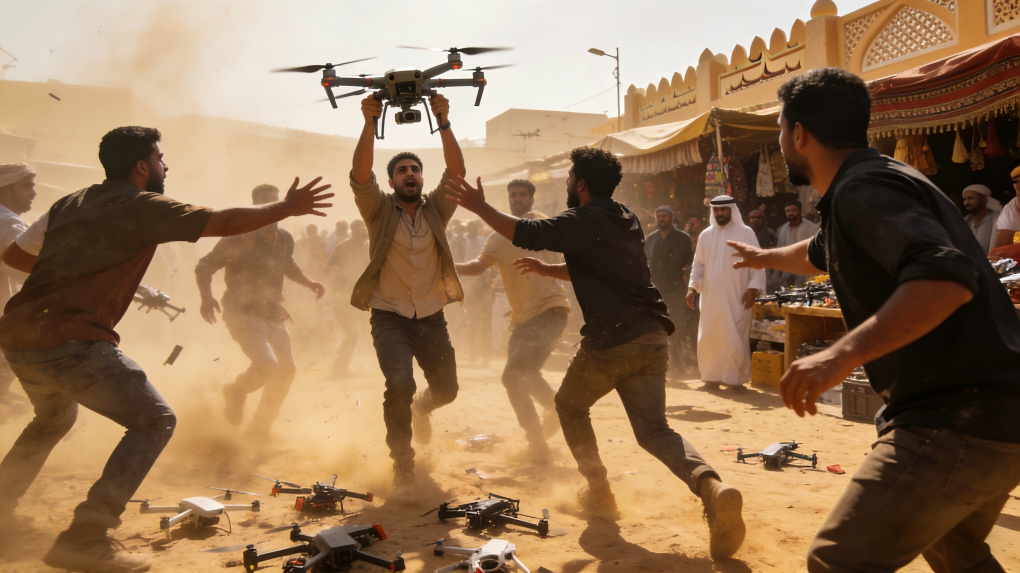
When Conflict Erupts: Gold and Oil Surge, But No One Expected Used Drones to Become the Hottest Commodity.
As military tensions escalate between Iran, Israel, and the United States, the Middle East has entered a new phase of warfare: the era of the drone attrition war. Reconnaissance requires drones. Precision strikes require drones. Electronic warfare and jamming require drones. Frontline units are now burning through hundreds of units daily. As official military stockpiles dwindle, forces are turning to a surprising source: the global second-hand and civilian market. The result? Prices for used drones have skyrocketed, with some models seeing a 300%+ increase. Spot goods is sold out instantly.
The background of this article: An Iranian suicide drone struck a high-rise building in Bahrain, simultaneously with Iran launching new waves of missiles and drones toward Saudi Arabia and the UAE
1. The Battlefield Creates Insatiable Demand: From “Hobbyist Gear” to “Strategic Asset”
Before the conflict escalated, the second-hand consumer drone market was a stable, gently depreciating niche. Drones like the DJI Mini, Air, and Mavic series followed predictable price curves, with buyers cautious and inventory moving slowly.
When war erupted, the logic of demand flipped entirely. The reasons are tactical:
• Frontline reconnaissance, artillery spotting, and low-altitude penetration missions are highly dependent on small multi-rotor drones. Civilian drones are easy to acquire, simple to modify, and incredibly cost-effective.
• Military-grade drone production lines can’t keep pace with the rate of attrition. Even low-cost systems like Iran’s Shahed series or the US’s LUCAS require supplementary parts and entire units.
• Regional militias and proxy forces lack access to official procurement channels. The secondary market becomes their primary supply line.
Market feedback from international second-hand platforms and grey-market channels reveals:
• Transaction prices for mainstream camera drones surged 150%–300% within a single week.
• Units equipped with thermal imaging, long-range flight capabilities, and stable video transmission systems command the highest premiums, often with zero inventory available.
• Prices for components—batteries, transmission modules, gimbals, GPS units—have also jumped, with spare parts sometimes becoming more sought-after than complete drones.
The joke circulating in trading circles is grim: “Selling drones used to be a tech business; now it’s a war matériel business.”
2. Why Used Drones? The Inevitable Choice of Low-Cost Warfare
Modern battlefields are no longer dominated exclusively by multi-million dollar, high-tech platforms. Asymmetric attrition is the new reality.
We’ve seen this playbook before: Iran forces the US to fire million-dollar Patriot missiles to intercept $20,000–$50,000 Shahed-136 loitering munitions. The Russia-Ukraine war proved definitively that modified civilian drones are among the most practical tactical tools on the front line.
Used drones offer distinct advantages in a combat zone:
• Immediate Availability:No waiting for production lines or navigating lengthy arms export approvals. Payment secures delivery.
• Low Modification Barrier:Adding simple payload release mechanisms, night-vision modules, or basic guidance systems can turn a hobbyist drone into a lethal or highly effective reconnaissance asset.
• Expendable Cost:Losing a $500–$3,000 drone is a tactical inconvenience, not a strategic loss.
• Mature Global Supply Chain: The global installed base of civilian drones is massive, providing a deep pool of potential “resources.”
War has forcibly reclassified “civilian electronics” as strategic commodities. The current spike in the second-hand market is only the first wave of price adjustments.
3. Behind the Price Surge: A Shadow Wartime Supply Chain
The explosive price growth is driven by a triple threat: a demand shock, tightening supply routes, and panic hoarding.
• Multiple Buyers Enter the Fray:Official military units, militias, private security contractors, and cross-border intermediaries are all competing for the same limited stock.
• Logistics Become a Bottleneck:Stricter export controls, heightened customs scrutiny, and airspace restrictions over the Middle East make shipping unpredictable and available in-country stock even more valuable.
• Speculation Fuels the Fire: Sellers hold onto inventory, anticipating higher prices. Individual sellers raise their asking prices daily, creating a classic “buying frenzy” as prices climb.
During the Russia-Ukraine conflict, Europe saw cases of civilian drones being resold to frontline buyers at 10 to 20 times their original retail price. Now, the Middle East conflict is writing a similar chapter.
4. Beyond Drones: How War Rewrites Global Commodity Pricing
The drone price surge isn’t an isolated incident; it’s a microcosm of how conflict ripples through commercial and civilian sectors.
Tensions in the Strait of Hormuz drive up oil prices. Defense, gold, and shipping stocks react instantly. Even seemingly mundane components—drone batteries, flight control chips, small motorcycle engines used for propulsion—are now included on wartime critical shortage lists.
The price curve of a single, ordinary used camera drone tells a larger story: Battlefield attrition → Supply chain restructuring → Global price reevaluation.
This serves as a stark reminder: Peace is the ultimate price anchor. Once conflict ignites, no one remains entirely insulated—from energy to electronics, from essential goods to industrial components.
Conclusion
The surge in used drone prices is a stark illustration of modern warfare’s trajectory: it is becoming lower-cost, civilian-integrated, and consumption-driven.
When consumer camera drones take to the skies over battlefields, and second-hand goods become a form of hard currency, we must recognize a fundamental truth: the value of peace is far more precious than any inflated price tag.
For more information about :How the Middle East Conflict is Reshaping the Lithium Battery Industry
