

As drones become widely used in aerial photography, logistics, agriculture, inspection, and many other fields, low-altitude security has emerged as a global concern. Unauthorized or malicious drones can threaten airport operations, major public events, critical infrastructure, and even be used for smuggling, surveillance, or sabotage.
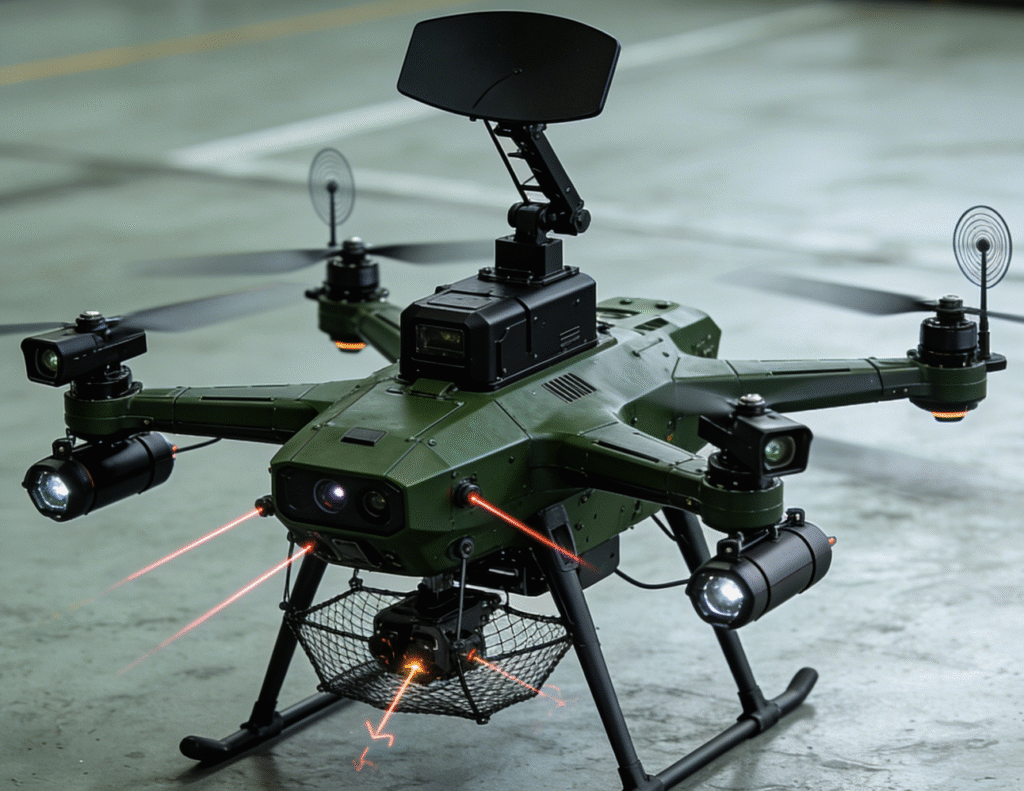
Against this backdrop, a new class of equipment has rapidly gained attention: the counter-drone drone (also known as an interceptor UAV or Counter-UAS drone). Instead of relying solely on ground-based jammers or radar systems, this approach uses drones to counter drones, offering mobility, flexibility, and three-dimensional interception capability.
This article provides a systematic analysis of counter-drone drones, covering their working principles, operational methods, key performance requirements—especially from a power system perspective—and typical application scenarios, before concluding with a summary of their strategic value.
1. How Does a Counter-Drone Drone Work?
A counter-drone drone is an unmanned aerial vehicle specifically designed to detect, track, disrupt, or neutralize hostile or unauthorized drones. Unlike ground-based counter-UAS systems, it operates in the air, allowing it to actively approach and engage targets in three-dimensional space.
From a technical standpoint, its working principle generally consists of the following core stages:
1) Target Detection and Identification
The counter-drone drone itself, or the wider defense system it belongs to, integrates multiple sensing technologies, such as:
-
RF spectrum monitoring (to detect control and video transmission signals)
-
Electro-optical and infrared vision systems
-
Radar or passive radar (in more advanced systems)
Through multi-sensor data fusion, the system determines:
-
Whether the target is a drone
-
The drone type (multirotor, fixed-wing, FPV, etc.)
-
Its flight status and threat level
2) Aerial Maneuvering and Interception
Once a target is confirmed, the counter-drone drone either launches immediately or adjusts its flight path, using superior speed, acceleration, and maneuverability to enter the interception zone.
Unlike missiles, this approach emphasizes:
-
Reusability
-
Continuous patrol capability
-
The ability to engage multiple targets over time
3) Execution of Neutralization Measures
Depending on mission requirements, counter-drone drones can employ various countermeasures, including:
-
Electronic jamming (disrupting control or navigation signals)
-
Spoofing or takeover (navigation or command deception)
-
Net capture or entanglement (physical interception)
-
Direct collision or close-range destruction (typically in military or extreme scenarios)
2. How Are Counter-Drone Drones Deployed in Practice?
In real-world operations, counter-drone drones rarely operate alone. Instead, they are deployed as part of an integrated counter-UAS system.
1) System-Level Coordination
A typical counter-drone architecture includes:
-
Ground-based detection systems (radar, RF sensors, cameras)
-
Command and control (C2) platforms
-
Aerial counter-drone UAVs
The counter-drone drone receives precise target cues from ground systems, enabling accurate and efficient interception rather than blind patrol.
2) Patrol and Rapid-Response Operations
In airports, borders, or sensitive zones, counter-drone drones may:
-
Conduct routine area patrols
-
Launch rapidly upon detecting an intrusion
-
Intercept targets via the shortest possible flight path
3) Multi-Drone Coordination
In high-risk environments, multi-drone coordination is often employed:
-
One drone tracks the target
-
Another executes jamming or capture
-
A third serves as backup or blocks escape routes
This “swarm-based countermeasure” strategy is particularly effective against low-cost or multiple-drone threats.
3. What Performance Characteristics Are Critical for Counter-Drone Drones?
Counter-drone drones are fundamentally different from consumer UAVs. Their performance requirements are mission-driven and reliability-focused.
1) Flight Performance
-
Speed: Must exceed that of the target drone
-
Acceleration and maneuverability: Essential for rapid interception and positional adjustment
-
Hover stability: Critical during jamming or net-capture operations
2) Endurance and Sustained Operations
-
Ability to support extended patrol missions
-
Capability for repeated takeoffs and landings
-
Standby readiness within the protected airspace
3) Payload Capacity
-
Electronic countermeasure modules
-
Optical and infrared identification systems
-
Physical interception devices
4) System Reliability and Resilience
-
Redundant system architecture
-
Strong anti-interference capability
-
Stable operation in complex electromagnetic environments
4. Why the Power System—Especially the Battery—Is So Critical
If sensors are the “eyes” and algorithms the “brain,” then the power system is the life-support system of a counter-drone drone.
1) High Power Output Capability
Counter-drone missions frequently require:
-
Instantaneous high-current output for rapid climb and acceleration
-
Repeated aggressive maneuvers
This places strict demands on the battery’s high discharge-rate capability. Without it, voltage sag and insufficient thrust can cause interception failure.
2) Energy Density vs. Weight Balance
The power system must strike a balance between:
-
Sufficient energy for patrol and pursuit
-
Minimal weight to maximize speed and agility
This balance directly defines the platform’s performance ceiling.
3) Safety and Reliability
Counter-drone drones often operate:
-
Over urban areas
-
Near airports
-
Above dense populations
Therefore, their power systems must feature:
-
Thermal runaway prevention
-
Multi-layer battery management systems (BMS)
-
High consistency and predictable aging behavior
4) Environmental Adaptability
Counter-drone missions may occur in:
-
High-temperature deserts
-
Humid coastal regions
-
Cold, high-altitude environments
The battery must maintain stable output across wide temperature ranges, or mission reliability will be severely compromised.
👉 In essence, the quality of the power system determines whether a counter-drone drone can catch the target, sustain the mission, and complete operations safely.
5. Where Are Counter-Drone Drones Used?
1) Airports and Civil Aviation Security
-
Preventing drone incursions into flight paths
-
Ensuring safe aircraft takeoff and landing
2) Major Events and Urban Security
-
Sporting events
-
Government conferences
-
Large concerts and exhibitions
3) Energy and Critical Infrastructure Protection
-
Power grids
-
Oil and petrochemical facilities
-
Nuclear plants and reservoirs
4) Border and Military Applications
-
Border patrol
-
Tactical counter-drone defense
-
Forward operating base protection
5) Prisons, Ports, and Special Zones
-
Preventing aerial smuggling of contraband
-
Providing cost-effective, continuous airspace protection
Conclusion: Counter-Drone Drones Are a Key Component of Low-Altitude Security
Counter-drone drones are far more than “standard drones with jammers.” They represent a highly systematized and engineered solution for low-altitude airspace security.
By combining:
-
Active aerial maneuvering
-
Airborne interception
-
Multiple neutralization methods
they effectively address the blind spots of traditional ground-based counter-drone systems. Behind all these capabilities, the power system—especially battery performance, safety, and reliability—plays a decisive role.
As the low-altitude economy continues to expand, counter-drone drones will evolve from specialized tools into standard defensive assets for airports, cities, and critical infrastructure. And those who achieve superior performance in power systems will hold a clear advantage in the future competition of counter-drone technologies.
