
When Drones No Longer Depend on Ground Networks
For decades, one fundamental limitation has constrained the evolution of drones:
A drone can fly farther than it can communicate.
Whether it is disaster rescue, remote inspection, military reconnaissance, or industrial surveying, unmanned aerial systems have always depended on a communication chain:
Drone → Ground Station → Satellite/Network → Command Center
This architecture works well in normal environments.
But what happens when a drone enters a place where infrastructure does not exist?
A flooded city.
A mountain area after an earthquake.
A desert with no cellular coverage.
An ocean far away from any communication tower.
In these scenarios, traditional communication systems become the bottleneck.
Recently, China Telecom Artificial Intelligence Research Institute (TeleAI) introduced a new concept at WAIC 2026:
AI-powered intelligent transmission — transforming communication from “bit streams” to “token streams”.
This technology enables lightweight drones to connect directly to satellites and transmit high-value video information in environments where traditional bandwidth is insufficient.
It represents a fundamental change:
Future drones may no longer need to stay close to communication infrastructure.
The Biggest Challenge: High-Definition Video Meets Limited Bandwidth
Modern drones generate massive amounts of data.
A single industrial drone equipped with high-resolution cameras can capture:
- 4K/8K video
- thermal images
- multispectral data
- LiDAR information
- real-time environmental sensing
However, transmitting this information in real time is extremely difficult.
Satellite communication solves the coverage problem, but introduces another challenge:
Bandwidth is limited.
A small drone cannot carry a large satellite terminal.
More communication power means:
- heavier payload
- higher energy consumption
- shorter flight endurance
For lightweight UAVs, every gram matters.
This creates a fundamental contradiction:
Drones need more data transmission capability, but they have limited payload and power capacity.
Traditional compression technology can reduce data size, but there is always a trade-off:
Lower bitrate = lower image quality.
Lower bandwidth = delayed or incomplete information.
For emergency response, this is a serious problem.
A blurry image may mean missing a trapped survivor.
A delayed transmission may mean a missed rescue opportunity.
From Bit Stream to Token Stream: A New Communication Paradigm
Traditional video communication works like this:
The camera captures pixels.
The encoder compresses the video.
The compressed data is transmitted.
The receiver reconstructs the image.
This process focuses on preserving as many original pixels as possible.
AI-powered intelligent transmission takes a different approach.
Instead of sending every detail, the system first understands the scene.
The drone analyzes:
- objects
- people
- movement
- environmental structures
- important semantic information
Then it converts the video information into a compact Token sequence.
These tokens travel through satellite networks.
At the receiving end, a generative AI model reconstructs the video.
In simple terms:
Traditional communication:
Send the whole picture.
AI communication:
Send the understanding of the picture.
This changes the relationship between computing power and communication bandwidth.
Instead of demanding more bandwidth, the system uses more AI computation.
This is what TeleAI describes as:
“Computing power replacing bandwidth.”
A New Era for Emergency Response Drones
Imagine a major flood disaster.
Roads are destroyed.
Mobile networks are down.
Rescue teams cannot enter dangerous areas.
A lightweight drone takes off.
It flies over flooded villages and captures:
- damaged roads
- isolated buildings
- trapped people
- water levels
- rescue routes
Previously:
Drone → Local receiver → Satellite → Command center
Now:
Drone → AI Token encoding → Satellite → Command center
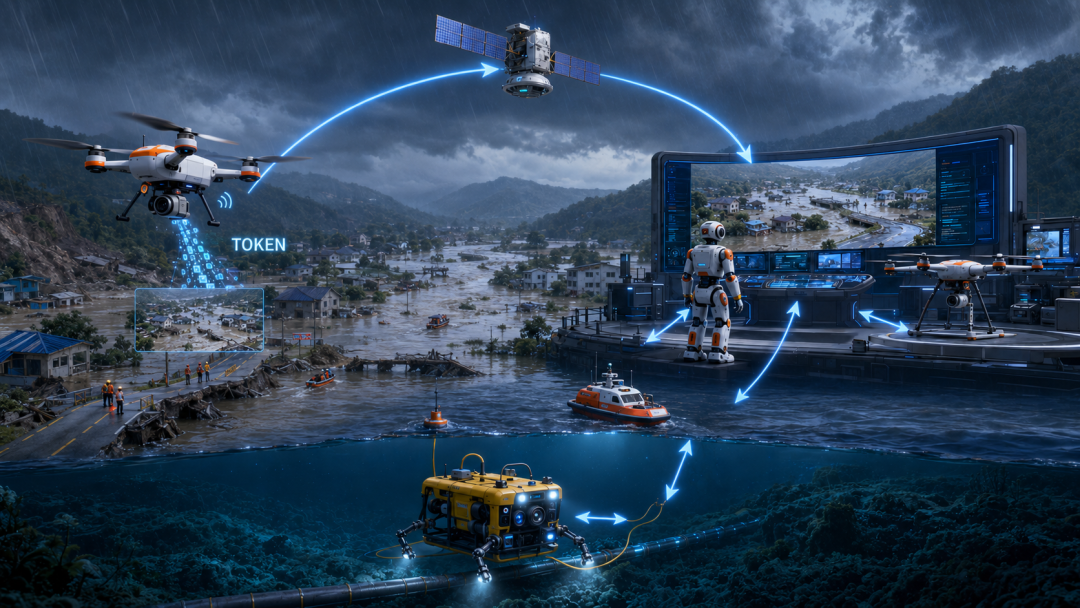
No temporary communication infrastructure is required.
The drone itself becomes a flying communication node.
This capability could transform:
Disaster rescue
Rapid assessment after:
- earthquakes
- hurricanes
- floods
- wildfires
Remote inspection
Including:
- pipelines
- power grids
- offshore facilities
- mining areas
Border and maritime monitoring
Where terrestrial networks are unavailable.
Beyond Drones: One Communication Architecture Connecting Sky, Land and Ocean
The most interesting aspect of this technology is not only drones.
It represents a broader trend:
AI will become distributed across physical devices.
Future intelligent systems will include:
- drones in the sky
- robots on the ground
- satellites in orbit
- underwater vehicles in the ocean
But these devices need a common language.
They need to exchange:
- perception data
- environmental understanding
- task instructions
- AI-generated knowledge
Token-based communication could become that bridge.
Robots: From Local Machines to Global Intelligent Networks
Robots today are often limited by communication distance.
A factory robot works inside a controlled environment.
A rescue robot operates within local networks.
But with AI-powered transmission:
A robot in a remote area could send visual information through satellite communication.
A human operator hundreds or thousands of kilometers away could control the robot.
Multiple robots could share information:
One robot discovers a blocked road.
Another robot immediately receives the information.
One machine identifies a dangerous area.
The entire robot network updates its understanding.
This could accelerate the development of:
- autonomous rescue systems
- remote industrial operations
- intelligent logistics
- large-scale robot collaboration
The Hidden Revolution: AI Is Changing What Networks Carry
For more than 100 years, communication networks have evolved around one principle:
Move information faster.
From:
2G → voice communication
3G → mobile internet
4G → video streaming
5G → massive IoT connectivity
The next generation may be different.
The network will not only carry:
- text
- voice
- images
- video
It will also carry:
- AI tokens
- model outputs
- machine decisions
- intelligent instructions
The future network will not simply connect people.
It will connect intelligence.
Challenges Ahead: Reliability, Accuracy and Trust
Of course, AI-generated transmission also introduces new questions.
When video is reconstructed by AI:
Can we trust every detail?
Will the reconstructed image preserve mission-critical information?
For entertainment applications, small differences may not matter.
But for:
- medical rescue
- military applications
- industrial safety
accuracy is essential.
The future communication system must balance:
- Compression efficiency
- Visual quality
- Semantic accuracy
- Decision reliability
The goal is not just:
“Make the image smaller.”
The goal is:
“Transmit the information that matters most.”
The Future of Drones: More Intelligence, Less Dependence
The evolution of drones has always been driven by three technologies:
- Better batteries
- Better autonomy
- Better communication
Battery technology determines:
How long a drone can fly.
AI determines:
How intelligently it can operate.
Communication determines:
How far its intelligence can reach.
AI-powered satellite communication represents a major step toward truly connected autonomous systems.
Tomorrow’s drone may not need to search for a mobile network.
It may not need a nearby control station.
It may not need to transmit every pixel.
It only needs to understand the world, extract the essential information, and send intelligence across the planet.
The future of unmanned systems is not only about flying higher or carrying heavier payloads.
It is about making intelligence travel farther.
From bits to tokens.
From connected devices to connected intelligence.
From drones operating locally to autonomous systems working globally.
The AI communication era has just begun.
#DroneTechnology #AI #SatelliteCommunication #UAV #AutonomousSystems #Robotics #LowAltitudeEconomy #FutureTechnology #EmergencyResponse #Aerospace #IndustrialDrones #SmartCommunication