
For more than a decade, when people talk about drones, one image usually comes to mind:
A quadcopter with four propellers.
From DJI Phantom and Mavic series dominating the consumer drone market, to agricultural drones carrying 20 kg of pesticides, to delivery drones serving remote islands and mountainous regions — rotor drones have become the mainstream solution for unmanned aerial systems.
Their success is undeniable.
Rotor drones are mature, reliable, easy to control, and relatively affordable.
However, they also have natural limitations:
- High noise generated by high-speed rotating propellers
- Limited endurance due to continuous energy consumption during hovering
- Safety concerns caused by exposed rotating blades
This raises an interesting question:
Can we build a flying machine that is as quiet as a bird, as efficient as a bird, and as safe as a bird?
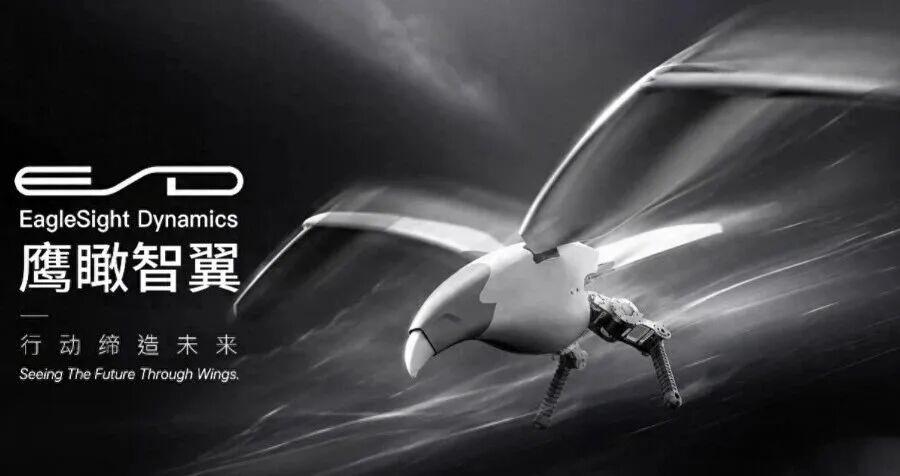
A Shenzhen-based company called Eagle Vision Wing (鹰瞰智翼) is exploring this possibility through a completely different approach:
Flapping-wing robotics.
Learning From Nature: Why Birds Fly Differently
Nature has spent hundreds of millions of years optimizing flight.
Birds, insects, and bats do not rely on rotating propellers.
Instead, they generate lift and thrust through wing movements.
This flight mechanism offers several potential advantages.
1. Lower Noise
Traditional rotor drones often produce significant acoustic noise because of high-speed propeller rotation.
Depending on the size and operating conditions, drone noise can easily reach 70–90 dB.
Flapping-wing systems, inspired by biological flight, can potentially reduce noise levels significantly, reaching around 30–40 dB in some designs.
That is closer to the sound level of normal human conversation.
This creates new possibilities for applications where stealth and low disturbance matter:
- Wildlife observation
- Urban inspection
- Indoor environments
- Emergency monitoring
2. Higher Energy Efficiency
Rotor drones must continuously consume energy to maintain hovering.
Flapping-wing systems can interact with surrounding airflow and potentially utilize aerodynamic forces more efficiently.
Some designs combine:
- Active wing flapping
- Passive gliding
This allows the aircraft to switch between high-mobility flight and energy-saving cruising.
In theory, this could significantly extend endurance compared with traditional rotor platforms of similar weight.
3. Improved Safety
One major weakness of conventional drones is the exposed high-speed propeller.
A collision with people, animals, or objects can cause serious damage.
Flapping-wing robots use flexible wings instead of rigid rotating blades.
The wing structure can deform during impact and absorb energy, reducing the risk of injury.
For future urban drone applications, this could become a critical advantage.
The Engineering Challenge: Why Flapping-Wing Robots Are So Difficult
Although birds make flying look simple, reproducing their ability is extremely challenging.
A bird can:
- adjust individual feathers
- instantly react to wind changes
- control complex wing movements
A machine cannot naturally do this.
Engineers must solve multiple problems:
- Lightweight structural design
- Flexible materials
- High-efficiency actuators
- Real-time control algorithms
- Aerodynamic optimization
This is why flapping-wing robots have remained mostly in research laboratories for many years.
The breakthrough requires not only mechanical innovation but also intelligent simulation and control.
The Role of AI and Fluid Simulation
One of Eagle Vision Wing’s key technologies is the Vortrix fluid-control integrated simulation engine.
The idea behind this technology is simple:
To make a flapping-wing robot fly reliably, engineers need to train and optimize its behavior under different airflow conditions.
Traditional development separates two processes:
- Fluid dynamics simulation
- Flight control algorithm development
The problem?
These systems often operate independently.
Data exchange is slow.
Optimization takes a long time.
Vortrix aims to combine fluid simulation and control training into one integrated environment.
For flapping-wing robots, this is extremely important.
Because unlike traditional drones, their performance depends heavily on:
- Wing movement
- Airflow interaction
- Real-time aerodynamic response
Without efficient simulation, large-scale commercialization would be almost impossible.

Eagle X: Moving From Laboratory to Product
Eagle Vision Wing’s first consumer product is called:
Eagle X
The aircraft adopts a hybrid flight mode:
Flapping-wing flight + gliding flight
This means:
During high maneuverability situations:
→ Wings actively flap for control and acceleration.
During cruising:
→ The robot reduces energy consumption through gliding.
The company reports that Eagle X has completed more than:
3,000 hours of testing
This is an important milestone.
For a completely new category of flying robots, long-duration testing is essential to prove:
- Mechanical reliability
- Flight stability
- Control accuracy
The company plans to launch Eagle X through Kickstarter in Q3 2026.
For an emerging technology category, crowdfunding is also a strategic choice:
It can:
- Validate market demand
- Build early user communities
- Increase brand awareness
From Consumer Robots to Industrial Applications
Although the first product targets consumers, the bigger opportunity may be industrial applications.
Future flapping-wing robots could potentially serve:
Environmental Monitoring
Quiet flight allows closer observation of:
- Birds
- Wildlife
- Forest ecosystems
Industrial Inspection
Including:
- Power lines
- Bridges
- Pipelines
- Large facilities
Urban Low-Altitude Applications
Lower noise and improved safety could make them attractive for:
- Smart city monitoring
- Indoor inspection
- Public safety operations
The Bigger Vision: Actively Riding the Wind
One of the most interesting concepts from Eagle Vision Wing is:
“Actively controlling and utilizing airflow.”
Most current aircraft are designed to resist environmental changes.
When wind comes:
The system compensates.
But future intelligent flying robots may do something different.
Instead of fighting the air:
They use the air.
A bird does not simply survive in the wind.
It uses the wind.
If machines can achieve similar capabilities, future drones could become:
- More efficient
- More adaptive
- More capable in complex environments
This represents a fundamental shift:
From controlling machines in the environment,
to machines cooperating with the environment.
Could Flapping-Wing Robots Challenge Rotor Drones?
Probably not immediately.
Rotor drones have decades of engineering optimization behind them.
Companies like DJI have built an enormous ecosystem around:
- Hardware
- Batteries
- Flight controllers
- Software
- Manufacturing
Replacing rotor drones entirely would be extremely difficult.
However, flapping-wing technology does not need to replace every drone.
It only needs to win in specific scenarios where rotor drones have limitations.
Just as:
- Helicopters did not replace airplanes
- Electric vehicles did not immediately replace gasoline cars
Different technologies will serve different missions.
Rotor drones will continue dominating applications requiring:
- High payload
- Precise hovering
- Cost efficiency
Flapping-wing robots may find opportunities where we need:
- Quiet operation
- Longer endurance
- Safer interaction with humans
- Better environmental adaptation
A New Variable in the Drone Industry
The drone industry has been dominated by one question:
How can we make propeller-based drones better?
Flapping-wing robots introduce a different question:
What if the future of flight does not use propellers at all?
Eagle Vision Wing is still at an early stage.
Whether it can become the next major player in unmanned aviation remains to be proven.
But one thing is certain:
Innovation often comes from challenging the assumptions of mature industries.
For years, the drone world was built around rotating blades.
Now, a new generation of engineers is looking at something much older:
The wings of nature.
Maybe the next evolution of drones will not sound like machines.
Maybe it will fly like birds.

#DroneTechnology #UAV #Robotics #BioInspiredEngineering #FlappingWingRobot #ArtificialIntelligence #LowAltitudeEconomy #FutureMobility #AutonomousSystems #AerospaceInnovation #DroneIndustry #BatteryTechnology
