
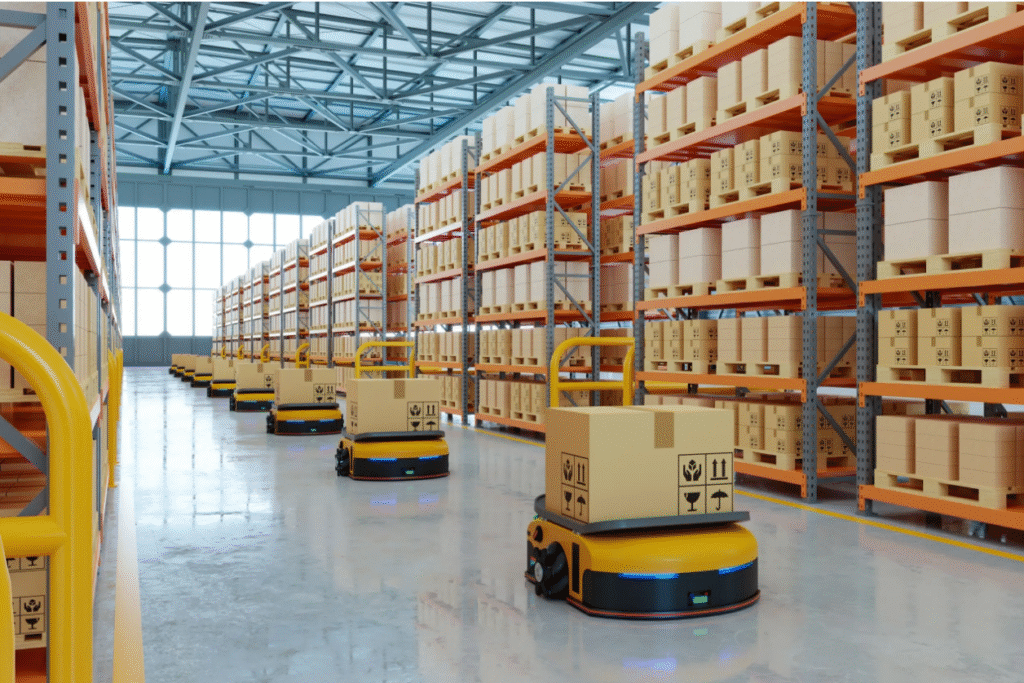
Have you ever seen a fulfillment center during a major e-commerce promotion?
Hundreds of AGVs and AMRs move between shelves, racks, conveyors, and picking stations. Every second counts. If one vehicle loses power and stops in a narrow aisle, the result is not simply one idle machine.
It may block an entire logistics route.
Production slows down.
Orders are delayed.
Other vehicles must be rerouted.
The financial loss caused by downtime can quickly exceed the price of several new batteries.
This is why battery selection for AGVs, RGVs, and AMRs is fundamentally different from battery selection for electric bicycles, passenger vehicles, consumer electronics, or residential energy storage.
These machines do not necessarily need the highest energy density.
They need batteries that can:
- Survive frequent starts and stops
- Deliver high peak power
- Recharge quickly
- Operate continuously
- Work reliably in harsh industrial environments
- Remain in service for years with minimal maintenance
For industrial mobility, the best battery is rarely the cheapest one.
It is the battery that delivers the lowest total cost of ownership—TCO.
Why AGV and AMR Batteries Face Unique Operating Stress
AGVs and AMRs are often described as mobile industrial workers.
Unlike consumer vehicles, they operate according to production schedules rather than personal driving habits.
A warehouse robot may run two or three shifts per day.
A port AGV may transport heavy cargo continuously.
An automotive plant RGV may repeatedly accelerate, stop, align, lift, and restart hundreds of times during one shift.
This creates four major battery challenges.
1. Frequent Starts, Stops, and Rapid Power Changes
AGVs rarely operate under a smooth and constant load.
Power demand can change dramatically within seconds.
For example, an AGV may:
- Start with no load
- Pick up a heavy pallet
- Accelerate
- Climb a ramp
- Stop suddenly
- Restart immediately
During this process, power demand may jump from a few hundred watts to several kilowatts.
If the battery has high internal resistance, insufficient discharge capability, or a slow BMS response, the terminal voltage may collapse under load.
The result can include:
- Sudden shutdown
- Motor controller alarms
- BMS overcurrent protection
- Incomplete transport tasks
- Vehicles stranded in production lanes
For industrial mobility, peak power capability is not optional.
It directly determines operational reliability.
2. Charging Time Must Be Minimized
A consumer vehicle may charge overnight.
An AGV cannot always afford that luxury.
In a high-throughput warehouse, every hour spent charging reduces asset utilization.
The ideal energy strategy may include:
- One-hour fast charging
- Thirty-minute opportunity charging
- Automatic battery swapping
- Wireless charging at workstations
- Short charging sessions during idle periods
The objective is not necessarily to achieve the longest single-charge runtime.
The real objective is to maximize:
productive operating hours per day.
A battery that supports fast, frequent charging may create more operational value than a larger but slower-charging battery.
3. Industrial Environments Are Extremely Demanding
AGV and AMR batteries may operate in conditions that are far more severe than normal consumer environments.
Typical challenges include:
- Low temperatures in cold-storage warehouses
- High temperatures near production equipment
- Oil, dust, and metal particles in automotive factories
- Salt mist and high humidity at ports
- Continuous vibration
- Electromagnetic interference near welding equipment
- Frequent mechanical shock
A standard battery may perform well in a laboratory but fail quickly under real operating conditions.
This is why industrial battery design must consider not only cell chemistry, but also:
- Sealing
- Connectors
- Busbars
- Cable sizing
- BMS protection logic
- Thermal management
- Anti-vibration structure
- Communication reliability
A battery pack is a complete system, not simply a collection of cells.
4. Maintenance Costs Can Exceed Battery Costs
Replacing an AGV battery is not always simple.
In large warehouses, vehicles may operate:
- Under racks
- Inside narrow lanes
- On elevated platforms
- In restricted automated areas
A battery replacement may require:
- Stopping the vehicle
- Removing it from the fleet
- Calling maintenance personnel
- Accessing a difficult installation location
- Recalibrating or restarting the vehicle
When labor, downtime, and production disruption are included, the replacement cost may be much higher than the battery itself.
This is why long life, reliability, and low maintenance are often more important than initial price.
Four Main Battery Routes for AGVs, RGVs, and AMRs
There is no universal battery chemistry for all industrial vehicles.
Different applications require different solutions.
The most common routes include:
- Standard lithium iron phosphate
- High-power modified LFP
- Lithium titanate
- Sodium-ion batteries
Each one solves a different operational problem.
1. Standard LFP: The Mainstream Choice for Warehouse AGVs
Lithium iron phosphate batteries are widely used in:
- Picking AGVs
- Latent lifting robots
- Sorting vehicles
- Light-duty AMRs
- Electronics factory logistics
Their main advantages include:
- High safety
- Long cycle life
- Stable thermal behavior
- Moderate cost
- Good charge acceptance
- Mature supply chains
For normal-temperature warehouses, LFP is often the best balance between performance and cost.
Typical advantages include:
- Thousands of cycles
- Five or more years of service under controlled use
- Support for fast charging
- Good compatibility with smart BMS systems
However, conventional LFP has one obvious weakness:
low-temperature performance.
In cold-storage environments, usable capacity and power output may decline significantly.
Therefore, standard LFP should not automatically be used in every warehouse application.
2. High-Power Modified LFP: Designed for Heavy Loads
Heavy-duty AGVs used in ports, automotive plants, and large manufacturing facilities require much stronger power capability.
These vehicles may carry loads ranging from one ton to dozens of tons.
High-power LFP cells improve performance through technologies such as:
- Carbon coating
- Particle nanosizing
- Improved electrode conductivity
- Optimized electrolyte formulations
- Low-resistance cell design
These batteries are suitable for:
- Heavy-duty AGVs
- Tow tractors
- Automated forklifts
- Automotive body transport systems
- Port logistics vehicles
Their key advantage is the ability to deliver high current without severe voltage sag.
Compared with lithium titanate, modified LFP offers a more moderate cost while still delivering strong power performance.
For many industrial customers, it represents the best compromise between:
power, cycle life, safety, and price.
3. Lithium Titanate: The Ultimate Choice for 24-Hour Operation
Lithium titanate batteries are expensive.
Their energy density is relatively low.
But in applications requiring continuous operation, extremely fast charging, and ultra-long life, LTO can be economically attractive.
Its advantages include:
- Extremely long cycle life
- Very high charge and discharge rates
- Strong low-temperature performance
- Excellent safety
- Rapid charging capability
- Stable power output
LTO is especially suitable for:
- Twenty-four-hour production lines
- High-frequency shuttle systems
- Heavy-duty AGVs
- Automated plants with very high downtime costs
- Opportunity-charging systems
The initial battery cost may be several times higher than LFP.
However, if the battery operates for ten or more years, requires fewer replacements, and reduces downtime, the total cost may be lower.
This is a perfect example of why industrial buyers should evaluate TCO rather than purchase price.
4. Sodium-Ion Batteries: A Promising Option for Cold Storage
Sodium-ion batteries are attracting increasing attention in cold-storage logistics and outdoor industrial mobility.
Their potential advantages include:
- Better low-temperature performance than conventional LFP
- Strong safety characteristics
- Reduced dependence on lithium resources
- Competitive long-term cost potential
- Good power capability
Possible applications include:
- Cold-storage AGVs
- Outdoor AMRs
- High-latitude industrial vehicles
- Low-temperature logistics systems
However, sodium-ion batteries currently have lower energy density than LFP.
Therefore, they may not be ideal for applications where battery volume is very limited or where the vehicle must travel long distances while carrying heavy loads.
Their greatest opportunity lies in applications where:
temperature performance matters more than maximum energy density.
A Practical Selection Framework
When selecting batteries for AGVs, RGVs, or AMRs, buyers should begin with four questions.
1. What Is the Vehicle Load?
For light-duty AGVs below approximately 500 kg:
- Standard LFP
- Sodium-ion for low-temperature operation
For medium-duty vehicles between approximately 500 kg and 5 tons:
- High-power LFP
- Optimized pouch or prismatic battery systems
For heavy-duty vehicles above 5 tons:
- High-power LFP
- Lithium titanate
- Redundant battery architectures
Load directly affects:
- Peak current
- Voltage sag
- Cable requirements
- BMS current rating
- Thermal output
2. What Is the Operating Temperature?
For normal indoor environments:
- Standard LFP is usually sufficient.
For cold storage or outdoor winter environments:
- Low-temperature LFP
- Sodium-ion
- Lithium titanate
- Battery heating systems
Temperature must be considered during both discharge and charging.
A battery that can discharge at low temperature may still require charging restrictions.
3. How Many Hours Must the Vehicle Work Each Day?
For single-shift operation:
- Standard LFP with overnight charging may be sufficient.
For two-shift operation:
- Fast-charge LFP
- Opportunity charging
- Sodium-ion solutions
- Partial battery swapping
For more than 20 hours per day:
- LTO
- Automatic battery swapping
- Wireless opportunity charging
- Dual-battery architectures
The more hours the vehicle must operate, the more important charging strategy becomes.

4. How Expensive Is Downtime?
For small factories with flexible schedules:
- Initial price may remain the priority.
For e-commerce warehouses:
- Charging speed and fleet availability become more important.
For automotive plants, airports, and ports:
- Downtime can be extremely expensive.
In these applications, higher-cost batteries may deliver better economics.
Common Battery Selection Mistakes
Using Consumer-Grade Cells
Consumer cells are not designed for:
- High-frequency industrial cycling
- Continuous vibration
- Large current spikes
- Long operating hours
A low-cost consumer cell may appear attractive initially, but rapid degradation and frequent failure can create much higher long-term costs.
Industrial vehicles require industrial-grade cells and packs.
Increasing Capacity Without Considering Weight
A larger battery does not always produce proportionally longer runtime.
Additional battery weight increases:
- Rolling resistance
- Acceleration energy
- Motor load
- Structural requirements
For heavy-duty AGVs, using high-power cells may be more effective than simply increasing capacity.
The battery must be optimized at system level.
Using Standard LFP in Cold Storage
Conventional LFP may experience noticeable power and capacity loss at low temperatures.
If it is used directly in a cold warehouse without modification, operators may face:
- Shorter runtime
- More charging cycles
- Higher heating costs
- Greater voltage sag
- Faster aging
A low-temperature chemistry or specialized pack design may provide better economics.
Treating the BMS as a Simple Protection Board
An AGV BMS should do much more than stop overcharge or over-discharge.
It should communicate with:
- Vehicle controller
- Charger
- Warehouse management system
- Fleet dispatch platform
- Battery cloud platform
A smart BMS can provide:
- SOC estimation
- SOH monitoring
- Temperature data
- Fault alarms
- Charging scheduling
- Remaining runtime prediction
- Maintenance reminders
When the BMS and fleet scheduling system are connected, low-energy vehicles can be routed to charging stations before they interrupt a task.
This can dramatically reduce unplanned downtime.
Future Trends: Smarter Charging and More Flexible Energy Systems
The next generation of AGV and AMR batteries will not be defined by chemistry alone.
Several technology trends are becoming increasingly important.
Automatic Battery Swapping
Battery swapping can reduce energy replenishment time from hours to minutes.
This is particularly valuable for:
- Large e-commerce warehouses
- Port logistics
- Automated factories
- Multi-shift operations
The vehicle continues working while another battery charges offline.
Opportunity and Wireless Charging
Wireless or automatic charging allows an AGV to recharge during short stops.
Charging locations may be installed at:
- Loading stations
- Elevators
- Picking areas
- Waiting points
- Conveyor interfaces
Instead of performing one long charge, the battery receives many short energy top-ups throughout the day.
Cloud-Based Battery Management
Industrial fleets may include hundreds or thousands of batteries.
Cloud platforms can analyze:
- Cycle count
- Internal resistance
- Temperature history
- Charging behavior
- Capacity degradation
- Fault patterns
This allows operators to move from reactive maintenance to predictive maintenance.
Sodium-Ion Expansion
Sodium-ion technology may become increasingly competitive in low-temperature and cost-sensitive applications.
Its adoption will depend on:
- Commercial cell availability
- Pack integration
- Cycle-life validation
- Cost reduction
- BMS optimization
Semi-Solid and Solid-State Batteries
Higher-energy batteries may eventually benefit long-distance AMRs and airport or port vehicles.
However, for most warehouse AGVs, energy density is not the only priority.
Safety, power, charging speed, cycle life, and cost remain equally important.
The Battery Supplier’s Role Is Changing
As a battery export manager supplying solutions for AGVs, RGVs, and AMRs, I increasingly see customers moving away from simple questions such as:
“What is the battery price?”
or
“How many amp-hours does it have?”
The more important questions are now:
- How many hours can the fleet operate each day?
- How quickly can the battery recharge?
- How does it perform at low temperature?
- How many cycles can it deliver under the actual duty profile?
- Can the BMS communicate with the vehicle and dispatch system?
- What is the total five-year operating cost?
This shift is important.
Industrial customers are no longer purchasing battery capacity.
They are purchasing:
uptime, reliability, and productivity.
Final Thoughts
Battery selection for AGVs, RGVs, and AMRs is not about choosing the cheapest chemistry or the highest specification.
It is about finding the best match between:
- Load
- Operating temperature
- Daily working hours
- Charging strategy
- Maintenance capability
- Downtime cost
LFP may be the best choice for a normal warehouse.
High-power LFP may be ideal for heavy-duty industrial transport.
LTO may be the most economical solution for continuous production.
Sodium-ion may become increasingly valuable in cold-storage applications.
There is no universal winner.
The right battery is the one that keeps the vehicle working, reduces maintenance, and delivers the lowest total cost over its full service life.
Because in industrial automation, every additional hour of uptime creates real value.
And every unexpected shutdown has a real price.
#AGV #AMR #RGV #IndustrialBattery #LithiumBattery #LFPBattery #LithiumTitanate #SodiumIonBattery #WarehouseAutomation #SmartManufacturing #Robotics #BatteryManagementSystem #BMS #MaterialHandling #FactoryAutomation #BatteryTechnology