
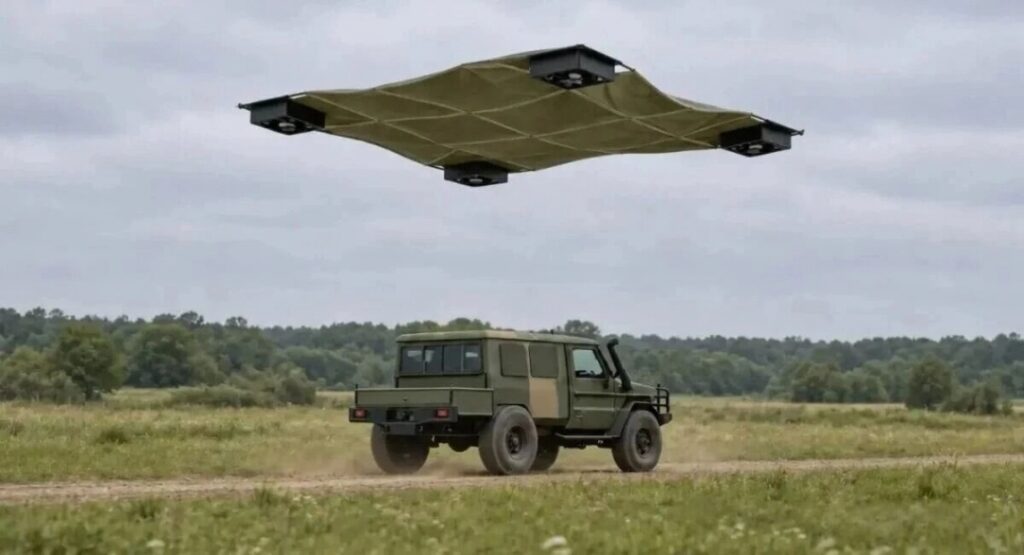
Vigil Autonomy’s Air Cover Concept Raises an Important Question: Can Flying Camouflage Reduce Operational Risk Without Creating an Expensive New Drone and Battery Support System?
A Flying Camouflage Net That Doesn’t Shoot Down Drones
Imagine a military vehicle protected by a camouflage canopy suspended by four drones.
The canopy moves with the vehicle, potentially reducing its visibility to aerial surveillance systems.
This is the concept behind Air Cover, developed by American startup Vigil Autonomy.
Unlike conventional counter-drone systems, Air Cover is not designed to intercept, jam, or destroy incoming UAVs.
Instead, it aims to make ground assets harder to detect, identify, and track.
The proposed system combines a multispectral camouflage membrane, coordinated aerial platforms, and automated deployment.
Its largest advertised configuration covers up to 100 square meters.
The concept addresses a genuine operational challenge: conventional camouflage nets require personnel to deploy, secure, and remove them, potentially increasing exposure during temporary stops.
Automated deployment could reduce some of that work.
But there is a more interesting question behind the technology:
Does reducing manual deployment create enough value to justify four additional drones, their batteries, maintenance, and charging infrastructure?
That is where the real engineering and economic analysis begins.
1. Two Hours of Flight: Understanding the Energy Trade-Off
According to the specifications discussed in Vigil Autonomy’s publicly presented concept, Air Cover has three proposed configurations.

These are presented as endurance targets, not independently verified operational results.
Importantly, active flight endurance is not the same as total camouflage duration.
If the membrane can remain in place after the drones land, continuous hovering may not be necessary.
That distinction changes the energy calculation significantly.
A system that uses drones primarily for deployment, recovery, and short-distance repositioning may consume far less energy than one requiring continuous flight.
From a battery-engineering perspective, the operating concept matters as much as the advertised flight time.

The Battery Challenge Behind Four-Drone Coordination
A conventional UAV battery is selected according to aircraft weight, propulsion power, mission duration, and operating conditions.
A coordinated four-drone system introduces additional variables:
- The weight supported by each aircraft
- Uneven load distribution between the four corners
- Wind-induced changes in propulsion demand
- Additional power required for position corrections
- Battery reserve requirements
- Safe recovery when one aircraft reaches a low-energy condition
The actual energy demand cannot be determined from canopy area alone.
It requires measured propulsion power, membrane mass, aerodynamic loads, and the intended deployment profile.
A two-hour endurance target is only meaningful when the payload, wind conditions, battery configuration, and operating mode are clearly defined.
2. The Hidden Cost of Automation: Battery Logistics
Automation can reduce certain manual tasks.
But it does not eliminate operational work. It often transfers that work into a different support system.
Four aerial platforms require battery charging, inspection, transportation, maintenance, and replacement planning.
If the camouflage system uses dedicated drones with proprietary batteries, operators may need to maintain an entirely separate support chain.
This creates what can be called a logistics tax.
The cost is not limited to purchasing batteries.
It includes charging equipment, spare packs, battery-health monitoring, trained personnel, storage arrangements, and maintenance procedures.
Why Battery Turnaround Time Matters
Consider a system that needs to perform several deployments during a single operating period.
The operator must account for:
Mission energy: How much energy is consumed during each deployment, repositioning, and recovery?
Charging time: How quickly can batteries be returned to an appropriate state of charge?
Battery inventory: How many packs are required to support the expected operating schedule?
Battery aging: How will repeated high-power operation affect usable capacity and internal resistance?
Environmental performance: Can the battery provide sufficient power in cold weather, heat, or demanding wind conditions?
These questions determine whether the system is operationally practical.
A demonstration may show a canopy deploying successfully once.
A real operating organization needs to know whether the same system can perform repeatedly without excessive downtime.
The true cost of an automated UAV system is measured across the complete operating cycle, not just the flight demonstration.
3. Why Reusing Existing UAV Platforms May Be More Practical
One potentially attractive development path is to turn flying camouflage into a modular mission capability.
Instead of purchasing an entirely new fleet, operators could potentially adapt compatible existing UAVs using suitable mechanical interfaces, control modules, and payload equipment.
This is an engineering proposal, not a capability that Vigil Autonomy has publicly demonstrated across third-party UAV platforms.
The potential advantage is straightforward.
Existing drones could continue performing their normal missions and be reassigned when a compatible temporary task arises.
That may reduce the need for dedicated aircraft procurement.
It could also allow organizations to reuse some existing batteries, chargers, maintenance procedures, and technical expertise.
However, compatibility must be demonstrated rather than assumed.
Battery Standardization Could Reduce Support Costs
For UAV fleet operators, battery compatibility can have a significant effect on lifecycle cost.
If several aircraft use compatible battery systems, organizations may be able to simplify:
- Battery inventory management
- Charging infrastructure
- Spare-pack allocation
- Maintenance procedures
- Battery-health tracking
- Replacement planning
However, physical battery compatibility alone is insufficient.
Voltage, discharge capability, connectors, BMS communication, thermal characteristics, and aircraft-specific validation must also match.
A battery that fits mechanically may still be electrically or operationally unsuitable.
The same principle applies to the aerial platforms themselves.
Modularity creates value only when the mechanical, electrical, software, and safety interfaces are properly validated.
There is also a scheduling trade-off.
Reassigning existing UAVs to another mission means those aircraft and their batteries are temporarily unavailable for their original tasks.
Reusing equipment can reduce procurement costs, but it does not eliminate competing operational demands.
4. The Engineering Challenges Go Beyond Battery Endurance
Suspending a flexible canopy with four drones is fundamentally different from having four independent aircraft carry separate payloads.
The drones become mechanically coupled through the membrane and suspension system.
A wind gust affecting one corner can influence the forces experienced by the others.
Differences in position, response time, and propulsion capability can change canopy tension.
The system must therefore manage several interacting challenges.
Coordinated Flight Control
Each aircraft must maintain stable flight while responding appropriately to the shared load.
Wind and Aerodynamic Forces
A large flexible membrane can generate substantial aerodynamic forces.
Wind loading, canopy deformation, and vehicle movement complicate the system’s behavior.
Fault Management
The system needs a validated response to communication loss, positioning degradation, or an individual aircraft becoming unavailable.
Battery Performance Differences
Battery state of charge, temperature, internal resistance, and aging can influence the power available to each aircraft.
Unequal battery performance may complicate coordinated operation.
Full-System Detectability
The canopy may reduce the visibility of the ground asset, but the aerial platforms introduce their own acoustic, thermal, visual, and potentially radio-frequency signatures.
The system’s overall effectiveness must therefore be evaluated as a complete system.
Reducing the signature of the protected vehicle does not automatically mean reducing the signature of the entire installation.
Publicly available information cited in the original discussion does not establish independently verified multispectral performance, wind resistance, or operational effectiveness for the complete Air Cover system.
Those remain important questions for future testing.
5. Flying Camouflage vs. Conventional Camouflage: Which Is More Practical?
Different camouflage approaches serve different operational requirements.

There is no universal winner.
Conventional nets may remain the most economical solution for long-duration static use.
Vehicle-mounted systems can be attractive where continuous coverage and mechanical integration are priorities.
Flying camouflage may offer advantages where temporary deployment and repeated repositioning are particularly valuable.
The modular approach may reduce some ownership costs, but only if compatibility and system performance can be demonstrated.
Dedicated systems may still be preferable when tightly integrated control and specialized performance requirements outweigh the advantages of platform reuse.
The best solution depends on the complete mission and lifecycle-cost assessment.
6. What Would Make the “Magic Carpet” Commercially Credible?
The next step for a concept such as Air Cover is not necessarily a more impressive promotional video.
It is reliable, repeatable test data.
For a meaningful engineering and commercial evaluation, several questions need clear answers.
How much energy does the complete system consume per deployment?
How many operating cycles can it perform before batteries require charging or replacement?
How does performance change under different wind conditions?
What happens when an individual aerial platform becomes unavailable?
How much maintenance is required after repeated deployments?
Does the reduction in manual work justify the added aircraft and battery infrastructure?
Can the system demonstrate its intended camouflage performance under representative observation conditions?
These questions turn an interesting concept into an engineering evaluation.
They also help distinguish genuine operational value from the visual appeal of an automated flying system.
Conclusion: The Real Innovation May Be in the Operating Model
Vigil Autonomy’s Air Cover is an interesting example of how UAV technology could support applications beyond conventional aerial missions.
Its central idea is not to destroy incoming drones, but to reduce the detectability of protected assets.
That is a meaningful distinction.
However, the technology’s practical value will depend on more than canopy coverage and flight endurance.
It will depend on energy consumption, system reliability, maintenance requirements, platform compatibility, and lifecycle cost.
From a battery perspective, the central lesson is particularly important:
Every new UAV capability creates a power-management requirement — and potentially a new logistics burden.
A modular system that can reuse compatible aircraft, batteries, and charging infrastructure may offer meaningful economic advantages.
But those advantages must be demonstrated through proper integration and validation.
The real breakthrough would not simply be a camouflage net that can fly.
It would be a system that delivers useful performance repeatedly, without creating an unnecessarily complicated support infrastructure.
The magic is in the demonstration. The real value is in the engineering, reliability, and operating economics.
UniquePower | UAV Battery & Charging Solutions
Supporting UAV manufacturers and system integrators with lithium-ion cell selection, customized battery packs, BMS integration, and charging solutions.
Website: www.uniquepower.net
Email: sales@uniquepower.net
WhatsApp: +86 178 2175 0340
#UAVTechnology #DroneEngineering #CounterUAS #BatteryManagement #DroneBattery #UAVIntegration #DroneInnovation