
When people talk about batteries, the conversation usually revolves around one question:
“How much energy can it store?”
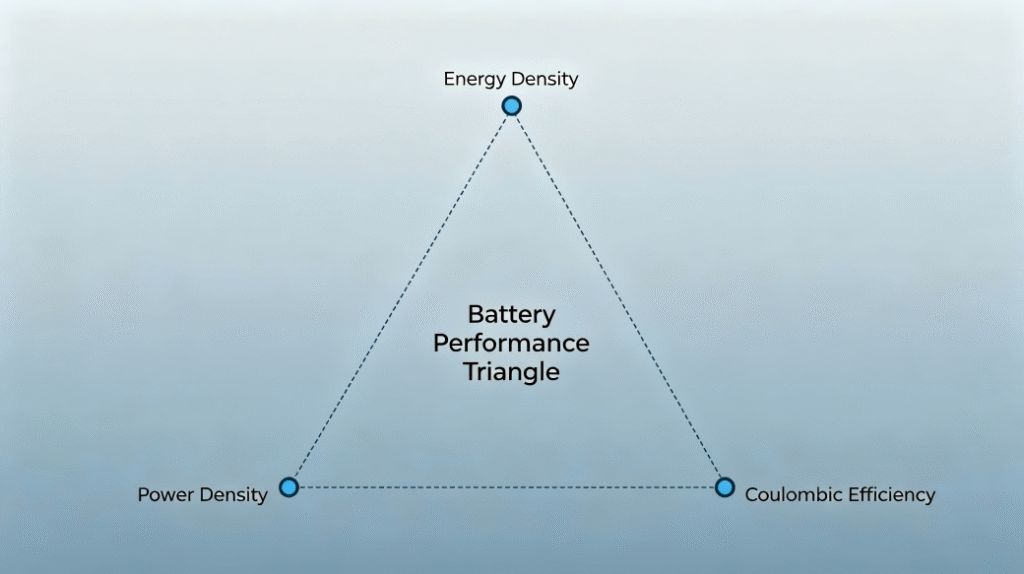
But in reality, battery performance is governed by a much more complex relationship involving three core parameters:
⚡ Energy Density 🚀 Power Density 🔄 Coulombic Efficiency (CE)
These three metrics form an invisible triangle that determines whether a battery succeeds in:
- UAVs
- eVTOLs
- Robotics
- Energy Storage Systems (ESS)
- EVs
- High-power industrial applications
Understanding their relationship is becoming increasingly important as the industry moves toward solid-state batteries, fast charging, and high-rate systems.
1. What Is Energy Density?
Energy Density = How much energy a battery stores per unit mass or volume
Typical units:
- Gravimetric: Wh/kg
- Volumetric: Wh/L
Formula:

Higher energy density means:
✅ Longer endurance ✅ Smaller battery packs ✅ Lower system weight
Examples:

Example:
A drone battery:
250 Wh/kg → 350 Wh/kg
can theoretically increase endurance by:
≈ 40%
without increasing weight.
2. What Is Power Density?
Power density answers another question:
How FAST can energy be delivered?
Unit:
- W/kg
Formula:

Higher power density means:
⚡ Higher discharge rate ⚡ Faster acceleration ⚡ Larger burst current capability
Examples:

Typical examples:
LFP ESS cell:
Low power density
Drone LiPo:
Very high power density
3. What Is Coulombic Efficiency (CE)?
This is the parameter most people underestimate.
Coulombic Efficiency:

Example:
Charge:
100 Ah
Discharge:
99.9 Ah
Then:
CE = 99.9%
At first glance:
0.1% loss seems tiny.
It isn’t.
Because CE accumulates over thousands of cycles.
Example:
99.99% CE:
Excellent cycle life
99.5% CE:
Rapid degradation
Small changes produce huge lifetime differences.
The Relationship Triangle
Below is the simplified relationship:

The Trade-Off Between Energy Density and Power Density
This is one of the oldest battery engineering problems.
Increasing energy density usually means:
- Thicker electrodes
- More active material
- Higher loading
Result:
✅ More stored energy
BUT:
❌ Longer ion transport paths ❌ Higher resistance ❌ Lower power capability
The Hidden Relationship Between Power Density and Coulombic Efficiency
Higher power output means:
Higher current
↓
More heat
↓
Side reactions increase
↓
Lower CE
↓
Faster aging
Relationship:

This is why:
15C UAV batteries
and
0.5P ESS batteries
behave completely differently.
Why CE Becomes Critical in Solid-State Batteries
Solid-state batteries aim for:
✅ High energy density ✅ Improved safety
BUT:
They face challenges:
- Interface resistance
- Lithium dendrites
- Mechanical stress
Ultimately:
Success depends heavily on:
Maintaining extremely high CE
Target values:
Conventional Li-ion:
99.8–99.95%
Advanced solid-state:
Need:
99.99%
for long-term commercialization.
Practical Comparison

UAV Industry Perspective
For drone batteries:
The ideal target is:
High Energy Density + High Power Density + High Coulombic Efficiency
Reality:
Improving one often hurts another.
Examples:
Long-range UAV:
Prioritize energy density
Heavy-lift drone:
Prioritize power density
Inspection UAV:
Prioritize CE and cycle life
Final Thought
Battery innovation is no longer a race for:
“Highest Wh/kg”
The future belongs to balancing:
⚡ Energy Density 🚀 Power Density 🔄 Coulombic Efficiency
Because the best battery is not the one storing the most energy.
It is the one delivering:
the right energy, at the right power, for the longest lifetime.