
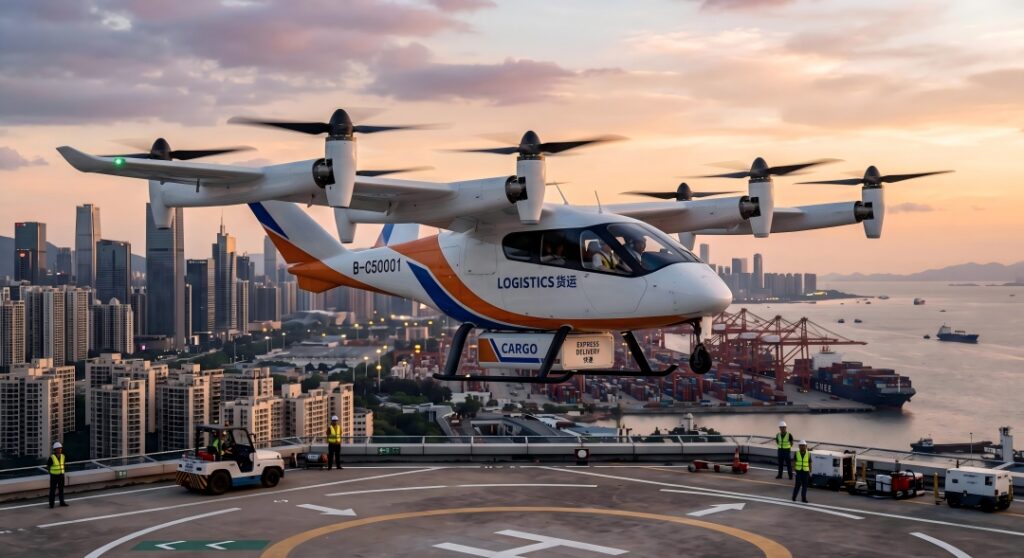
When people talk about eVTOL aircraft, the first image that usually comes to mind is an air taxi carrying passengers across a city.
But China’s emerging commercialization path may look very different.
The first large-scale eVTOL market may not be passenger transport.
It may be: Cargo.
And if cargo eVTOL becomes the first commercially mature segment, it could fundamentally change what the industry needs from batteries.
The dominant questions may no longer be:
How fast can we charge?
or:
How high can the discharge C-rate go?
Instead, the next stage of battery competition may increasingly focus on:
Higher energy density + Longer cycle life + Better safety + Swappable battery architecture + Lower cost per flight
That shift is becoming increasingly important as China’s low-altitude economy moves from demonstration flights toward commercial operations.
1. eVTOL Commercialization Is Moving From A-to-A Toward A-to-B
Many eVTOL aircraft currently operating in small batches are still primarily used in A-to-A missions.
The aircraft takes off from one location, performs a task, and returns to the same location.
Typical examples include:
- Heavy-lift operations
- Aerial lifting
- Tourism and sightseeing
- Demonstration flights
- Industrial operations
These applications are easier to manage because the aircraft operates around a relatively fixed site.
The next step is much more important:
A-to-B transportation.
This means the aircraft departs from one location and lands at another.
Once eVTOL moves into A-to-B transportation, it becomes much closer to a true logistics or transportation network.
China’s revised Civil Aviation Law officially took effect on July 1, 2026, strengthening the regulatory framework supporting civil aviation, unmanned aircraft and the development of the low-altitude economy.
Commercial development is likely to proceed gradually.
A realistic path is:
Cargo before passengers
Suburban and industrial routes before dense urban routes
Pilot operations before nationwide deployment
This makes sense.
Cargo does not carry passengers.
Operational risk can be controlled more easily.
Routes can be standardized.
Takeoff and landing locations can be fixed.
And commercial economics can be tested before moving toward high-frequency passenger operations.
2. Cargo eVTOL Is Already Moving Beyond the Prototype Stage
One of the clearest examples is AutoFlight.
Its V2000CG CarryAll, a two-ton-class unmanned cargo eVTOL, received its Chinese Type Certificate in 2024.
In June 2026, the aircraft also received validated type certification in Indonesia, allowing commercial cargo operations there.
According to AutoFlight, this made the V2000CG the first eVTOL to obtain overseas validation of its type certificate.
That matters.
For years, eVTOL development was dominated by:
- Concept aircraft
- Flight demonstrations
- Financing announcements
- Prototype testing
Certification changes the conversation.
Once an aircraft becomes certified and begins entering commercial operations, the key questions become very different:
- How many missions per day can it fly?
- How long does turnaround take?
- How much does each flight cost?
- How often must batteries be replaced?
- How much maintenance does the aircraft require?
- How reliable is dispatch availability?
This is when battery technology moves from an engineering specification into a business model variable.
3. Why Cargo May Become China’s Largest eVTOL Battery Market
GGII estimates that lithium-battery demand from China’s low-altitude and aviation applications could exceed 10 GWh by 2030 and potentially reach more than 50 GWh by 2035, with cargo eVTOL expected to account for a major share.
There are several reasons why cargo could develop faster than passenger eVTOL.
Reason 1: China Already Has Massive Logistics Demand
China has one of the world’s largest express-delivery and e-commerce ecosystems.
But many logistics routes remain inefficient.
Examples include:
- Islands
- Mountainous regions
- Offshore facilities
- Remote industrial sites
- Cross-river transportation
- Emergency logistics
- High-value urgent cargo
Traditional ground logistics can be slowed by:
- Roads
- Traffic
- Terrain
- Bridges
- Ferry schedules
Cargo eVTOL can bypass much of this infrastructure.
Instead of building a new road, the aircraft can fly directly between logistics nodes.
4. Energy Economics Could Become a Major Advantage
One of the most interesting long-term advantages of electric aviation is operating-energy cost.
GGII estimates that by around 2030, electricity consumption for Chinese cargo eVTOLs could potentially fall below approximately:
0.5 kWh per ton-kilometer
If electricity costs around RMB 0.8/kWh, the corresponding energy expense could approach:
RMB 0.4 per ton-kilometer
That would be dramatically lower than conventional helicopter fuel economics under comparable cargo calculations.
Of course, electricity is only one part of operating cost.
Real eVTOL economics must also include:
- Aircraft depreciation
- Battery depreciation
- Maintenance
- Charging or swapping infrastructure
- Insurance
- Airspace operations
- Ground support
- Labor
- Software
But energy cost matters because commercial aircraft may accumulate thousands of operating hours.
Even a small reduction in cost per kilometer becomes significant at fleet scale.
5. Why Cargo Makes More Sense Than Passenger Transport in the Early Stage
China already has extremely strong ground passenger-transport infrastructure.
Including:
- High-speed rail
- Metro systems
- Ride-hailing
- Intercity rail
- Expressways
For many passengers, ground transportation is already affordable and convenient.
That creates a difficult competitive benchmark for passenger eVTOL.
Cargo is different.
Businesses may pay significantly more when transportation delivers measurable value through:
- Faster delivery
- Reduced inventory
- Emergency response
- Fewer road delays
- Better access to remote regions
- Higher asset utilization
This is why cargo may be one of the best environments for proving the economics of eVTOL.
6. But Cargo eVTOL Creates a Huge Battery Challenge
An eVTOL battery has to solve several conflicting requirements simultaneously.
It needs:
High Energy Density
because every kilogram of battery reduces available payload.
High Power
because vertical takeoff requires significant peak output.
High Cycle Life
because commercial aircraft may charge several times per day.
Fast Energy Replenishment
because aircraft only earn money when they are flying.
High Safety
because eVTOL is an aviation platform.
These objectives often conflict.
A cell optimized for maximum energy density may not deliver the best cycle life.
A cell optimized for ultra-fast charging may generate more heat and degrade faster.
A very high-power cell may sacrifice energy density.
This means eVTOL battery development is fundamentally a multi-objective optimization problem.
7. Current eVTOL Batteries Are Already Entering the 280–350 Wh/kg Range
According to GGII’s 2026 industry research, current lithium cells designed for eVTOL applications are generally entering a gravimetric energy-density range of approximately:
280–350 Wh/kg
This is substantially higher than many conventional industrial lithium battery systems.
And the reason is obvious.
For an aircraft:
Battery weight directly competes with payload and range.
Suppose an eVTOL contains a 300 kg battery system.
If cell technology improves enough to reduce battery mass by 15% while maintaining the same usable energy, dozens of kilograms can potentially be released for:
- Cargo
- Range
- Redundancy
- Structural margin
This is why eVTOL creates much stronger willingness to pay for high-energy battery technology than many ground applications.
8. But Energy Density Alone Is Not Enough
This is one of the biggest misconceptions about aviation batteries.
A battery with:
400 Wh/kg
is not automatically better than one with:
320 Wh/kg
if the 400 Wh/kg battery cannot provide the required takeoff power.
Vertical takeoff may require very high instantaneous current.
GGII indicates that current eVTOL battery systems commonly target continuous discharge capability of at least around:
5C
with peak discharge potentially reaching:
10C or higher
depending on aircraft design.
This is why aviation batteries must balance:
Energy + Power
A battery optimized only for range may fail during takeoff.
A battery optimized only for power may become too heavy.
9. The More Interesting Question Is Charging Rate
Current eVTOL battery systems may support charging rates around:
2C–5C
because turnaround time is commercially important.
But extremely fast charging creates another problem:
Battery degradation.
High charging current can increase:
- Polarization
- Heat generation
- Lithium plating risk
- Electrode stress
- Side reactions
If an aircraft performs several flights every day, the battery may experience thousands of high-rate charging events over its operating life.
This creates a direct conflict:
Faster charging → Higher aircraft utilization
but potentially:
Faster charging → Shorter battery life
And once battery replacement cost is included, faster charging is not always the cheapest solution.
10. This Is Why Battery Swapping Could Become Extremely Important
One of GGII’s most interesting conclusions is that battery swapping may become the preferred energy-replenishment model for cargo eVTOL.
There are several reasons.
Reason 1: Swapping Separates Aircraft Turnaround From Battery Charging
Imagine an aircraft lands with 20% SOC.
Fast-charging model:
Land
↓
Connect charger
↓
Charge for 20–40 minutes
↓
Take off again
The aircraft is earning nothing during charging.
Now consider swapping:
Land
↓
Remove battery
↓
Install charged battery
↓
Aircraft departs
The depleted battery can then be charged slowly offline.
This creates a major advantage:
Aircraft turnaround time no longer equals battery charging time.
11. Slower Charging Can Actually Improve Fleet Economics
This sounds counterintuitive.
If a battery supports 5C charging, why not charge it as quickly as possible?
Because commercial operators care about:
battery lifecycle cost.
If battery swapping allows the pack to recharge at 0.5C or 1C instead of constantly charging at 3C–5C, the operator may gain:
- Lower cell temperature
- Reduced lithium plating risk
- Lower degradation
- More cycles
- Longer battery life
The aircraft still returns to service quickly because another battery is already available.
So swapping effectively allows operators to optimize two different assets independently:
Aircraft
Maximum utilization
Battery
Maximum lifetime
This could be one of the strongest economic arguments for battery swapping.
12. Fixed Vertiports Make Swapping More Practical
Battery swapping works poorly when vehicles operate randomly.
But cargo eVTOL networks are likely to use fixed or semi-fixed locations:
- Logistics hubs
- Distribution centers
- Airports
- Ports
- Offshore bases
- Industrial parks
- Island terminals
That creates a point-to-point network.
For example:
Hub A → Hub B → Hub C
Battery swapping stations can be installed at each node.
This is very similar to logistics warehouses.
The infrastructure does not need to cover every square kilometer.
It only needs to cover the operational network.
That dramatically improves the economics of swapping.
13. The Battery Could Become a Fleet Asset Instead of an Aircraft Component
Battery swapping creates another interesting change.
Traditionally:
Aircraft owns battery.
But in a swapping network:
Fleet owns battery pool.
Imagine an operator with:
- 30 cargo eVTOL aircraft
- 80 battery packs
- 10 vertiports
The battery management system can dynamically allocate batteries according to:
- SOC
- SOH
- Temperature
- Mission distance
- Payload
- Charging status
- Internal resistance
- Remaining useful life
A newer battery might be assigned to a long-range mission.
An older battery might be assigned to a short route.
A battery showing abnormal resistance may automatically be removed from service.
Battery management therefore becomes part of fleet dispatching.
14. Cycle Life May Become More Important Than Even Faster Charging
GGII notes that current aviation-oriented battery products generally target more than:
1,000 cycles
with some higher-end products reaching:
2,000 cycles or more.
But consider commercial cargo operations.
Suppose one aircraft completes:
6 missions per day
That can represent more than:
2,000 flight cycles per year
depending on how battery cycles are defined and how packs are rotated.
Suddenly, a 1,000-cycle battery does not sound particularly long-lived.
This is why future eVTOL battery competition may increasingly shift toward:
2,000 → 3,000 → 5,000 effective commercial cycles
while maintaining acceptable:
- Energy density
- Power
- Safety
That is an extremely difficult materials-engineering challenge.
15. Battery Cost per Flight Will Become a Critical Metric
Suppose Battery A costs:
USD 30,000
and provides:
1,000 usable cycles
Simplified battery depreciation:
USD 30 per cycle
Battery B costs:
USD 40,000
but provides:
2,000 cycles
Battery depreciation becomes:
USD 20 per cycle
Battery B is 33% more expensive upfront.
But its lifecycle cost is 33% lower per cycle.
For commercial aviation, this difference becomes enormous.
Therefore, eVTOL operators will increasingly care about:
Battery Cost per Flight
rather than simply:
Battery Purchase Price
This is exactly the same transition already happening in AGV, AMR and industrial robot fleets.
16. Safety Will Become the Non-Negotiable Requirement
Cargo eVTOL may commercialize before passenger aircraft.
But that does not mean battery safety requirements will be relaxed.
These aircraft may operate:
- Over cities
- Near logistics centers
- Around ports
- Near industrial facilities
- In populated environments
Battery failures could still have serious consequences.
Future eVTOL battery validation will therefore need to focus heavily on:
- Thermal runaway
- Cell propagation
- Overcharge
- Over-discharge
- External short circuit
- Internal short circuit
- Mechanical shock
- Vibration
- Crush
- Drop
- High-temperature exposure
- Low-temperature charging
- Water ingress
- Cell imbalance
Safety needs to be designed at multiple levels:
Cell → Module → Pack → Aircraft
17. Pouch Cells Have Advantages—but Also Special Challenges
Pouch cells are attractive for aviation because they can offer:
- High energy density
- Efficient packaging
- Lower inactive-material weight
- Flexible dimensions
But high-energy pouch systems also demand careful engineering around:
- Swelling
- Mechanical compression
- Thermal propagation
- Pouch integrity
- Gas generation
- Cell consistency
As eVTOL pushes energy density upward, pouch-cell safety optimization may become an increasingly important R&D direction.
The goal is not simply:
“Make the cell lighter.”
It is:
“Make the cell lighter without reducing the safety margin.”
18. The BMS Will Become Part of the Flight-Safety System
Traditional battery management focuses on:
- Overcharge
- Over-discharge
- Temperature
- Current protection
- Cell balancing
For eVTOL, that is not enough.
The BMS may need to predict:
- Remaining flight energy
- Maximum available power
- Remaining useful life
- Abnormal cell behavior
- Internal resistance growth
- Thermal risk
Imagine an aircraft approaching takeoff.
The system should not only know:
SOC = 82%
It should know:
“Can this battery safely deliver the required takeoff power for this payload, at this temperature, after 1,200 cycles?”
That is a much more difficult question.
Future aviation BMS systems may therefore become deeply integrated with:
- Flight control
- Mission planning
- Fleet management
- Charging infrastructure
- Battery swapping
- Predictive maintenance
19. Battery Traceability Will Become Critical
In consumer electronics, users rarely know the history of individual battery cells.
That will not be acceptable for commercial eVTOL.
Every aviation battery may need a complete digital history:
- Cell batch
- Manufacturing date
- Capacity
- Internal resistance
- Self-discharge characteristics
- Cycle count
- Fast-charge exposure
- Maximum temperature
- Minimum temperature
- Peak current
- Deep-discharge events
- Fault records
This information could follow the battery through its entire life.
From:
Cell factory
to:
PACK manufacturer
to:
Aircraft
to:
Swap station
to:
Retirement
to:
Second life or recycling
In aviation, battery traceability may eventually become as important as battery performance.
20. Solid-State Batteries Could Eventually Change the Equation
Current eVTOL battery systems are still predominantly based on advanced lithium-ion technology.
But aviation is one of the most logical early markets for:
- Semi-solid batteries
- Hybrid solid-liquid batteries
- All-solid-state batteries
- Lithium-metal batteries
Why?
Because aircraft are extremely weight-sensitive.
If a future battery can reliably deliver:
400+ Wh/kg
while maintaining:
- High discharge power
- Long cycle life
- Strong safety
the aircraft-level benefit could be enormous.
However, aviation will not adopt a new chemistry simply because a laboratory reports a record energy density.
The battery must survive:
real aviation duty cycles.
That means certification, consistency, thermal safety and production quality may matter even more than headline Wh/kg.
21. What Battery Specifications Will Matter Most After 2030?
If cargo eVTOL + battery swapping becomes the dominant commercialization model, battery priorities may gradually change.
Today, the industry often focuses heavily on:
Energy density + C-rate
By the next stage, the hierarchy may increasingly become:
1. Energy Density
Still essential because it directly affects payload and range.
2. Cycle Life
Critical for fleet economics.
3. Safety
Non-negotiable for aviation.
4. Consistency
Necessary for predictable pack performance.
5. Fast Charging
Still valuable, but swapping may reduce the need to chase extreme charging rates.
6. Peak Discharge Power
Still necessary for takeoff, but once aircraft requirements are reliably met, further increases may create limited economic value.
This is an important distinction.
Sometimes the industry keeps optimizing a number even after it stops being the real bottleneck.
22. The Next eVTOL Battery Race May Not Be About “More C”
This may be the most interesting conclusion.
During the early stage of electric aviation, engineers naturally focus on:
Can the battery provide enough power?
Once that requirement is achieved, the question changes.
If 5C continuous and 10C peak already satisfy the propulsion system, increasing the battery to 15C or 20C may not create much additional value.
Meanwhile, increasing energy density from:
300 Wh/kg → 350 Wh/kg
could directly improve:
- Range
- Payload
- Aircraft efficiency
Increasing cycle life from:
1,000 → 2,000 cycles
could dramatically reduce:
- Battery depreciation
- Replacement frequency
- Operating cost
So the optimization target may shift from:
Higher C-rate
toward:
More Wh/kg + More cycles + More safety
That may define the next generation of commercial eVTOL batteries.
23. Cargo eVTOL Could Become the Real Test Ground for Electric Aviation
Passenger air taxis receive most of the media attention.
But cargo eVTOL may ultimately play the more important role in commercialization.
Cargo operations can help the industry learn:
- Real battery degradation
- Charging economics
- Swap-station design
- Fleet scheduling
- Maintenance intervals
- Weather limitations
- Airspace coordination
- Insurance economics
- Route profitability
Every cargo flight produces operational data.
That data can eventually support passenger operations.
So the likely sequence may be:
Cargo proves the technology.
Cargo proves the economics.
Cargo builds the infrastructure.
Passenger eVTOL scales later.
Final Thoughts: eVTOL Is Becoming an Energy-Economics Business
For years, the eVTOL industry has been dominated by aircraft questions:
How far can it fly?
How much can it carry?
How fast can it fly?
Can it get certified?
Those questions remain important.
But once commercial operation begins, another set of questions becomes equally important:
How many flights per day?
How long between flights?
How many cycles before battery replacement?
How much does one battery cycle cost?
How much does one ton-kilometer cost?
How many aircraft can one battery-swapping station support?
That is when eVTOL stops being only an aerospace technology.
It becomes an operational economics system.
And from the battery perspective, I believe this is where the next major shift will occur:
The best eVTOL battery will not necessarily be the battery with the highest C-rate or even the highest energy density.
It will be the battery that delivers the best combination of:
Energy Density × Cycle Life × Safety × Reliability × Fleet Utilization
at the lowest:
Cost per Safe Flight
If cargo eVTOL truly enters large-scale commercialization between 2029 and 2035, battery technology will not simply determine how far these aircraft can fly.
It will determine whether the business model can make money at all.
#eVTOL #CargoEVTOL #ElectricAviation #AdvancedAirMobility #LowAltitudeEconomy #DroneBattery #AviationBattery #LithiumBattery #BatteryTechnology #BatterySwap #BMS #EnergyDensity #UrbanAirMobility #AirCargo #AutonomousAviation #BatteryEngineering