
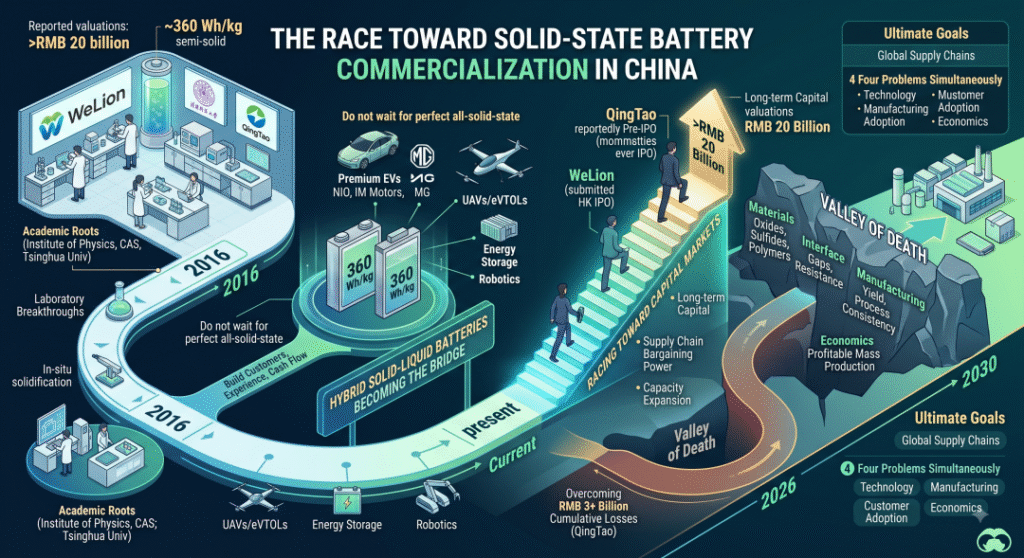
China’s solid-state battery industry is entering a new phase.
The competition is no longer limited to laboratory breakthroughs, pilot lines, energy-density records, or prototype vehicle demonstrations.
It is now moving into the capital markets.
Two of China’s most prominent solid-state battery unicorns — WeLion New Energy and QingTao Energy — are both accelerating toward public-market listings.
QingTao submitted an application to the Hong Kong Stock Exchange in April 2026, while WeLion has reportedly begun a Pre-IPO financing round as it prepares for a potential listing on China’s ChiNext market.
Both companies have valuations that have reportedly exceeded RMB 20 billion.
More importantly, both companies have chosen a remarkably similar commercialization strategy:
Do not wait for perfect all-solid-state batteries. Commercialize hybrid solid-liquid batteries first, build customers, production experience, and cash flow, and then gradually move toward true all-solid-state systems.
That strategy may tell us more about the future of the solid-state battery industry than any laboratory energy-density record.
From Research Institutes to Battery Unicorns
Both companies have strong academic origins.
WeLion New Energy
WeLion was founded in 2016 with roots in the Institute of Physics, Chinese Academy of Sciences.
Its founding team includes prominent Chinese battery researchers such as Chen Liquan and Li Hong.
The company has spent years developing what it calls in-situ solidification technology, allowing it to move gradually from conventional liquid-electrolyte systems toward hybrid solid-liquid and eventually solid-state architectures.
One of WeLion’s most visible milestones came through its cooperation with NIO, where it supplied semi-solid battery cells reportedly reaching around 360 Wh/kg at the cell level.
But automotive applications are only one part of the strategy.
WeLion has also expanded into:
- Energy storage
- Low-altitude aviation
- AIDC power systems
- Robotics
- Other high-energy applications
This diversification matters because solid-state batteries may not reach commercial maturity in every market at the same speed.
Some applications are much more willing to pay for higher energy density or improved safety than mass-market passenger vehicles.
QingTao Energy: Commercialization at Larger Scale
QingTao Energy also has a strong academic background, emerging from research associated with Tsinghua University.
Its technical route focuses heavily on organic-inorganic composite solid electrolytes, with a gradual transition from hybrid solid-liquid batteries toward all-solid-state technology.
QingTao has already achieved meaningful commercial deployment.
Its solid-state-related battery products have reportedly been used across more than 30 passenger and commercial vehicle models, including vehicles from brands such as:
- IM Motors
- MG
- Foton
The company has also expanded into energy storage, particularly applications where safety carries a high economic value.
This illustrates an important point:
Solid-state battery commercialization will probably not happen through one single “killer application.”
Instead, it will spread through multiple high-value markets where customers are willing to accept higher initial battery costs in exchange for:
higher safety + higher energy density + differentiated system performance.
The Most Important Trend: Hybrid Solid-Liquid Batteries Are Becoming the Bridge
For years, the solid-state battery conversation was dominated by a simple narrative:
Liquid lithium-ion batteries are today.
All-solid-state batteries are tomorrow.
Reality is becoming much more complicated.
The emerging industry structure looks more like this:
Liquid battery → Hybrid solid-liquid battery → Quasi-solid battery → All-solid-state battery
This gradual transition is important because all-solid-state batteries require fundamental changes across:
- Materials
- Electrode architecture
- Electrolytes
- Manufacturing equipment
- Interface engineering
- Quality control
- Production pressure
- Cell formation
- Pack design
Trying to jump directly from conventional liquid lithium-ion manufacturing to mature all-solid-state mass production is enormously difficult.
Hybrid solid-liquid batteries offer a more practical route.
They allow manufacturers to introduce part of the solid electrolyte system while still retaining enough liquid phase to maintain good ionic conductivity and interface contact.
This helps solve one of the biggest challenges in solid-state batteries:
solid-solid interface resistance.
Why the Industry May Need Until 2030 for True Mass Commercialization
All-solid-state batteries offer extremely attractive theoretical advantages.
Potential benefits include:
- Higher gravimetric energy density
- Improved intrinsic safety
- Compatibility with lithium-metal anodes
- Potentially wider operating temperature windows
- Reduced dependence on flammable liquid electrolytes
However, moving from “the technology works” to “the technology can be manufactured economically at scale” is a completely different challenge.
Three major barriers remain.
1. The Material Problem
The solid electrolyte is the heart of an all-solid-state battery.
But it must simultaneously provide:
- High lithium-ion conductivity
- Electrochemical stability
- Mechanical stability
- Compatibility with the cathode
- Compatibility with lithium metal
- Manufacturability
- Acceptable cost
That combination is extremely difficult to achieve.
Whether the technology uses:
- Oxides
- Sulfides
- Polymers
- Composite electrolytes
there is always a trade-off.
A material that performs beautifully in a laboratory coin cell may behave very differently when scaled into a large-format commercial cell.
2. The Interface Problem
Liquid electrolyte has one enormous engineering advantage:
It flows.
It can penetrate microscopic gaps inside porous electrodes and maintain intimate contact with active materials.
Solid electrolyte cannot do this naturally.
Solid meets solid.
As the battery cycles, electrodes expand and contract.
Tiny gaps may form.
Contact deteriorates.
Interface resistance increases.
This can lead to:
- Higher polarization
- Lower power performance
- Faster degradation
- Reduced cycle life
This is arguably one of the most difficult challenges facing all-solid-state batteries.
3. The Manufacturing Problem
Perhaps the biggest commercial barrier is not electrochemistry.
It is manufacturing.
Solid-state production requires new solutions for:
- Electrolyte preparation
- Electrode coating
- Lamination
- Pressing
- Interface treatment
- Cell assembly
- Moisture control
- Quality inspection
- Yield management
And yield is everything.
A 400 Wh/kg battery sounds impressive.
But if only 60% of the cells produced are qualified, the economics may be impossible.
This is why the next phase of solid-state competition may be less about laboratory energy density and more about:
Yield rate.
Consistency.
Production speed.
Unit manufacturing cost.
The Financial Reality: Technology Is Expensive Before It Becomes Profitable
QingTao’s financial performance illustrates the challenge.
According to disclosed information, the company recorded significant losses between 2023 and 2025.
Its losses reportedly exceeded RMB 3 billion cumulatively over the three-year period.
The reasons are understandable:
- Pilot and early-stage production lines
- Low capacity utilization
- High unit manufacturing costs
- Material optimization
- Equipment commissioning
- Process validation
- Trial production
- Heavy R&D spending
This is typical of deep-tech manufacturing.
The first cell coming off a pilot line may be technically impressive.
But that does not mean it is economically competitive.
The hardest transition is:
prototype → pilot production → stable mass production → profitable mass production
Many battery companies fail somewhere between the second and fourth steps.
Capacity Utilization May Matter More Than Nominal Capacity
Battery companies often announce production capacity in GWh.
But nominal capacity alone tells us very little.
The more important questions are:
- What is the utilization rate?
- What is the yield?
- What is the qualified output?
- What is the customer mix?
- What is the gross margin?
- How quickly can production costs decline?
A 10 GWh factory running at 40% utilization can be financially weaker than a 3 GWh factory operating close to full capacity.
For solid-state battery companies, this distinction will become increasingly important as they enter public markets.
Investors will no longer evaluate them purely as technology stories.
They will increasingly evaluate them as manufacturing businesses.
Why IPOs Matter for Solid-State Battery Companies
Building a competitive battery company is extremely capital intensive.
The industry requires continuous investment in:
- R&D
- Pilot lines
- Production equipment
- Material procurement
- Customer qualification
- Certification
- Manufacturing expansion
- Global supply chains
For solid-state battery companies, the capital requirements may be even greater because many processes cannot simply reuse conventional lithium-ion production lines.
This explains why access to public capital markets is so important.
An IPO can provide:
- Long-term capital
- Stronger customer confidence
- Supply-chain bargaining power
- Funding for capacity expansion
- Global market visibility
But listing is not the finish line.
It only provides more fuel for the next stage.
The Bigger Competition: Who Can Cross the “Valley of Death”?
The solid-state battery industry is currently entering what could be called its commercialization valley of death.
The scientific principle has been demonstrated.
Prototype batteries exist.
Customers have started testing them.
Pilot lines are running.
But profitability has not yet been proven.
The companies that survive this stage will likely be those that solve four problems simultaneously:
1. Technology
Can the battery deliver meaningful improvement over liquid lithium-ion systems?
2. Manufacturing
Can it be produced consistently and at acceptable yield?
3. Customer Adoption
Are customers willing to integrate the battery into real products?
4. Economics
Can the manufacturer eventually earn money?
That fourth question may ultimately be the hardest.
Hybrid Solid-Liquid Batteries Could Win the Next Few Years
The near-term winner may not be all-solid-state batteries.
It may be hybrid solid-liquid batteries.
Why?
Because they offer a more realistic balance between:
- Higher energy density
- Improved safety
- Manufacturing compatibility
- Cost
- Cycle life
- Commercial readiness
From 2026 to 2028, we are likely to see increasing penetration in high-value applications where battery performance matters more than the absolute lowest cost.
Potential early markets include:
- Premium EVs
- Long-range vehicles
- Energy storage
- UAVs
- eVTOL aircraft
- Robotics
- AIDC backup power
These markets can absorb higher battery costs more easily than entry-level passenger vehicles.
Why UAVs and eVTOLs Could Become Important Early Markets
From the perspective of the drone battery industry, solid-state technology is particularly interesting.
Aircraft are extremely sensitive to battery weight.
A 20% improvement in cell-level energy density can potentially translate into:
- Longer flight time
- Higher payload
- Greater mission radius
- More redundancy
This gives aviation applications a much stronger willingness to pay for high-energy cells.
For an electric vehicle, adding 50 kg of battery may be acceptable.
For a drone, an additional 5 kg could fundamentally change the aircraft’s mission capability.
That is why UAVs, high-altitude platforms, heavy-lift drones, and eVTOL aircraft may become some of the earliest commercially meaningful markets for high-energy solid-state or hybrid solid-liquid batteries.
However, aviation customers will demand more than energy density.
They will also require:
- High discharge capability
- Low internal resistance
- High-voltage stability
- Thermal reliability
- Excellent cell consistency
- Long cycle life
- Predictable degradation
- Advanced BMS integration
A 400 Wh/kg cell that cannot safely deliver takeoff power is not an aviation battery.
Solid-State Will Not Completely Replace Liquid Lithium Batteries
Perhaps the most important long-term conclusion is that the battery market will not become a simple competition of:
solid-state vs. liquid lithium-ion
Different chemistries will coexist.
LFP may continue dominating:
- Energy storage
- Commercial vehicles
- Cost-sensitive applications
High-nickel lithium-ion may remain strong in:
- Long-range EVs
- High-performance applications
Hybrid solid-liquid batteries may expand rapidly in:
- Premium mobility
- UAVs
- Robotics
All-solid-state batteries may first dominate the highest-value applications where performance and safety justify their cost.
The future battery market will likely become more fragmented, not less.
Final Thoughts
The race between QingTao Energy and WeLion New Energy toward the capital markets is significant.
But the real competition is not about who becomes the “first solid-state battery stock.”
The real competition is:
Who can turn advanced battery science into repeatable manufacturing, real customer demand, and sustainable profit?
That is the question that will define the next decade of solid-state batteries.
The industry is moving quickly.
Hybrid solid-liquid batteries are already entering commercialization.
All-solid-state batteries are progressing.
Capital is arriving.
Customers are testing.
Factories are being built.
But the final winner will not necessarily be the company with the highest laboratory energy density.
It will be the company that can combine:
Technology × Manufacturing × Scale × Cost × Reliability
Because in the battery industry, invention gets attention.
Mass production creates the market.
And profitable mass production creates the winner.
#SolidStateBattery #SemiSolidBattery #BatteryTechnology #EnergyStorage #LithiumBattery #EVBattery #DroneBattery #eVTOL #Robotics #BatteryManufacturing #BatteryInnovation #EnergyDensity #LowAltitudeEconomy #CleanEnergy #AdvancedBattery