
The question of whether fast charging damages batteries seems to resurface every so often across the internet.
Some say fast charging is a battery life killer. Others point out that today’s smartphones, EVs, drones — everything is fast charging — so it must be fine.
If I had to give a one-line conclusion, it would be this:
Yes, fast charging does accelerate battery aging, but not nearly as dramatically as many people imagine. What actually harms batteries more is often not “fast charging” itself, but high temperatures, charging in the cold, storing at 100% for long periods, and poor charging habits.
To explain this properly, we have to go back to the very basics:
How does a lithium-ion battery actually charge?
1. Before we debate “does fast charging hurt,” let’s understand how lithium-ion charging works
Charging a lithium-ion battery is essentially moving lithium ions from the positive electrode to the negative electrode.
A simple analogy:
Lithium ions = people moving house Electric current = speed of moving Voltage = how many floors up
So charging isn’t “pouring electricity in” — it’s making lithium ions migrate from Building A to Building B.
Almost all lithium-ion batteries — whether in phones, EVs, robots, or drones — follow the same classic charging logic:
CC-CV (Constant Current – Constant Voltage) charging strategy.

For more information about CC-CV charging strategy, please click here.
2. What does fast charging actually change?
Many people think fast charging is a completely different way of charging.
It’s not.
Fast charging doesn’t change the CC-CV logic. It only changes the current during the CC phase.
For example:
- Standard charge: 1A
- Fast charge: 3A, 5A, or even higher
So:
Fast charging simply means cranking up the “moving speed” in the first half of the charge.
The problem is exactly there — when moving faster, can the negative electrode keep up with receiving all those lithium ions?
3. Why does fast charging accelerate aging? Two core reasons
Fast charging puts extra stress on the battery through two main mechanisms:
Reason 1: Lithium “traffic jam” — Lithium Plating
Remember the moving-house analogy?
With fast charging, the moving speed suddenly doubles or triples. But the entrance to the negative electrode building is only so big. If lithium ions arrive too fast, they get stuck at the door.
In battery terms, this is called:
Lithium Plating

Lithium ions can’t intercalate into the graphite layers fast enough, so they deposit as metallic lithium on the anode surface.
This leads to three consequences:
- Irreversible capacity loss — those plated lithium ions can no longer participate in normal cycling, permanently reducing capacity.
- Safety risk — metallic lithium can form dendrites that might pierce the separator, potentially causing short circuits or even thermal runaway.
- Increased side reactions — plated lithium continuously reacts with the electrolyte, further consuming active material and accelerating degradation.
However, here’s a crucial nuance:
Lithium plating does not happen every time you fast charge. It’s much more likely under high C‑rates, low temperatures, or with poorly designed battery systems. Modern battery systems — through materials, BMS, and charging strategies — are heavily optimized to avoid this.
Reason 2: Heat — the real “chronic poison” of fast charging
Compared to “speed” itself, heat is often a more direct driver of battery aging.
Higher current means more heat generated by internal resistance. Physically:
Heat Q ≈ I²R
So if you increase current a little, heat increases much faster.
And high temperatures damage lithium-ion batteries in multiple ways:
- SEI layer thickening — the protective layer on the anode grows faster, hindering lithium ion transport and increasing internal resistance.
- Electrolyte decomposition — heat accelerates electrolyte aging, producing gas that can cause swelling.
- Cathode material degradation — higher temperatures accelerate decay of the cathode crystal structure, speeding up capacity loss.

So from an engineering perspective:
The core issue with fast charging isn’t “speed” — it’s the temperature rise that comes with it.
4. Let’s talk numbers: how much less battery life does fast charging actually cause?
Theory can feel abstract. Let’s look at a logical comparison.

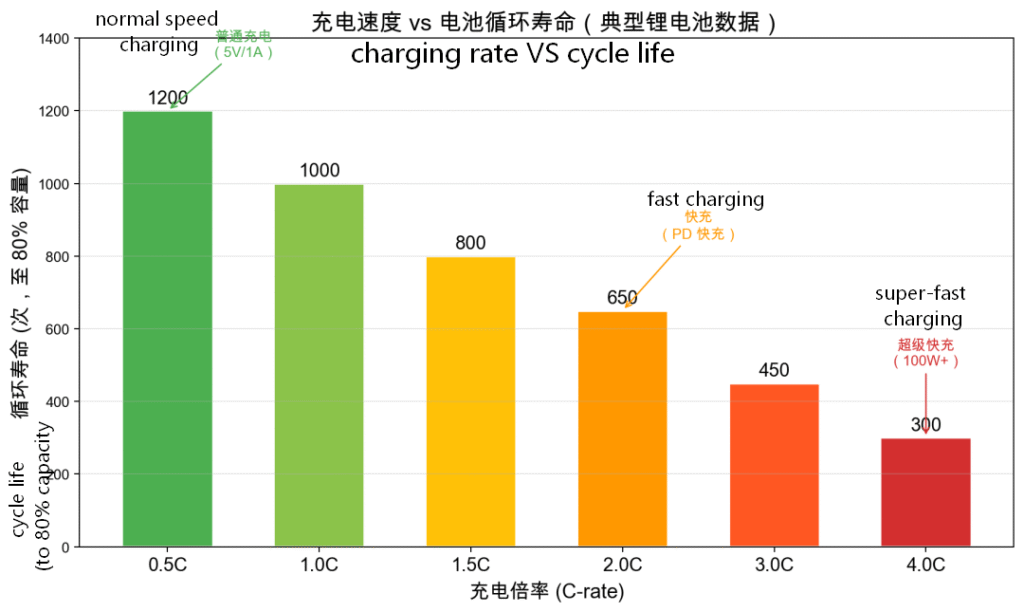
Typical cycle counts to 80% capacity retention at different charge rates:
- 0.5C slow charge: ~1200 cycles
- 1C standard charge: ~1000 cycles
- 2C fast charge: ~650 cycles
- 4C ultra-fast charge: ~300 cycles
That looks like a big gap.
But several important points:
1) Real-world use is not always 0–100%
Most people don’t run to 0% and charge to 100% every time. More common is:
- Start charging at 20–30%
- Stop at 80–90%
Shallow charging is far less damaging than full cycles.
2) Devices actively protect themselves
Modern devices don’t blast full power the whole time. Example:
- First 50%: full speed
- 50–80%: reduced speed
- Above 80%: further reduced
That “100W fast charge” is often a peak number, not sustained.
3) Most batteries don’t age noticeably before replacement
For phones, many users upgrade every 2–3 years. Within that window, the extra aging from fast charging is often not dramatic.
5. What actually hurts batteries more than fast charging?
If we rank what damages batteries, fast charging itself might not even be #1.
1) Storing at 100% for long periods
Lithium batteries age fastest at high SOC (90–100%). If you habitually:
- Leave your device plugged in overnight
- Keep it at 100% for hours
- Constantly keep it at high voltage
That often hurts more than one fast charge session.

Why? High voltage keeps the cathode in a highly oxidized state, accelerating side reactions and stressing materials.
✅ Tip: 80–90% is plenty for daily use. Enable “optimized charging” or smart protection if available.
2) Using the device heavily while charging
This is the triple whammy: charging + discharging + heat. Examples:
- Playing heavy games while plugged in
- Navigation, streaming, or video rendering while charging
This causes:
- Heat from charging
- Heat from the chip under load
- Temperatures easily exceeding 40°C
And heat is the single biggest enemy of battery life.
✅ Tip: Either let the device rest while charging, or avoid heavy loads while plugged in.
3) Fast charging in cold temperatures
This is easily overlooked but very risky.
At low temperatures:
- Electrolyte activity drops
- Lithium ion diffusion slows
- Graphite anode kinetics worsen
If you blast high current in the cold, you dramatically increase the risk of lithium plating.
In short: cold + fast charging = high risk of lithium plating.
✅ Tip: Avoid high-rate charging below 0°C. Warm up the device first.
4) Using poor quality chargers
This isn’t just about battery health — sometimes it’s a safety issue. Risks of cheap chargers include:
- Poor temperature control
- Incorrect protocol handshaking
- High output ripple
- Imprecise voltage/current control
All of these affect the electrochemical process and can create safety hazards.
✅ Tip: Use original or certified chargers and cables. Don’t save a few dollars at the expense of safety.
6. Why modern fast charging isn’t as scary as you think — because the system protects you
Many people think fast charging is just “dumping current” aggressively.
That’s not how modern systems work. Smartphones, EVs, drones, power tools — they all have multiple layers of protection:
1) Staged charging strategy
Not full current all the way — power is reduced in steps.
2) Real‑time temperature monitoring
If the battery gets warm, the system automatically slows down.
3) High‑precision charging chips
Modern power management ICs deliver:
- High efficiency conversion
- Real‑time current regulation
- Dynamically optimized charging curves
4) Battery material and structural improvements
Examples:
- Silicon‑carbon anodes
- High‑conductivity electrolytes
- Multi‑tab or full‑tab electrode designs
- Better heat dissipation
All these technologies make today’s fast charging systems far more mature than just a few years ago.
7. Practical advice if you truly care about battery life
Instead of obsessing over “should I use fast charging or not,” remember these simpler principles:
✅ 1. Avoid staying at 100% for long periods 80–90% is enough for most daily use.
✅ 2. Don’t do heavy tasks while charging Temperature management matters more than power anxiety.
✅ 3. Don’t fast charge in very cold conditions Warm up the battery first, then charge.
✅ 4. Use quality charging equipment A good charger isn’t just fast — it’s stable and safe.
Conclusion: Does fast charging hurt batteries? Yes — but far less absolutely than you think
Back to the original question:
Does fast charging damage batteries?
The answer:
Yes, it adds some extra aging. But with reasonable temperature control, smart charging strategies, and normal usage habits, that impact is usually manageable.
What truly determines battery life isn’t just charging power — it’s:
- Temperature
- SOC operating range
- Usage environment
- Charger quality
- System management strategy
If I had to rank by “harm level”:
- High heat (gaming while charging, direct sun, poor cooling)
- Storing at 100% for long periods
- Fast charging in cold temperatures
- Fast charging itself
So instead of worrying about “should I avoid fast charging,” focus on what matters more:
Temperature management and charging habits are the real variables that determine battery life.
One last line I strongly agree with:
Batteries are consumables, not collectibles. They exist to be used efficiently and safely — not to be “babied.”
At Unique Power,we deliver complete drone power solutions including batteries and charging solution built on quality, testing, and precision. Our commitment to UAV innovation ensures that your drones stay powered, connected, and mission-ready.
Email: sales@uniquepower.net
WhatsApp: +86-178-2175-0340
