
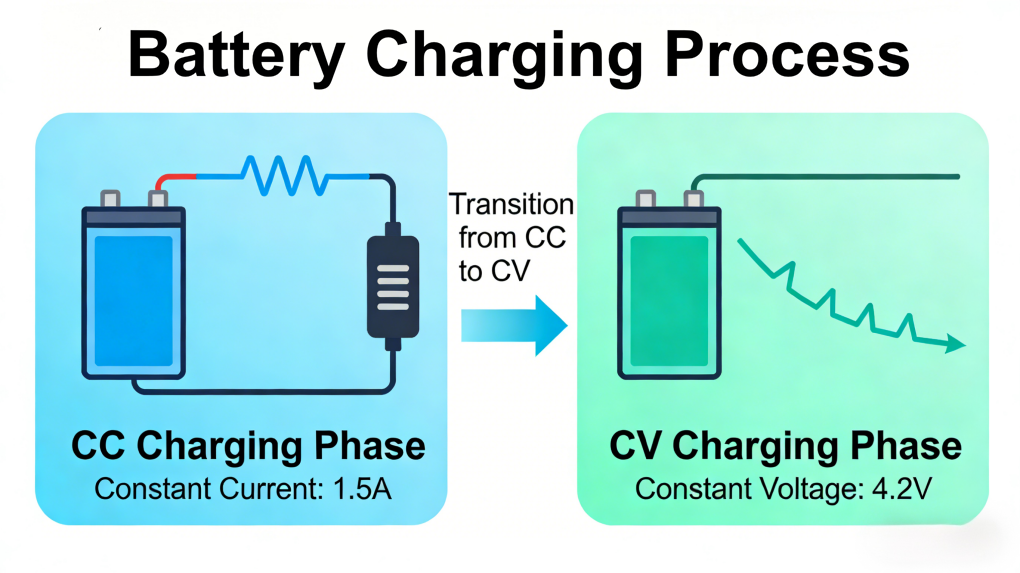
In lithium-ion battery systems, one charging method has become the global standard:
CC-CV charging (Constant Current → Constant Voltage)
Whether it’s electric vehicles, drones, robotics, or energy storage systems, almost all lithium batteries follow this charging logic.
But why is this two-stage process necessary? Why not charge with constant current only—or constant voltage only?
To answer this, we need to look deeper into electrochemistry, safety constraints, and system-level optimization.
1. The Core Nature of Lithium Battery Charging
At its essence, charging a lithium-ion battery is:
the process of moving lithium ions from the cathode to the anode and storing them in the anode structure
This process is governed by three key constraints:
- Diffusion speed of lithium ions
- Electrode material stability
- Voltage limits of the electrolyte system
Unlike simple capacitors, lithium batteries cannot accept unlimited current or voltage without consequences.
2. What Happens If We Only Use Constant Current (CC)?
Let’s imagine charging a battery using constant current only, without switching to constant voltage.
At the beginning:
- Battery voltage is low
- Internal resistance is relatively stable
- The battery can safely accept high current
But as charging progresses:
- Cell voltage rises continuously
- The battery approaches its upper voltage limit (e.g., 4.2V for many Li-ion cells)
If current continues unchanged:
👉 Voltage will exceed the safe limit
⚠️ Risks of Overvoltage
Once the voltage exceeds the safe threshold:
- Electrolyte begins to decompose
- Cathode structure becomes unstable
- Lithium plating may occur on the anode
- Gas generation and swelling increase
- Thermal runaway risk rises sharply
👉 This is why constant current alone is unsafe
3. What Happens If We Only Use Constant Voltage (CV)?
Now let’s consider the opposite case:
Charging with constant voltage only from the beginning.
At the start:
- Battery voltage is low
- Difference between charger voltage and battery voltage is large
👉 This causes a very high inrush current
⚠️ Risks of High Initial Current
- Excessive current can damage electrode structure
- Rapid lithium deposition may occur
- Heat generation spikes
- Battery lifespan degrades
👉 This is why constant voltage alone is also unsafe
4. The Logic of CC-CV Charging
To balance efficiency, safety, and battery life, the industry converged on a two-stage method:
Stage 1: Constant Current (CC)
At the beginning of charging:
- Battery voltage is relatively low
- The battery can safely accept higher current
So we apply:
A fixed current (e.g., 0.5C, 1C, or higher depending on design)
What happens in this stage?
- Lithium ions move steadily into the anode
- Voltage gradually rises
- Charging speed is maximized
👉 This stage delivers most of the charging energy efficiently
Stage 2: Constant Voltage (CV)
When the battery reaches its upper voltage limit:
- Charger switches from constant current to constant voltage
Example: 4.2V per cell
Now:
- Voltage is fixed
- Current gradually decreases
What happens in this stage?
- Lithium ions continue to diffuse into deeper anode sites
- The battery approaches full capacity
- Charging becomes slower and more controlled
👉 This stage ensures safe and complete charging without overvoltage
5. Why the Current Must Decrease in the CV Stage
As the battery becomes nearly full:
- Available insertion sites for lithium decrease
- Diffusion becomes slower
- Internal resistance effectively increases
If high current is forced at this stage:
👉 Lithium cannot intercalate fast enough 👉 It starts depositing as metallic lithium (lithium plating)
⚠️ Lithium Plating Risks
- Permanent capacity loss
- Increased internal resistance
- Dendrite formation
- Internal short circuit risk
👉 CV stage prevents this by gradually reducing current
6. A More Intuitive Way to Understand CC-CV
You can think of charging a lithium battery like filling a sponge with water:
- At the beginning → sponge is dry → can absorb water quickly → high flow (CC)
- Near saturation → absorption slows → must reduce flow → gentle filling (CV)
If you keep forcing water at high pressure at the end:
👉 Water spills or damages the structure
That’s exactly what happens inside a battery.
7. Impact on Battery Performance and Lifespan
The CC-CV strategy directly affects:
🔋 Charging Speed
- CC stage = fast energy input
- CV stage = slower but necessary completion
🔁 Cycle Life
- Proper CV control reduces lithium plating
- Extends battery lifespan
🔥 Thermal Behavior
- Limits overheating during both early and late charging
🛡 Safety
- Prevents overvoltage and structural damage
8. Why Fast Charging Still Uses CC-CV
Even in fast-charging systems (EVs, drones, robotics):
- Charging starts with higher CC levels (e.g., 2C–6C)
- Still transitions to CV near full charge
The difference is:
- Better materials
- Lower internal resistance
- Advanced thermal management
- Smarter BMS control
👉 But the fundamental CC-CV logic remains unchanged
9. Engineering Trade-Off: Speed vs Longevity
From an engineering perspective, charging is always a trade-off:

That’s why:
- Consumer electronics → prioritize speed
- EVs → balance speed and lifespan
- Energy storage → prioritize lifespan
10. Final Takeaway
The reason lithium batteries use constant current followed by constant voltage is simple but fundamental:
No single charging mode can simultaneously satisfy speed, safety, and electrochemical stability.
- Constant current alone → unsafe (overvoltage risk)
- Constant voltage alone → inefficient and damaging (high initial current)
- CC-CV → the optimal balance
In One Sentence
CC charges the battery quickly, while CV finishes the charge safely.
As battery systems continue evolving—higher energy density, faster charging, and more demanding applications—the CC-CV framework remains one of the most elegant and essential control strategies in modern energy systems.