
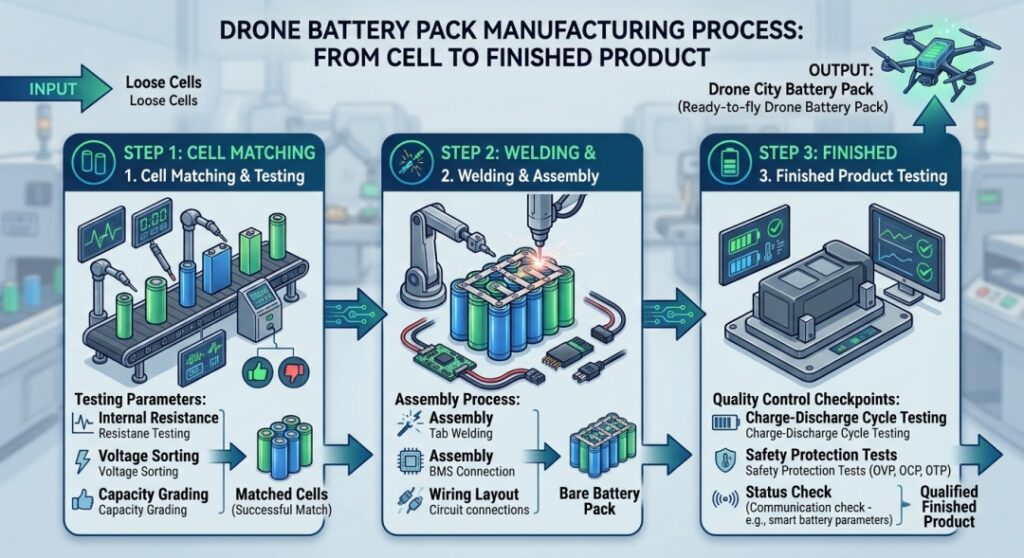
From Cell Matching to Welding and Final Testing: What UAV Manufacturers Should Know About Battery Pack Quality
Introduction: A High-Quality Drone Battery Starts Long Before Its First Flight
When evaluating a drone battery, most buyers focus on a few familiar specifications: capacity, voltage, discharge rate, weight, and energy density.
These parameters are important. But they do not tell the whole story.
Two battery packs can use the same brand of lithium-ion cells, have identical nominal specifications, and still deliver noticeably different performance in actual flight.
One pack may maintain a stable voltage during takeoff and climbing. Another may experience excessive voltage sag under the same load.
One may operate consistently over many cycles. Another may develop increasing cell imbalance, unexpected temperature rise, or intermittent electrical faults.
Why?
Because the quality of a drone battery pack depends not only on the cells inside it, but also on how those cells are selected, connected, assembled, and tested.
For industrial UAV applications, this becomes particularly important.
Agricultural drones, heavy-lift multirotors, inspection UAVs, and VTOL aircraft often operate under demanding electrical and mechanical conditions.
Their batteries must withstand high discharge currents, vibration, temperature changes, and repeated charging cycles.
A small manufacturing defect that might initially go unnoticed can become a serious problem under these conditions.
From individual cells to a flight-ready battery pack, three manufacturing processes deserve particular attention:
1. Cell Matching and Screening
2. Welding and Battery Pack Assembly
3. Final Battery Testing and Quality Verification
Each stage addresses a different source of risk.
And weaknesses in any one of them can affect the performance of the entire battery pack.
1. Cell Matching: Battery Pack Quality Begins Before Assembly
One of the most important principles in lithium battery manufacturing is cell consistency.
A battery pack is rarely made from a single cell.
For example, a 6S2P battery configuration contains six series-connected groups, each consisting of two cells connected in parallel.
In such a system, differences between cells can influence charging behavior, discharge performance, usable capacity, and long-term reliability.
The goal of cell matching is straightforward:
Select cells with sufficiently similar electrical characteristics so they can operate together reliably.
This is especially important for high-discharge UAV batteries.
Capacity Matching: Why Small Differences Matter
Capacity is one of the fundamental parameters used for cell matching.
Imagine a battery pack containing several series-connected cell groups.
If one group has lower usable capacity than the others, it may reach its lower voltage limit first during discharge.
Even if the remaining groups still contain usable energy, the battery may need to stop discharging to protect the weakest group.
As a result, the pack cannot fully utilize the energy available in its stronger cells.
The same problem can occur during charging.
A lower-capacity or otherwise mismatched cell group may reach its upper voltage limit earlier, limiting the charging process.
Over time, these differences can contribute to increasing imbalance.
For this reason, battery manufacturers often establish capacity-matching tolerances.
A capacity difference of approximately 1% may be used as a demanding internal screening target for some battery designs.
However, it should not be treated as a universal industry requirement.
The appropriate tolerance depends on cell chemistry, battery architecture, application requirements, and the manufacturer’s validated process.
How Should Capacity Be Tested?
A typical capacity measurement involves controlled charging followed by discharge under defined conditions.
For example, a manufacturer may use a constant-current/constant-voltage charging process followed by a 1C discharge at a controlled ambient temperature.
But the correct test procedure must follow the cell manufacturer’s specifications.
A 1C test can provide a useful capacity reference, yet it does not demonstrate how the cell will behave at the much higher discharge rates encountered in some UAV applications.
For high-power drone batteries, capacity testing and high-rate performance testing serve different purposes.
Capacity matching tells us how much energy the cells can deliver under specified conditions. High-rate testing tells us how effectively they can deliver power under demanding loads.
Both are important.
Internal Resistance: The Hidden Source of Voltage Sag
Internal resistance is another critical matching parameter.
Cells with different resistance values may respond differently to the same current.
A higher-resistance cell can experience greater voltage drop and heat generation.
The approximate relationship is:
Voltage Drop = Current × Resistance
For example, at a discharge current of 100 A:
- A resistance of 2 mΩ produces approximately 0.2 V of voltage drop.
- A resistance of 5 mΩ produces approximately 0.5 V of voltage drop.
These simplified figures illustrate the effect of resistance; actual battery behavior is more complex and changes with operating conditions.
For a high-power UAV, resistance differences can affect voltage stability during takeoff, climbing, and heavy-load operation.
Two commonly discussed resistance measurements are ACR and DCR.
ACR: AC Internal Resistance
ACR is typically measured using a small alternating-current signal at a specified frequency.
It is relatively fast and convenient, making it useful for incoming inspection and production screening.
However, ACR does not fully represent the voltage behavior of a battery under high-current discharge.
DCR: DC Internal Resistance
DCR is commonly estimated from voltage response during a defined current pulse or discharge procedure.
It can provide information that is more directly relevant to certain operating loads.
However, DCR results depend strongly on test conditions, including:
- State of charge
- Temperature
- Pulse current
- Pulse duration
- Measurement timing
Therefore, DCR values are meaningful only when the measurement conditions are clearly defined.
Which Is Better for Drone Battery Matching?
For high-discharge UAV batteries, DCR can provide valuable information about cell behavior under load.
However, this does not mean ACR is useless.
A practical quality-control strategy may use ACR for efficient production screening and DCR for additional characterization or validation.
A matching tolerance such as a 5% resistance spread may be used as an internal engineering target, but the correct acceptance criteria must be validated for the specific battery design.
The important point is not simply choosing ACR or DCR. It is ensuring that the measurements are consistent, relevant, and capable of identifying cells that may behave differently in service.
K-Value Testing: Identifying Abnormal Self-Discharge
Capacity and resistance measurements do not reveal every potential cell defect.
A cell may initially show acceptable capacity and resistance while exhibiting abnormal self-discharge during storage.
This is why some manufacturers use K-value screening.
In battery manufacturing, K-value commonly refers to the rate of open-circuit voltage change over a defined rest period.
A simplified expression is:
K = ΔOCV / Δt
Where:
- ΔOCV is the change in open-circuit voltage.
- Δt is the elapsed rest time.
The measurement conditions are critical.
Cells should be evaluated at comparable states of charge, temperatures, and rest periods.
A cell showing an unusually rapid voltage decline may require additional investigation.
Possible causes include abnormal self-discharge or other cell inconsistencies.
However, K-value alone cannot conclusively diagnose an internal short circuit.
It is a screening indicator rather than a complete failure-analysis method.
Why Does K-Value Matter for UAV Batteries?
Imagine assembling a battery pack from cells that appear similar during initial testing.
After storage, one cell group gradually loses more charge than the others.
When the battery is later used, that group may reach its discharge limit earlier.
The result can be reduced usable capacity, increasing imbalance, or unexpected low-voltage warnings.
For UAV operators, this may appear as reduced flight endurance or inconsistent battery performance.
This is why cell matching should consider more than a single capacity measurement.
Good cell matching combines capacity, resistance, voltage behavior, and traceability.
It also requires consistent testing conditions and appropriate rejection criteria.
2. Welding and Pack Assembly: Where Small Defects Become High-Current Risks
After cell screening and matching, the selected cells are assembled into the required battery configuration.
This stage includes cell arrangement, electrical joining, insulation, protection-circuit integration, and mechanical packaging.
For industrial UAV batteries, assembly quality is especially important because the pack must combine high electrical performance with low weight.
Cell Arrangement and Mechanical Protection
The first task is to arrange the cells according to the required series and parallel configuration.
For example, a 6S2P design contains six series groups with two cells in each group.
The assembly must maintain correct polarity and appropriate electrical isolation.
Engineers must also consider:
- Cell positioning
- Mechanical support
- Insulation
- Vibration resistance
- Thermal management
- Allowance for normal dimensional changes
- Wire routing and strain relief
Weight is a major concern in UAV battery design.
However, reducing mechanical support and insulation solely to save weight can introduce reliability risks.
Pouch lithium-ion cells are particularly sensitive to inappropriate mechanical pressure, sharp edges, and poorly controlled packaging.
The battery structure must protect the cells without imposing unsuitable mechanical constraints.
Electrical Connections: Why Welding Quality Matters
Battery-pack electrical connections must carry the intended current without excessive resistance or mechanical deterioration.
Different cell formats require different joining methods.
For cylindrical-cell packs, resistance spot welding is commonly used for certain nickel or nickel-plated interconnections.
Laser welding may be used for selected cell-terminal and busbar connections.
For pouch-cell packs, ultrasonic metal welding and other suitable joining methods may be used depending on tab material, thickness, and joint design.
The correct joining process depends on the cell format, materials, current requirements, and validated manufacturing procedure.
It is not accurate to assume that every drone battery should use the same welding technology.
The Most Dangerous Defect: A Weak Electrical Joint
One of the most serious assembly problems is an incomplete or unreliable electrical connection.
A joint may look acceptable during visual inspection but have insufficient bonding or excessive electrical resistance.
Under high-current operation, this can become a significant problem.
The resistive heating relationship is:
P = I²R
Where:
- P is heat generated by electrical resistance.
- I is current.
- R is resistance.
Consider a connection carrying 100 A.
If the connection resistance is 0.2 mΩ, resistive power loss is approximately 2 W.
If the resistance increases to 1 mΩ, the loss rises to approximately 10 W.
That is five times as much heat.
The actual temperature rise depends on the connection geometry, thermal environment, and duration of the current.
Nevertheless, the principle is clear.
At high discharge currents, even a small increase in connection resistance can create significant localized heating.
For heavy-lift UAV batteries, this makes connection quality a critical engineering concern.
What Causes Poor Weld Quality?
Depending on the welding process, defects may result from:
- Insufficient welding energy
- Excessive welding energy
- Incorrect pressure
- Poor surface preparation
- Material contamination
- Improper joint alignment
- Worn welding tools
- Inadequate process control
Potential consequences include incomplete bonding, excessive heating, mechanical weakness, and damage to nearby materials.
A weak joint may deteriorate further during vibration and thermal cycling.
Why Visual Inspection Is Not Enough
A weld can appear normal while failing to provide adequate electrical or mechanical performance.
Manufacturers may therefore combine:
- Visual inspection
- Mechanical strength testing
- Electrical resistance measurement
- Process monitoring
- Appropriate sampling and destructive testing
The inspection strategy should reflect the joint’s importance and the risks associated with failure.
Connection Materials Must Match the Current
Another common design problem is using electrical interconnections that are too narrow or too thin for the intended current.
A battery may use cells advertised with a high discharge capability, but that rating does not automatically apply to the complete battery pack.
The pack also contains:
- Cell tabs
- Welded joints
- Busbars
- Wires
- Connectors
- Protection components
Each element contributes resistance and may impose its own current limit.
A battery advertised as capable of high-C discharge must be evaluated as a complete electrical system.
High-performance cells cannot compensate for undersized current paths.
Polarity and BMS Wiring Errors
Electrical assembly also introduces the possibility of incorrect connections.
Potential errors include:
- Reversed polarity
- Incorrect series connections
- Misordered balance leads
- Incorrect temperature-sensor wiring
- Loose monitoring connections
These faults may damage the BMS, produce incorrect measurements, or create hazardous electrical conditions.
Manufacturers should use validated assembly procedures, suitable error-proofing measures, and independent verification where appropriate.
Connection order should follow the specific BMS manufacturer’s instructions rather than a universal wiring sequence.
BMS Integration and Mechanical Reliability
For battery packs equipped with a BMS, voltage-sensing and temperature-sensing connections must remain reliable throughout the battery’s operating life.
Loose or damaged sensing wires can cause:
- Incorrect cell-voltage readings
- Missing cell measurements
- Unexpected protection events
- Unreliable state-of-charge estimates
For UAV applications, vibration and repeated battery handling make strain relief and wire protection particularly important.
Packaging and Pouch-Cell Expansion
Pouch batteries may undergo dimensional changes during normal aging and operation.
Their mechanical support must be designed accordingly.
Excessive compression or poorly distributed mechanical pressure can affect cell performance.
Insufficient support may expose the cells to vibration, abrasion, or impact damage.
The appropriate mechanical design depends on the cell manufacturer’s requirements and the complete battery-pack architecture.
A reliable drone battery pack is not simply a group of cells connected together. It is an integrated electrical, thermal, and mechanical system.
3. Final Battery Testing: Proving the Pack Is Ready for Flight
Even if individual cells pass incoming inspection and the assembly process is carefully controlled, the finished battery must still be tested.
Final testing is the last major opportunity to identify defects before the battery reaches the customer.
It is useful to distinguish between two categories:
Routine production testing, performed according to the manufacturer’s release plan, and type or qualification testing, used to validate a battery design against specified requirements.
These serve different purposes.
Routine Production Testing
Routine testing should verify that each finished pack meets the defined release requirements.
Appearance, Dimensions, and Weight
The battery should be checked for visible damage, incorrect assembly, and labeling errors.
Dimensions and weight are particularly important for UAV applications.
A battery that does not fit the aircraft’s compartment may be unusable.
Unexpected weight differences can also affect aircraft mass and center-of-gravity calculations.
Pack Voltage and Cell-Group Voltage
Total battery voltage and individual series-group voltages should be checked.
Unexpected voltage differences may indicate:
- Cell mismatch
- Assembly errors
- Abnormal self-discharge
- Other electrical problems
However, voltage imbalance alone does not identify the root cause.
Additional investigation may be necessary.
Electrical Resistance
Finished-pack resistance can help reveal excessive electrical losses.
A high value may result from cell resistance, interconnections, wiring, connectors, or other components.
Testing should use a consistent measurement method and defined conditions.
Capacity Verification
A finished battery should be evaluated against its rated capacity under the specified test conditions.
The charging and discharging procedures must be appropriate for the cell chemistry and product design.
A capacity test is essential, but it is not sufficient to demonstrate high-power performance.
High-Rate Discharge Testing
For industrial UAV batteries, this is one of the most important performance evaluations.
A high-rate discharge test examines how the complete pack behaves under substantial electrical load.
Engineers should evaluate:
- Voltage sag
- Temperature rise
- Usable capacity under load
- Connection behavior
- Protection-system response
- End-of-discharge characteristics
A battery may deliver its rated capacity at a low discharge rate but perform poorly at the current required by a heavy-lift drone.
This is why high-rate testing is important when evaluating advertised discharge capability.
A C-rate printed on a label is not proof that the finished pack can safely sustain the corresponding current.
The complete battery must be validated under the specified conditions.
BMS Functional Testing
For packs with a BMS, relevant functions should be verified.
These may include:
- Overcharge protection
- Overdischarge protection
- Overcurrent protection
- Temperature protection
- Cell balancing
- Communication
- Fault reporting
For smart UAV batteries, communication with the aircraft or charger may also require verification.
The actual test scope depends on the battery architecture and risk assessment.
Insulation and Connector Checks
Insulation performance and connector integrity are important for electrical safety.
Testing may include insulation-resistance measurements, polarity verification, continuity, and appropriate connector checks.
Acceptance limits must come from the applicable product requirements and validated design.
A single insulation-resistance threshold should not be assumed suitable for every UAV battery voltage or construction.
Aging and Reinspection
Some defects become more visible after a period of rest or controlled cycling.
Manufacturers may use aging and reinspection to identify:
- Abnormal self-discharge
- Increasing cell imbalance
- Unexpected resistance changes
- Early performance instability
The appropriate duration and method depend on the production process and product requirements.
Type Testing and Qualification
Routine testing cannot establish every aspect of long-term safety and reliability.
Additional qualification tests may be required for the battery design.
Depending on the application and applicable standards, these may include:
- Cycle-life testing
- High- and low-temperature performance
- Vibration testing
- Mechanical shock or drop testing
- Thermal-abuse evaluation
- Low-pressure testing
- Humidity exposure
- Electrical abuse testing
- Relevant electromagnetic compatibility testing
Not every test applies to every battery design, and destructive abuse tests should not be performed on every production unit.
For UAV applications, low-temperature, vibration, and altitude-related conditions deserve particular attention.
A battery that performs well in a controlled laboratory environment may behave differently during cold-weather or high-altitude operation.
Qualification should reflect the aircraft’s actual operating environment.
4. Common Manufacturing Problems and Their Flight Symptoms
Many battery manufacturing defects are first noticed through changes in operational performance.
Understanding these relationships helps UAV engineers investigate problems more efficiently.

These symptoms are not unique to the listed causes.
A proper investigation should use measurement data and root-cause analysis rather than assuming that one symptom proves one defect.
5. What Should UAV OEMs Ask Their Battery Suppliers?
For UAV manufacturers, battery quality evaluation should go beyond the product specification sheet.
A supplier may provide the required voltage, capacity, dimensions, and discharge rating.
But those specifications do not explain how manufacturing consistency is controlled.
When evaluating a battery-pack supplier, several questions are particularly valuable.
How are cells matched?
Ask whether capacity, internal resistance, voltage behavior, and abnormal self-discharge are considered.
How are electrical connections validated?
Understand which joining methods are used and how joint quality is evaluated.
How is high-current performance verified?
Request test data showing voltage and temperature behavior under relevant discharge conditions.
How are assembly errors prevented?
Ask about polarity verification, BMS connection checks, and electrical inspection.
What testing is performed before shipment?
Distinguish routine production testing from qualification and certification testing.
Can the supplier provide traceable quality records?
Traceability helps identify affected production batches and investigate field failures.
For industrial UAV manufacturers, these questions can reveal more about actual battery quality than an impressive discharge-rate claim alone.
Conclusion: Three Manufacturing Processes, One Objective — Reliable Flight Power
A drone battery pack begins with individual cells.
But turning those cells into a reliable power source requires much more than electrical assembly.
Cell matching establishes a foundation for consistent performance.
Welding and pack assembly create the electrical and mechanical connections that must survive high currents, vibration, and repeated operation.
Final testing verifies that the finished product meets its defined performance and safety requirements.
Each stage addresses different risks.
Poor cell matching can reduce usable capacity and accelerate imbalance.
Weak electrical connections can increase resistance and localized heating.
Inadequate final testing can allow defects to reach the customer.
For high-power industrial UAVs, these issues are particularly important because battery performance directly influences flight endurance, power availability, and operational reliability.
The key lesson is simple:
A high-quality drone battery is not defined only by the quality of its cells. It is defined by the consistency of its cells, the reliability of its connections, and the evidence supporting the finished pack’s performance.
For UAV manufacturers, choosing the right battery therefore means evaluating not only what the battery promises, but also how its quality is controlled and verified.
Standards and Transportation Considerations
Relevant Chinese standards include:
GB 42590—2023: Safety Requirements for Civil Unmanned Aircraft System, a mandatory national standard with a defined scope covering specified civil UAV categories.
GB/T 46460—2025: Specifications of Lithium-Ion Cells and Batteries Used in Unmanned Aerial Vehicles, a recommended national standard effective May 1, 2026.
The applicability of each standard must be evaluated against the actual product and its intended market.
For international transportation, lithium batteries must also satisfy applicable dangerous-goods requirements, including relevant UN Manual of Tests and Criteria Section 38.3 requirements.
Under IATA’s 2026 guidance, lithium-ion batteries shipped separately as UN 3480 are generally required to be offered for air transport at no more than 30% state of charge, subject to the specified approval provisions.
Requirements differ for batteries packed with or contained in equipment, so shipment classification must be confirmed before dispatch.
Damaged, defective, or unsafe batteries require special handling and must not be treated as ordinary lithium-battery shipments.
UniquePower | UAV Battery & Charging Solutions
We support industrial UAV manufacturers and system integrators with battery cell selection, customized battery packs, BMS integration, and charging solutions.
Website: www.uniquepower.net Email: sales@uniquepower.net WhatsApp: +86 178 2175 0340
#DroneBattery #BatteryPackManufacturing #LiPoBattery #UAVEngineering #BatteryQuality #BatteryTesting #BatteryManagementSystem