
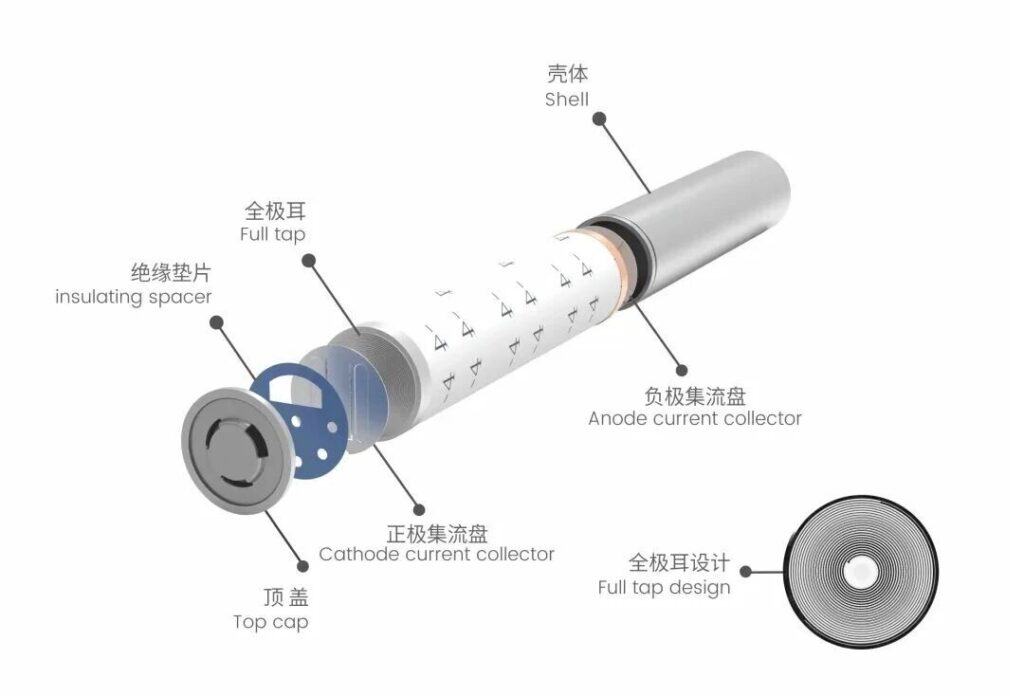
In lithium-ion design, a seemingly “structural” change is quietly reshaping performance ceilings:
Tabless (full-tab) cylindrical cells replace discrete tabs with a full-edge current collection design.
The result is straightforward but powerful:
- Shorter electron paths → lower internal resistance
- Lower I²R loss → less heat
- Higher rate capability → stronger power output
- More uniform current distribution → longer cycle life
This isn’t just a lab improvement. It’s now moving into production across 21700 and 18650 formats, and it’s starting to change how we design packs for tools, robotics, power banks, energy storage—and increasingly, UAVs

1. Where the Market Is Today: 21700 Leads, 18650 Follows
Over the past 12–18 months, we’ve seen 10+ cell manufacturers release tabless cylindrical products.
21700 is clearly the main battlefield:
- 25+ public models
- Capacity ladder: 4.0Ah → 6.0Ah
- Growing share of ≥5.0Ah high-energy + high-power cells
18650 is catching up:
- ~6 manufacturers, ~10+ models
- Capacity mostly 2.0–3.0Ah
- Noticeable acceleration of new releases since late 2024
What this tells us:
The industry is not experimenting anymore— it is building a complete product matrix from high-rate to high-capacity.
2. Representative Suppliers & Product Direction
A quick scan of the current ecosystem shows how broad the push has become:
- Ampace: JP series (21700/18650 tabless)
- BAK Battery: 40D / 45D / 50D families
- EVE Energy: 40PL / 50PL high-power variants
- Lishen Battery: 40PT / 50PT / 55PT
- Murata Manufacturing: VX40 series
- Great Power, Far East Battery, TenPower and others are also expanding rapidly
Across suppliers, one pattern is consistent:
The same form factor is now expected to deliver BOTH energy density and power density.
That expectation didn’t exist a few years ago.
3. Why Tabless Is Winning: It Solves a System Problem
From an engineering standpoint, tabless design is not just about the cell—it solves a pack-level problem:
1) Thermal bottlenecks in high-power packs
- Traditional tab design creates localized current concentration
- Leads to hotspots and uneven aging
👉 Tabless distributes current → more uniform thermal field
2) High-rate discharge limitations
- UAVs, power tools, robotics often operate at 5C–20C bursts
- Tab resistance becomes a limiting factor
👉 Tabless reduces internal resistance → higher usable power per cell
3) Cycle life under stress
- High current + high temperature = accelerated degradation
👉 Lower heat + uniform current → slower degradation under real load
4. What This Means for UAV Battery Systems
From my perspective as a UAV battery solution providers, this shift is particularly important.
Because drones are not “energy-limited” systems anymore.
They are power-limited AND thermal-limited systems.
In UAV applications, tabless cells bring three direct advantages:
1) Higher burst power without oversizing the pack
- Less need to parallel more cells just to meet peak current
- Enables lighter packs
2) Lower temperature rise during aggressive flight
- Especially in: Takeoff Climb Wind resistance maneuvers
👉 Better thermal stability = more predictable flight performance
3) Improved consistency across cycles
- Less imbalance growth
- More stable internal resistance over time
👉 Critical for fleet-level operations
5. Application Expansion: Where Tabless Is Going Next
The growth path is already visible:
🔧 Power Tools
- High current demand + compact size
- Expected penetration: >50% in 3 years
🤖 Robotics
- Increasing demand for: high power density long cycle life
👉 5.0Ah+ 21700 tabless cells becoming key candidates
🔋 Power Banks & Consumer Electronics
- Fast-charging systems pushing for higher C-rate
- Tabless 18650 gaining traction in premium segments
✈️ Emerging Applications
- eVTOL
- UAV systems
- Data center BBU (Battery Backup Units)
👉 All share one requirement:
High power + high safety + high consistency
6. What Still Needs to Be Solved
Tabless is not a magic bullet.
There are still real challenges:
- Manufacturing yield and consistency
- Edge current collection reliability
- Cost vs conventional cells (for now)
- Pack integration optimization
But the direction is clear:
As manufacturing matures, cost will drop— and tabless will become the default for high-power systems.
7. Final Takeaway
From a market and engineering perspective:
Tabless is not just a “better cell” — it is a better system enabler.
And in high-power applications like UAVs:
It directly translates into:
- lighter packs
- higher peak power
- better thermal behavior
- longer usable life
From My Side (UAV Battery Experts Perspective)
When we evaluate cells for drone applications today, the question is no longer:
“What is the highest capacity?”
But rather:
“What is the best balance of power, heat, and consistency under real flight conditions?”
And increasingly, the answer points to:
Tabless cylindrical cells—especially in the 21700 format.
Looking Ahead
As scale improves and costs decline, I expect:
Tabless cells to replace traditional tabbed cells in most high-power lithium applications within the next 3–5 years.
The transition has already started.
If you are working on:
- UAV systems
- Robotics
- High-power battery packs
and are evaluating next-generation cell platforms, feel free to connect—happy to exchange insights from real project cases.
For more information about tabless battery, please click below articles:
What Is a Tabless Battery, and Why Is It Reshaping High-Power Lithium Systems?
#BatteryTechnology #TablessBattery #21700 #UAVBattery #DroneTechnology #EnergyStorage #BatteryEngineering #PowerElectronics
