
For years, the electric vehicle industry has been playing a game of inches—squeezing out incremental gains in energy density while battling the fundamental limitations of lithium-ion chemistry.
That game just changed.

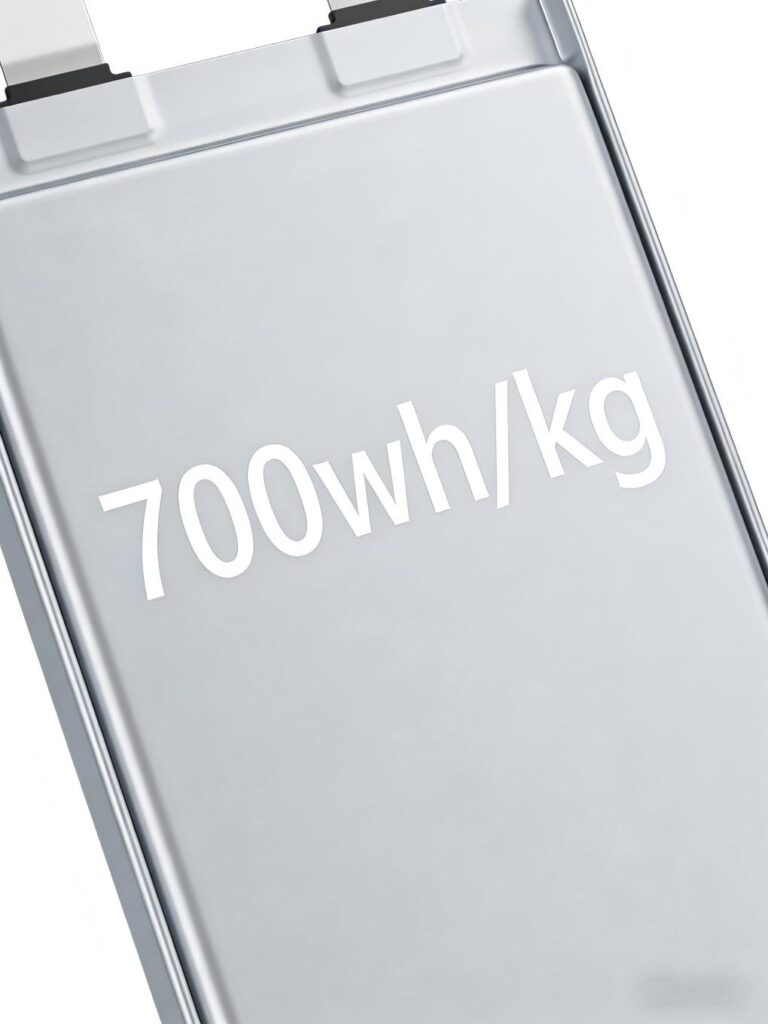
A team led by Academician Jun Chen and Researcher Qing Zhao at Nankai University, in collaboration with the Li Yong team at the Shanghai Institute of Space Power-Sources, just published a landmark paper in Nature. They have successfully developed a lithium-metal battery with a room-temperature energy density of 700 Wh/kg.


Let’s put that number into perspective for every EV owner and industry professional:
- Mainstream ternary lithium batteries: 250–350 Wh/kg
- Second-generation blade batteries: 160–210 Wh/kg
- All-solid-state batteries (the industry’s holy grail): 400–600 Wh/kg

This breakthrough effectively doubles the ceiling of what we thought was possible for mass-produced battery energy density.
But the specs get even more interesting when you factor in extreme cold weather performance.
At -50°C, this battery still delivers 400 Wh/kg—a figure that exceeds the room-temperature performance of most batteries on the road today. For context, that’s a direct solution to the “range anxiety in winter” problem that has plagued Northern EV owners since the dawn of electrification.
How did they solve the two biggest bottlenecks?
Historically, high-energy-density batteries have been stuck between a rock and a hard place: lithium dendrite growth (which causes safety risks) and poor low-temperature performance (where the electrolyte becomes sluggish).
The Nankai team broke away from conventional electrolyte systems entirely. They developed a novel fluorine-coordinated electrolyte—essentially building a highway for lithium ions that doesn’t freeze in the arctic. To tackle dendrites, they introduced a self-healing dual-layer protective film, effectively curing the root cause of lithium-metal instability.
What does this mean for the user experience?
Imagine pairing a 700 Wh/kg cell with the ultra-fast charging technology recently rolled out by BYD.
- Range: A battery pack of equivalent weight to today’s standard could achieve 2,000 km CLTC range (roughly 1,250 miles). To visualize that: a drive from Beijing to Shenzhen (2,100 km) would require almost no mid-journey charging.
- Charging: For longer trips where you do need to stop, we’re looking at 10 minutes to replenish over 1,000 km of range.
If this combination reaches mass production, it doesn’t just close the gap with internal combustion engines—it erases it.
The Road Ahead (The Reality Check)
Before we get too excited, it’s important to note the timeline. This 700 Wh/kg cell is currently in the laboratory validation phase.
- 2026–2028: Expected to debut in specialized sectors like drones and aerospace, where energy density is the single most critical metric.
- 3–5 years: Gradual path toward consumer automotive applications.
Meanwhile, BYD’s flash-charging infrastructure is just beginning its rollout. The convergence of ultra-high-density cells and ultra-fast charging networks will define the next era of mobility.
We are looking at the end of “range anxiety” as we know it. The question is no longer if batteries can outperform gasoline, but how fast the supply chain can scale this technology.
