
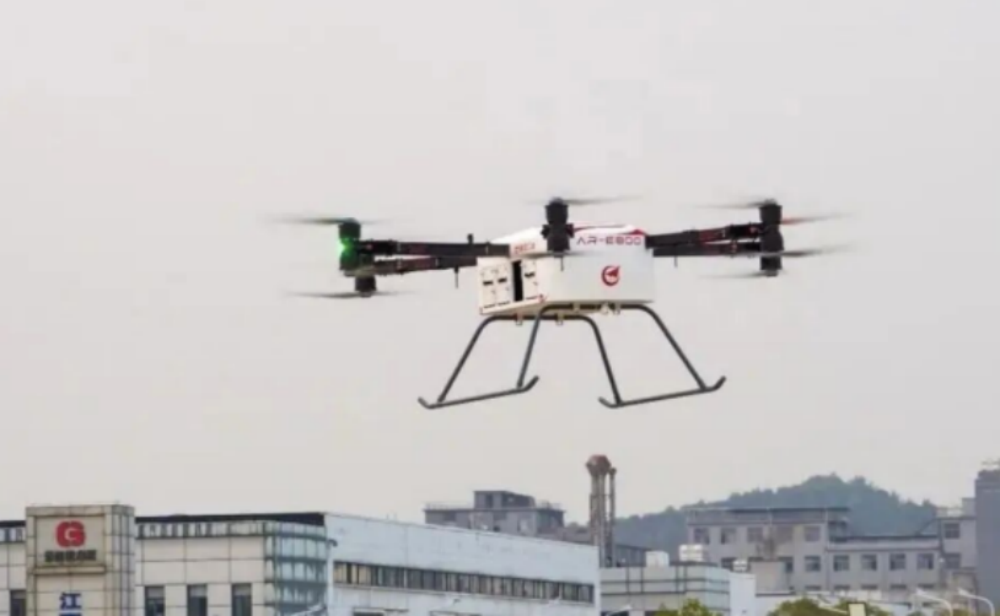
On April 22, 2026, China’s first domestically produced heavy-lift eVTOL, the AR-E800, successfully completed its maiden flight. At the core of this aircraft is an 800V high-voltage platform battery pack, independently developed by Changhong Power, overcoming major technical challenges including high-voltage insulation, thermal management, and weight optimization. This battery serves as the aircraft’s reliable “heart,” signaling that batteries are no longer mere components—they are now the technological battleground shaping business models.
The Enduring Challenge: Range and Flight Duration
Despite major advancements in flight control chips and algorithms over the past five years, drone endurance remains a persistent bottleneck:
- Consumer drones typically fly 20–30 minutes per battery.
- Industrial drones usually last 40–50 minutes.
- Early eVTOL prototypes targeting 100–200 km flight routes often need to land after less than 40 minutes to recharge.

The root cause is the limited energy density of current lithium batteries, which is approaching theoretical limits. Unlike ground vehicles, low-altitude aircraft require continuous high thrust for takeoff, hovering, and landing, while also demanding lightweight, low-energy-consumption solutions. The energy requirements for drones are an order of magnitude higher than for cars, making battery performance the critical constraint.
Current commercial eVTOL cells exceed 300 Wh/kg, enough for demonstration flights. However, urban air mobility will require energy densities of 400–500 Wh/kg or higher.

The Standardization Gap
Beyond physical limits, the lack of tailored standards remains a challenge. Low-altitude flight exposes batteries to extreme weather and temperatures, yet existing standards do not fully address aviation-specific requirements. Fragmented R&D and the absence of dedicated testing, fault diagnostics, and certification protocols drive higher costs and slower commercialization.
As highlighted by Yao Jinjian, Director of Hefei Guoxuan Machining Engineering Center, during China’s 2026 Two Sessions, the energy supply for low-altitude aircraft lags behind airframe development in technology, infrastructure, and standards—a potential safety hazard and a barrier to industry growth.
Mainstream Battery Technologies for UAVs
Currently, four primary battery technologies dominate UAV applications: lithium polymer (LiPo), lithium-ion, solid-state, and hydrogen fuel cells.
Lithium Polymer (LiPo)
- Most widely used and mature solution.
- Accounted for 79.4% of global UAV battery shipments in 2025.
- Lightweight (15–20% lighter than standard lithium-ion) and high energy density (>250 Wh/kg), making LiPo ideal for weight-sensitive aerial operations.
Lithium-Ion (Li-ion)
- Higher energy density and longer cycle life.
- Significant for long-endurance UAVs, particularly high-altitude inspection and platform drones.
- Maintains stable voltage under medium loads for sustained cruise.
Solid-State Batteries
- Expected to exceed 400 Wh/kg, 50% higher than conventional batteries.
- Challenges: high interface impedance and shorter cycle life.
- Commercial-scale deployment anticipated after 2028.
- Notable collaboration: Enli Power & SF Express Fengyi Technology targeting 480 Wh/kg solid-state UAV batteries with 70% cycle life improvement within three years.
Semi-Solid Batteries
- Use composite electrolytes combining high ionic conductivity with solid-state safety and energy density potential.
- Tianneng and Sunwoda have achieved medium-scale production, with applications in drones and robotics.
- Energy densities of 320–380 Wh/kg already powering light UAVs and eVTOLs, validated in flights over 100 km.
Hydrogen Fuel Cells
- Offer ultra-long endurance, rapid refueling, and wide temperature adaptability.
- Example: hydrogen-powered drones achieve 9 hours of flight with 3–5 minutes of refueling, stable between -40°C to 45°C.
- Hybrid architectures (Li batteries for peak power, hydrogen for cruise) recognized as the optimal energy solution.
- Solar-assisted hybrids further improve energy efficiency and extend flight time by 10%+.

Who’s Driving the Battery Revolution?
The UAV battery market is defined by market concentration at the top and a long tail of niche players.
- In 2025, global UAV smart battery revenue reached CNY 14.74 billion, projected to exceed CNY 32.02 billion by 2032 (CAGR 11.1%).
- Top manufacturers, including CATL (ATL) and Sunwoda, account for ~38–40% market share.
Leading companies are overcoming traditional limitations:
- InnoCharge: solid-state batteries >450 Wh/kg, with thousand-unit deliveries by Q4 2026.
- Ganfeng Lithium: solid-state UAV solutions in collaboration with eVTOL manufacturers.
- Changhong Power: 800V high-voltage platforms delivering 50% more power and improving energy utilization.
Conclusion
In UAVs and eVTOLs, battery technology is the strategic core of innovation, defining range, reliability, and operational efficiency. From high-voltage platforms to fast-charging smart batteries, the era when batteries were secondary components is over—they are now the “heart” of the low-altitude aviation revolution.
At Unique Power, we deliver complete drone power solutions built on quality, testing, and precision. Our commitment to UAV innovation ensures that your drones stay powered, connected, and mission-ready.
Email: sales@uniquepower.net
WhatsApp/Tel: +86-178-2175-0340
#UAVBattery #eVTOL #DroneTechnology #EnergyStorage #LithiumPolymer #SolidStateBattery #HydrogenFuelCell #UrbanAirMobility #BatteryInnovation #AviationTech