

1. Introduction to BVLOS Technology
The commercial drone industry is on the cusp of a revolutionary leap, moving from localized, pilot-dependent operations to expansive, automated missions that were once the realm of science fiction. At the heart of this transformation is a critical capability: BVLOS, or Beyond Visual Line of Sight. This technology represents the next evolutionary stage in unmanned aerial systems, enabling drones to operate beyond the pilot’s direct visual range while maintaining safety and operational efficiency.
2. Technical Definition and Regulatory Framework
2.1 What Does BVLOS Mean?
BVLOS stands for Beyond Visual Line of Sight. It refers to the operation of an unmanned aircraft system (UAS) where the remote pilot-in-command (PIC) does not maintain direct, unaided visual contact with the drone. According to FAA regulations, this means the aircraft is flown at distances where the pilot cannot visually determine its orientation, position, or flight path without technological assistance.
2.2 Regulatory Standards
The Federal Aviation Administration (FAA) has established specific guidelines for BVLOS operations under Part 107 of the Federal Aviation Regulations. These regulations require:
◆ Advanced detect-and-avoid systems
◆ Redundant communication links
◆ Comprehensive risk assessment protocols
◆ Special certification for remote pilots
*Source: FAA Advisory Circular 107-2, Small Unmanned Aircraft Systems*
3. Key Technological Requirements
3.1 Advanced Sensor Systems
BVLOS drones require sophisticated sensor packages including:
◆ LiDAR and radar systems for obstacle detection
◆ Multi-spectral cameras for environmental monitoring
◆ Advanced GPS and inertial navigation systems
◆ Real-time data transmission capabilities
3.2 Communication Infrastructure
◆ Redundant data links (satellite and cellular)
◆ Secure communication protocols
◆ Low-latency video transmission systems
◆ Automated fail-safe mechanisms
4. Battery Technology Requirements for BVLOS Operations
4.1 Performance Specifications
4.2 Critical Battery Features for BVLOS
4.2.1 High Energy Density
BVLOS missions require batteries with significantly higher energy density to support extended flight times of 2-6 hours, compared to typical VLOS flights of 20-30 minutes.
4.2.2 Enhanced Safety Features
◆ Thermal runaway prevention systems
◆ Advanced battery management systems (BMS)
◆ Redundant cell architecture
◆ Fire-resistant casing materials
4.2.3 Environmental Resilience
Batteries must maintain performance in extreme conditions including:
◆ High altitude operations
◆ Wide temperature variations (-20°C to 60°C)
◆ Humidity and precipitation exposure
5. Comparative Analysis: BVLOS vs. VLOS Battery Requirements
5.1 Performance Comparison
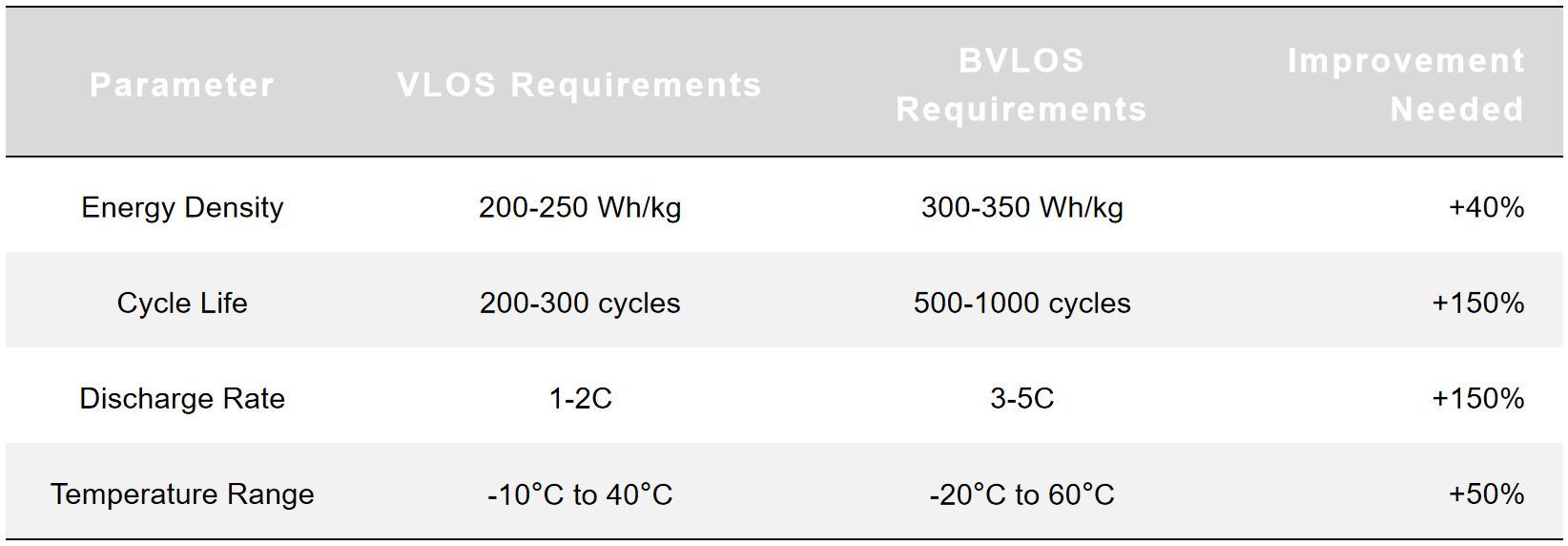
VLOS Battery Characteristics:
◆ Typical flight time: 20-30 minutes
◆ Energy density: 200-250 Wh/kg
◆ Moderate discharge rates (1-2C)
◆ Basic thermal management
◆ Standard cycle life (200-300 cycles)
BVLOS Battery Requirements:
◆ Extended flight time: 2-6 hours
◆ High energy density: 300-350 Wh/kg
◆ High discharge rates (3-5C)
◆ Advanced thermal management
◆ Extended cycle life (500-1000 cycles)
5.2 Technical Challenges
The transition to BVLOS operations presents several battery technology challenges:
◆ Weight optimization for extended range
◆ Power consistency during long-duration flights
◆ Rapid charging capabilities for operational efficiency
◆ Integration with power management systems
6. UniquePower Advanced Battery Solutions for BVLOS Drones
6.1 Semi-Solid State Battery Technology
UniquePower‘s innovative semi-solid state batteries represent a breakthrough in BVLOS power technology, offering:
Key Specifications:
◆ Energy density: 350 Wh/kg (industry leading)
◆ Cycle life: 800+ cycles at 80% capacity retention
◆ Operating temperature: -40°C to 60°C
◆ Discharge rate: Up to 5C continuous
◆ Charging time: 80% charge in 45 minutes
6.2 Technical Advantages
6.2.1 Enhanced Safety Features
◆ Intrinsic thermal stability
◆ Ceramic separator technology
◆ Multi-level protection systems
◆ Fire-resistant electrolyte formulation
6.2.2 Performance Benefits
◆ 40% longer flight time compared to conventional batteries
◆ Consistent power delivery throughout discharge cycle
◆ Excellent low-temperature performance
◆ Minimal capacity degradation over time
6.3 Customization Capabilities
UniquePower offers tailored battery solutions including:
◆ Custom form factors for specific drone models
◆ Integrated battery management systems
◆ Smart monitoring and diagnostics
◆ Rapid prototyping services
7. Applications and Industry Impact
7.1 Key Application Areas
7.1.1 Infrastructure Inspection
◆ Power line monitoring (100+ km range)
◆ Pipeline inspection
◆ Railway and highway surveillance
7.1.2 Agricultural Operations
◆ Large-scale crop monitoring
◆ Precision spraying operations
◆ Soil analysis and mapping
7.1.3 Emergency Services
◆ Search and rescue operations
◆ Disaster assessment
◆ Medical supply delivery
7.2 Economic Impact
The implementation of BVLOS technology with advanced battery systems enables:
◆ 60% reduction in inspection costs
◆ 80% improvement in operational efficiency
◆ 50% reduction in human risk exposure
◆ Significant environmental benefits through reduced fuel consumption
8. Future Developments and Trends
8.1 Technology Roadmap
Near-term (2024-2026):
◆ Energy density targets: 400 Wh/kg
◆ Fast charging capabilities (15 minutes to 80%)
◆ Enhanced AI-powered battery management
Long-term (2027-2030):
◆ Solid-state battery implementation
◆ Wireless charging systems
◆ Hybrid power systems integration
8.2 Regulatory Evolution
The FAA and other international aviation authorities are continuously updating regulations to accommodate advancing BVLOS technologies while maintaining safety standards.
9. Conclusion
The evolution of BVLOS drone technology represents a transformative advancement in unmanned aerial systems. The successful implementation of these systems fundamentally depends on advanced battery technology that can meet the demanding requirements of extended-range operations.
UniquePower’s semi-solid state battery technology, with its industry-leading energy density of 350 Wh/kg and enhanced safety features, provides the ideal power solution for BVLOS applications. Our batteries enable longer flight times, improved safety, and greater operational efficiency, making them the perfect choice for next-generation drone operations.