
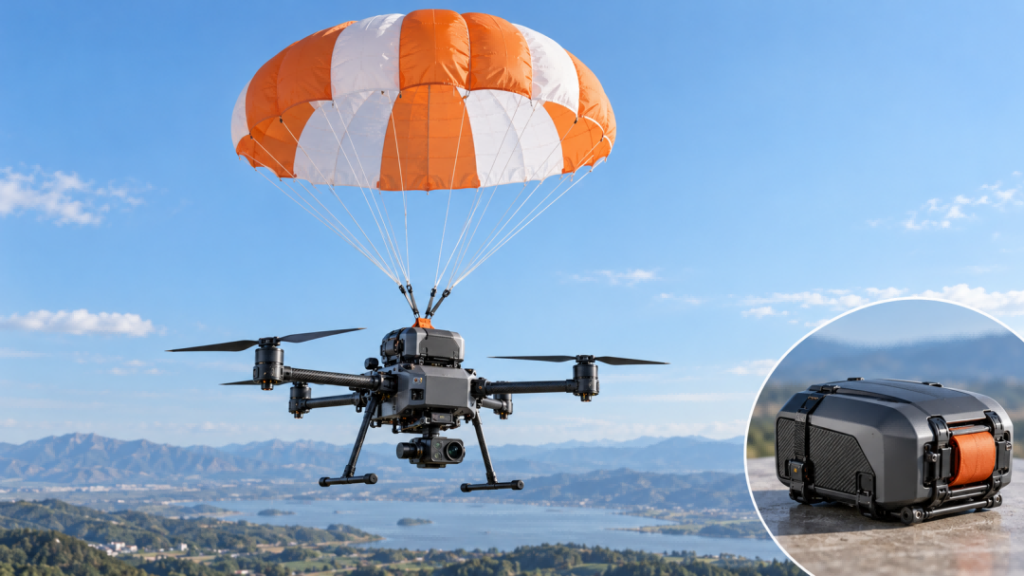
How China’s MH/T 6140—2026 Standard Is Reshaping Parachute System Design, Emergency Power Architecture, and Ground Risk Management for Industrial UAVs
Introduction: Is a Parachute Becoming Essential for Industrial Drones?
For years, installing a parachute on a drone was largely considered an additional safety precaution.
Some UAV manufacturers offered parachute systems as optional accessories. Certain professional operators installed them to reduce the consequences of an unexpected loss of flight control. Others relied primarily on flight-controller redundancy, propulsion reliability, and operational restrictions.
But the industry is changing.
As drones become larger, carry heavier payloads, and operate closer to populated areas, the consequences of an uncontrolled descent become increasingly serious.
A small consumer drone crashing in an isolated field presents a different risk from a heavy industrial UAV operating above roads, buildings, or logistics facilities.
For drone manufacturers and operators, the central question is no longer simply:
“Should we install a parachute?”
It is becoming:
“How can we demonstrate that our emergency recovery system is reliable, independently powered, and appropriate for the aircraft’s operating environment?”
China has taken an important step toward answering that question.
On January 11, 2026, the Civil Aviation Administration of China (CAAC) issued MH/T 6140—2026, Specification for Civil Unmanned Aircraft Parachute System.
The standard took effect on February 1, 2026.
It establishes a technical framework for parachute systems used with micro, light, small, and medium civil unmanned aircraft.
For UAV manufacturers, parachute suppliers, system integrators, and battery engineers, this development deserves attention.
It represents a shift from treating parachutes primarily as accessories toward evaluating them as engineered aircraft safety systems.
1. A New UAV Parachute Standard Takes Effect in China
1.1 What Is MH/T 6140—2026?
MH/T 6140—2026 is a civil aviation industry standard issued by the CAAC.
Its official English title is:
Specification for Civil Unmanned Aircraft Parachute System
The standard addresses parachute systems matched to specific unmanned aircraft and provides requirements concerning system composition, technical performance, and verification methods.
Its stated application covers the design, production, verification testing, and operational risk assessment of parachute systems for micro, light, small, and medium civil unmanned aircraft.
The covered aircraft categories extend through the medium-UAV category, commonly associated with a maximum takeoff mass not exceeding 150 kg under China’s classification framework.
The official release and implementation dates are:
- Publication: January 11, 2026
- Implementation: February 1, 2026
- Standard number: MH/T 6140—2026
- Issuing authority: Civil Aviation Administration of China
Official source: CAAC — MH/T 6140—2026
1.2 Why Is This Standard Important?
Historically, parachute standards have often focused on manned aviation, personnel parachutes, or other established aviation applications.
Industrial UAVs introduce different design challenges.
A multirotor drone does not behave like a conventional aircraft during a propulsion failure.
A fixed-wing VTOL platform may experience different failure conditions during vertical takeoff, transition, cruise, and landing.
A heavy-lift drone carrying external equipment introduces additional considerations involving mass distribution and suspended loads.
These aircraft require parachute systems that are evaluated against their specific flight characteristics.
A technical standard helps manufacturers and operators establish a more consistent basis for design and verification.
Instead of relying solely on product descriptions or supplier claims, engineering teams can assess a parachute system against defined technical requirements and test methods.
This matters for aircraft development, supplier qualification, and operational risk assessment.
1.3 Does the Standard Make Parachutes Mandatory for Every Drone?
No.
This distinction is essential.
MH/T 6140—2026 is classified as a recommended civil aviation industry standard, rather than a universal national mandate requiring every drone to carry a parachute.
Its existence does not automatically mean that every UAV below 150 kg must install one.
Specific operational approvals, aircraft certification requirements, and applicable local rules must be evaluated separately.
However, the standard provides a recognized technical reference when parachute systems are selected, designed, or assessed.
That alone is a meaningful development for the industry.
2. A Parachute System Is More Than a Fabric Canopy
When people think of a drone parachute, they often imagine a folded canopy that opens during an emergency.
In reality, an effective recovery system is much more complex.
The framework described in the supplied technical discussion divides the system into four major elements:
1. Parachute assembly
The canopy and associated components responsible for creating aerodynamic drag and reducing descent speed.
2. Suspension system
The lines, attachment points, and structural interfaces that transfer deployment and descent loads to the aircraft.
3. Deployment system
The mechanism that releases or launches the parachute.
4. Control system
The electronics and logic responsible for detecting relevant failure conditions and initiating deployment.
All four elements must work together.
A parachute with an excellent canopy may still fail if the deployment mechanism does not activate.
A reliable deployment mechanism cannot compensate for weak structural attachment points.
An advanced control algorithm is ineffective if it loses electrical power at the same moment as the aircraft’s main propulsion system.
Parachute reliability is therefore a system-level engineering problem, not merely a component-level performance specification.
3. Why Independent Deployment Control Matters
One of the most important principles highlighted in the discussion of MH/T 6140—2026 is the independence of emergency deployment capability.
Consider a common UAV failure scenario.
A multirotor aircraft is operating above an industrial facility.
Its main propulsion battery experiences a serious electrical fault.
The battery protection system disconnects the power output, or the aircraft loses its primary electrical bus.
Within moments, propulsion is unavailable.
If the parachute controller depends entirely on that same failed power source, it may also become unavailable.
The aircraft has lost both its normal flight capability and its emergency recovery capability.
This is a dangerous example of a common-cause failure.
3.1 Why a Separate Control System Is Valuable
An independently functioning parachute controller can reduce dependence on the aircraft’s primary flight-control system.
Depending on the architecture, it may monitor relevant information through dedicated sensors or independent detection logic.
Possible inputs include:
- Aircraft attitude
- Angular velocity
- Abnormal acceleration
- Descent behavior
- Loss of relevant electrical power
- Other validated flight-failure indicators
The appropriate triggering logic depends on the aircraft type and operating conditions.
For example, a rapid attitude change may be abnormal for a hovering multirotor but could be part of a different aircraft’s authorized maneuver.
Therefore, automatic deployment logic must be designed to distinguish actual emergencies from normal flight behavior.
3.2 Why Independent Power Is Equally Important
A separate controller still needs electrical energy.
If its power supply fails together with the aircraft’s main battery, control independence alone is insufficient.
This creates an important design requirement:
The emergency recovery system should remain capable of performing its required functions after relevant failures of the primary aircraft power system.
An independent power source is one way to address that requirement.
For battery engineers, this creates a specialized application for compact, reliable backup power.
4. The Role of Backup Batteries in UAV Parachute Systems
A parachute deployment system may require relatively little total energy compared with the aircraft’s propulsion system.
However, the power requirements can be demanding in other ways.
The backup battery may need to remain ready for long periods and then deliver power immediately during an emergency.
4.1 Energy Capacity Is Only One Requirement
The energy needed by an emergency system depends on the complete electrical architecture.
Potential loads include:
- Control electronics
- Sensors
- Communication interfaces
- Status monitoring
- Deployment actuators
- Release or initiation mechanisms, where applicable
The backup power source must support the required functions for the specified operating duration.
The design should include appropriate energy margins for aging, temperature, and other relevant conditions.
4.2 Peak Power Capability
Some deployment mechanisms may require short-duration power pulses.
This means battery selection cannot be based only on nominal capacity.
Engineers must also evaluate:
- Peak discharge capability
- Voltage stability
- Internal resistance
- Operating temperature
- Battery age
- Connection reliability
A small battery with adequate stored energy may still be unsuitable if it cannot support the required instantaneous electrical load.
4.3 Low-Temperature Performance
Industrial UAVs may operate in cold environments.
At low temperatures, lithium-ion batteries can experience increased internal resistance and reduced available power.
For an emergency recovery system, these characteristics matter because the battery may need to operate without warning.
A suitable backup power design must be validated across the aircraft’s specified operating temperature range.
4.4 Long-Term Readiness
An emergency battery may remain unused for extended periods.
That creates requirements different from those of a propulsion battery that is regularly charged and discharged.
Important considerations include:
- Self-discharge
- Storage conditions
- State-of-charge monitoring
- Replacement intervals
- Periodic functional checks
- Aging under environmental exposure
4.5 Electrical Isolation
A separate battery does not automatically create a fully independent emergency system.
If the backup power path shares vulnerable wiring, connectors, protection devices, or control electronics with the primary system, a single failure may still disable both.
The complete architecture must be evaluated for common-cause faults.
For UAV parachute applications, backup battery reliability should be assessed through the entire emergency power chain—not simply through cell specifications.
5. Parachute Performance: What Must Engineers Verify?
Installing a parachute is only the beginning.
The real question is whether the system can perform as intended under relevant emergency conditions.
Several engineering factors are particularly important.
5.1 Structural Strength
Deployment can impose substantial transient loads on the aircraft.
The suspension lines, attachment points, and supporting airframe structure must tolerate the relevant forces.
The supplied discussion of MH/T 6140—2026 identifies differentiated strength safety factors for aircraft categories, including a factor of 1.5 for medium-UAV applications and 2 for other covered categories.
Engineers should consult the official standard for the precise definitions, loading conditions, and calculation methods before using these figures in a compliance assessment.
5.2 Stabilized Descent Speed
After deployment, the parachute must reduce the aircraft’s descent speed.
A simplified steady-state relationship is:
[ mg=\frac{1}{2}\rho C_D A v^2 ]
Where:
- (m) = descending mass
- (g) = gravitational acceleration
- (\rho) = air density
- (C_D) = effective drag coefficient
- (A) = reference canopy area
- (v) = stabilized descent speed
Rearranging:
[ v=\sqrt{\frac{2mg}{\rho C_D A}} ]
This simplified model illustrates the relationship between aircraft mass, parachute aerodynamic performance, and descent speed.
It does not capture every aspect of real deployment behavior.
In practice, engineers must also consider canopy inflation, oscillation, wind, aircraft orientation, and other factors.
5.3 Minimum Deployment Altitude
A parachute needs time and altitude to deploy.
If an aircraft experiences a failure too close to the ground, the canopy may not fully inflate before impact.
The minimum effective deployment altitude depends on:
- Initial flight conditions
- Failure detection time
- Deployment initiation delay
- Canopy extraction time
- Inflation behavior
- Aircraft descent characteristics
This is particularly important for low-altitude inspection, delivery, and urban operations.
A parachute system that performs well during high-altitude testing may not provide the same benefit in every low-altitude emergency.
5.4 Deployment Reliability
A reliable system should be evaluated under representative operating conditions.
Testing may need to address:
- Different aircraft masses
- Different flight attitudes
- Different airspeeds
- Different failure conditions
- Relevant environmental conditions
- Mechanical integration
- Electrical power availability
A successful deployment demonstration is valuable, but repeatability and documented verification are equally important.
6. Why Aircraft Weight Changes the Safety Equation
A heavier UAV generally presents greater potential impact energy than a lighter aircraft at the same speed.
The kinetic energy associated with motion is:
[ E_k=\frac{1}{2}mv^2 ]
Where:
- (m) = mass
- (v) = speed
This relationship illustrates why both aircraft mass and impact velocity matter.
Doubling mass doubles kinetic energy when velocity remains unchanged.
Doubling velocity increases kinetic energy by a factor of four.
For UAV parachute systems, reducing impact velocity can therefore be an important risk-mitigation objective.
However, the actual consequences of a ground impact also depend on aircraft geometry, impact angle, exposed structures, and the environment.
6.1 Small Commercial UAVs
Smaller commercial drones may benefit from compact parachute systems where their mission and risk assessment justify the additional equipment.
Weight, installation complexity, and minimum deployment altitude are important considerations.
6.2 Medium Industrial UAVs
Larger industrial platforms may operate with heavier batteries, sensors, and payloads.
Their potential ground impact consequences can be more severe.
Parachute system design becomes increasingly dependent on aircraft mass, structural integration, and deployment performance.
6.3 Heavy-Lift UAVs
Heavy-lift drones create additional challenges.
Their propulsion systems may have high power requirements, and their airframes may carry large or externally suspended payloads.
An emergency recovery system must be evaluated against the aircraft’s complete configuration.
A parachute suitable for an unloaded aircraft may not automatically be appropriate for the maximum takeoff configuration.
6.4 Fixed-Wing VTOL Aircraft
Fixed-wing VTOL aircraft operate across multiple flight regimes.
A recovery system may encounter different conditions during:
- Vertical takeoff
- Hover
- Transition
- Forward flight
- Descent
- Landing
Deployment logic and parachute performance must account for these differences.
The larger and more operationally complex the UAV, the more important aircraft-specific recovery-system engineering becomes.
7. Are Parachutes Mandatory for Drones Above a Certain Weight?
This is one of the most common questions raised by new UAV safety standards.
The answer requires separating three different concepts.
7.1 Technical Standard Applicability
MH/T 6140—2026 provides a technical framework for parachute systems used with specified categories of civil unmanned aircraft.
Its scope should not be confused with a universal installation requirement.
7.2 Aircraft Certification and Airworthiness
Certain UAV categories and operations may be subject to additional airworthiness or certification requirements.
China has also issued AC-21-AA-2026-44, Airworthiness Standards for Restricted-Category Unmanned Aircraft Systems, dated February 12, 2026.
That document addresses a different regulatory function from the parachute system standard.
It should not be interpreted as automatically requiring parachutes on every aircraft above a particular mass.
7.3 Operational Risk Requirements
Operational approval may depend on the risks associated with a specific flight.
Relevant factors can include:
- Aircraft characteristics
- Population exposure
- Flight location
- Operating altitude
- Mission profile
- Emergency procedures
- Available ground-risk mitigations
A parachute may be considered as part of a broader safety strategy.
However, the specific requirements must be determined from the applicable regulatory framework and approval conditions.
As of October 2026, the cited Chinese standard does not establish a nationwide rule that every drone above a single weight threshold must carry a parachute.
8. Urban Drone Operations: Why Ground Risk Is Becoming Central
Urban UAV operations present a different safety challenge from flights over sparsely populated areas.
A drone operating above an unoccupied agricultural field may have more options for an emergency landing.
A delivery drone operating near residential buildings, roads, and pedestrians has fewer safe recovery opportunities.
This changes how manufacturers and operators must think about failure management.
8.1 The Ground Risk Problem
Ground risk depends on more than aircraft reliability.
Even a highly reliable aircraft can experience an unexpected failure.
The potential consequences depend on where that failure occurs.
Important factors include:
- Population density
- Aircraft mass
- Impact energy
- Operating altitude
- Flight route
- Emergency recovery capability
8.2 Why Parachutes Are Attractive
A parachute may reduce descent speed and therefore mitigate some consequences of an uncontrolled descent.
It can provide an additional layer of protection when normal flight control is unavailable.
However, a parachute does not eliminate all risks.
It may not deploy effectively below its minimum operating altitude.
Wind may influence the eventual landing location.
The aircraft may still collide with people or infrastructure.
Therefore, parachutes should be understood as one part of a comprehensive ground-risk mitigation strategy.
8.3 Could Parachutes Become a Requirement for Urban Delivery?
It is reasonable to expect closer scrutiny of emergency recovery capability as urban drone operations expand.
Future operating conditions may place greater emphasis on demonstrated ground-risk mitigation.
Parachutes could become an important compliance or approval consideration for certain aircraft and routes.
But this remains a regulatory and market-development expectation, not a blanket rule that all residential-area drone flights currently require parachutes.
Operators must evaluate the actual requirements of the relevant jurisdiction and flight authorization.
9. What This Means for UAV Manufacturers
For UAV OEMs, the emergence of a dedicated parachute system standard creates several engineering and business considerations.
9.1 Earlier Safety-System Integration
Parachute integration should ideally be considered during aircraft development rather than after the airframe design is complete.
Late integration may create problems involving:
- Available installation space
- Center of gravity
- Structural attachment
- Electrical architecture
- Flight-control interfaces
- Weight
- Aerodynamic interference
Early planning can reduce redesign work.
9.2 Independent Power Architecture
If a recovery system must remain operational after primary power failure, the aircraft electrical architecture must support that objective.
This may require a dedicated backup battery or another appropriately independent energy source.
9.3 Failure Detection and Deployment Logic
Automatic triggering must be designed around actual aircraft behavior.
A system should avoid unnecessary deployment during normal flight while still responding to the defined emergency conditions.
This requires engineering analysis and validation.
9.4 Documentation and Traceability
Manufacturers may need to maintain suitable records covering:
- System configuration
- Component specifications
- Test conditions
- Deployment performance
- Electrical integration
- Maintenance requirements
- Operating limitations
Reliable documentation can support supplier evaluation and operational risk assessments.
9.5 Supplier Qualification
UAV manufacturers should evaluate parachute suppliers based on demonstrated system performance rather than marketing claims alone.
A supplier’s ability to provide test records and integration guidance may become increasingly valuable.
10. A New Opportunity for UAV Battery and Power-System Engineers
Although parachute standards primarily concern aircraft safety, they also have implications for battery-system engineering.
The most important connection is emergency power independence.
Consider three possible electrical architectures.
Architecture A: Shared Main Battery Supply
The parachute controller is powered by the main UAV battery.
This is simple, but it creates dependence on the primary power system.
If the main battery or shared distribution path fails, the recovery controller may lose power.
Architecture B: Main Battery With Backup Energy Storage
The recovery system normally receives power from the main aircraft electrical system but has a separate backup energy source.
The design must ensure that the backup source can operate under the relevant primary-power failure conditions.
Architecture C: Dedicated Independent Recovery-System Power
The parachute controller and required deployment functions use a dedicated power source and appropriately independent circuitry.
This can reduce some common-cause dependencies.
However, the actual level of independence depends on the complete implementation.
Battery Selection Considerations
For a dedicated emergency battery, engineers should evaluate:
Voltage compatibility: Can the battery supply the required operating voltage across its specified discharge range?
Pulse power: Can it support the deployment mechanism’s peak electrical demand?
Temperature performance: Will the system remain functional at the aircraft’s minimum and maximum operating temperatures?
Storage life: Can the battery remain ready during long periods without use?
Monitoring: How will the operator know whether the emergency power source is healthy?
Maintenance: What inspection, charging, or replacement schedule is required?
Electrical protection: Can the battery and its wiring tolerate relevant faults without disabling the emergency system?
For industrial UAV battery suppliers, these requirements represent a specialized engineering application.
The opportunity is not simply to provide a small lithium battery.
It is to support a reliable emergency power solution matched to the aircraft’s safety architecture.
11. Parachutes, Redundant Batteries, and Flight Safety: Different Layers of Protection
Parachutes and redundant battery systems are sometimes discussed as alternatives.
In reality, they address different failure scenarios.
A redundant propulsion battery architecture may help maintain electrical power after certain battery faults.
A parachute may help reduce descent speed when continued controlled flight is no longer possible.
These systems can be complementary.
A simplified safety strategy may include:
Prevention
Reliable cells, appropriate BMS protection, robust electrical connections, and suitable charging practices.
Fault Tolerance
Redundant power paths, fault isolation, and appropriate flight-control or propulsion redundancy.
Emergency Recovery
Independent failure detection, parachute deployment, and controlled emergency procedures.
Ground Risk Mitigation
Flight-route planning, operational restrictions, and emergency landing considerations.
No single layer guarantees complete safety.
For example, an independent parachute battery does not prevent a propulsion failure.
A redundant propulsion battery does not protect against every structural or flight-control failure.
A parachute cannot guarantee a harmless landing.
The engineering objective is to combine suitable protections so that one failure does not necessarily lead to the worst possible outcome.
12. How International UAV Manufacturers Should Interpret China’s New Standard
Although MH/T 6140—2026 is a Chinese civil aviation industry standard, its significance extends beyond the Chinese domestic market.
International UAV manufacturers and system integrators can study it as one example of how emergency recovery systems are becoming more formally defined.
However, companies should avoid assuming that compliance with one national standard automatically satisfies another country’s requirements.
Different jurisdictions may use different approaches to:
- Aircraft certification
- Operational approval
- Ground-risk assessment
- Emergency recovery
- Equipment verification
- Maintenance requirements
European UAV Operations
European operators must consider the applicable EASA regulatory framework, including the requirements associated with their operational category and authorization.
Parachute systems may be relevant to particular risk-mitigation strategies, but their regulatory treatment depends on the operation and applicable means of compliance.
United States UAV Operations
In the United States, parachute systems may be relevant to certain operational approval strategies, including some operations involving flight over people.
However, the requirements depend on the applicable FAA rules and approval pathway.
Other International Markets
For UAV manufacturers supplying customers in the Middle East, Southeast Asia, Africa, and South America, the appropriate approach is to evaluate each target market separately.
A well-documented emergency recovery system can support technical discussions with customers and regulators.
But regulatory acceptance should never be assumed without jurisdiction-specific verification.
13. The Next Competitive Advantage: Verified Safety Performance
A new technical standard does more than introduce engineering requirements.
It can also change how customers evaluate suppliers.
In an immature market, product selection may focus heavily on price, weight, and advertised specifications.
As the market develops, buyers increasingly ask for evidence.
For UAV parachute systems, that evidence may include:
- Deployment test records
- Structural strength verification
- Descent performance measurements
- Minimum deployment altitude evaluation
- Environmental testing
- Electrical independence analysis
- Maintenance documentation
For UAV OEMs, the ability to integrate and document these systems may become an important competitive capability.
Why the Next Few Years Matter
Newly implemented standards often create opportunities for further technical development.
Manufacturers and research organizations may contribute to:
- Improved test procedures
- Application-specific design methods
- Operational risk assessment practices
- Equipment integration guidelines
- Industry technical discussions
Companies that invest in meaningful test data and engineering validation may be better positioned to respond as customer expectations evolve.
This is a strategic opportunity, not a guarantee that every parachute-equipped UAV will receive operational approval.
14. Five Questions Every UAV OEM Should Ask
Before integrating a parachute system into a new aircraft platform, engineering teams should answer five fundamental questions.
1. What Failure Scenarios Must the System Address?
Define the emergencies in which parachute deployment is expected to provide a safety benefit.
2. Can the System Operate After Primary Power Failure?
Evaluate control independence, backup energy, wiring, and shared failure points.
3. Is the Parachute Suitable for the Aircraft’s Maximum Operating Configuration?
Consider aircraft mass, structural loads, payload configuration, and flight characteristics.
4. What Is the Minimum Effective Deployment Altitude?
Ensure that deployment performance is compatible with the intended mission profile.
5. What Test Evidence Supports the Supplier’s Claims?
Request relevant documentation and determine whether testing represents the actual aircraft integration.
These questions can help prevent a common mistake:
Selecting a parachute as an accessory without evaluating it as an integrated safety system.
Conclusion: UAV Parachutes Are Moving From Optional Equipment Toward Engineered Safety Systems
The implementation of China’s MH/T 6140—2026 marks an important step in the standardization of civil UAV parachute systems.
It provides a more structured technical reference for system design, production, verification, and operational risk assessment.
It does not mean that every UAV is now legally required to carry a parachute.
Nor does it mean that parachutes alone can make urban drone operations safe.
But it reflects an important direction in UAV engineering.
As aircraft become heavier and operate in more complex environments, emergency recovery capability is likely to receive greater attention.
For manufacturers, this means considering parachute integration earlier in aircraft development.
For operators, it means evaluating emergency recovery against actual mission risks.
For battery and power-system engineers, it highlights the importance of reliable, appropriately independent backup power.
And for the broader UAV industry, it reinforces a principle that will become increasingly important as commercial operations expand:
A safety system must be able to function precisely when the aircraft’s normal systems can no longer be trusted.
The future of UAV safety will not depend on parachutes alone.
It will depend on the integration of reliable propulsion power, fault-tolerant electrical systems, intelligent flight control, independent emergency recovery, and verified engineering performance.
The goal is not simply to equip more drones with parachutes. It is to ensure that emergency recovery systems can perform when they are needed most.
References
- Civil Aviation Administration of China (CAAC). MH/T 6140—2026: Specification for Civil Unmanned Aircraft Parachute System. Published January 11, 2026; implemented February 1, 2026. https://www.caac.gov.cn/XXGK/XXGK/BZGF/HYBZ/202601/t20260114_229762.html
- National Public Service Platform for Standards Information, China. MH/T 6140—2026, current recommended civil aviation industry standard. https://std.samr.gov.cn/hb/search/stdHBDetailedCNF?id=48F5C22168B651DCE06397BE0A0A85F7
- Civil Aviation Administration of China. AC-21-AA-2026-44: Airworthiness Standards for Restricted-Category Unmanned Aircraft Systems. Issued February 12, 2026. https://www.caac.gov.cn/XXGK/XXGK/GFXWJ/202602/t20260226_230117.html
Regulatory information reviewed October 28, 2026. The engineering discussion of backup power and UAV integration is an application analysis, not a claim that every proposed architecture is required or certified under MH/T 6140—2026.
UniquePower | UAV Battery & Charging Solutions
Supporting UAV manufacturers and system integrators with battery cell selection, customized battery packs, BMS integration, and charging solutions.
Website: www.uniquepower.net
#DroneSafety #UAVParachute #UAVEngineering #DroneRegulations #UAVBattery #BatteryManagementSystem #AdvancedAirMobility #DroneTechnology