
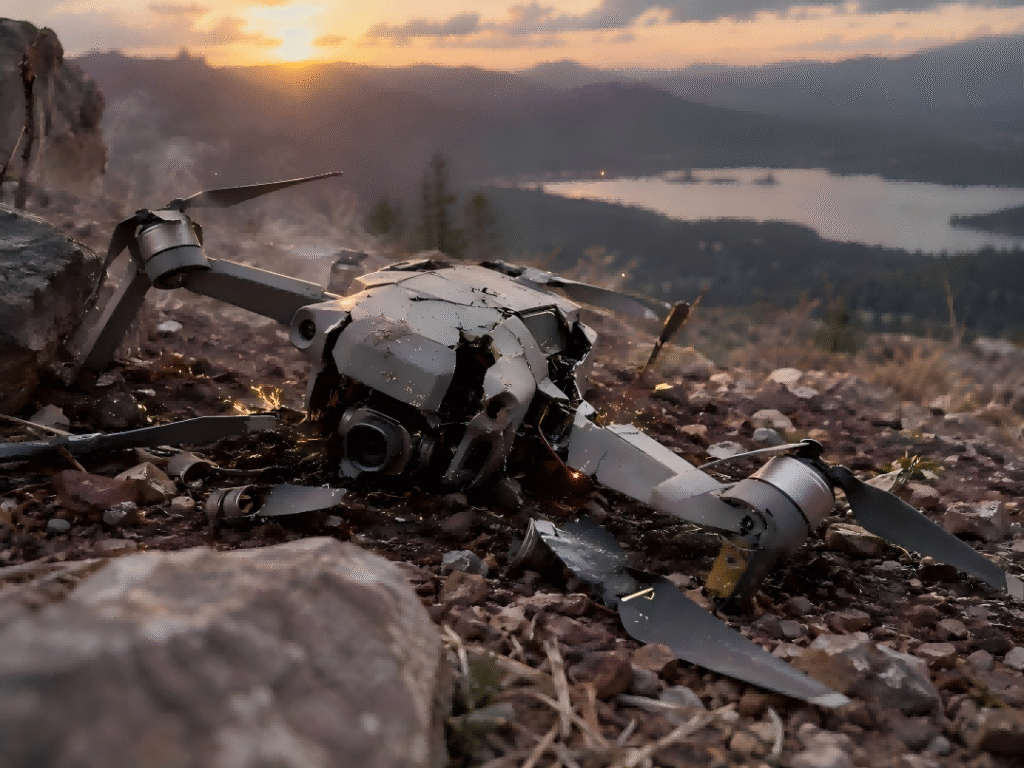
Every drone pilot eventually experiences a crash.
The immediate reaction is usually predictable:
- Check the frame
- Inspect the propellers
- Replace broken parts
- Repair the aircraft
- Fly again
But the most valuable action happens before the next flight:
Download the flight log and find out why the crash happened.
A damaged arm can be replaced.
A motor can be replaced.
A battery can be replaced.
But if the root cause is never identified, the same failure can happen again.
And again.
A good pilot does not just repair the aircraft.
A good pilot learns how to reconstruct the accident.
That is where flight logs become invaluable.

1. The Flight Log Is the Drone’s Black Box
Modern flight controllers continuously record enormous amounts of data during flight.
Depending on the autopilot and logging configuration, this can include:
- Attitude
- Desired attitude
- Gyroscope data
- Accelerometer data
- GPS position
- Compass heading
- RC commands
- Motor outputs
- Battery voltage
- Battery current
- Vibration
- EKF status
- Flight mode changes
- Error messages
- Failsafe events
In other words, almost everything the flight controller knew—and almost everything it tried to do—is recorded.
That makes the log the closest thing a drone has to an aircraft black box.
After a crash, the wreckage tells you:
What broke.
The log can tell you:
What broke first.
That distinction is everything.
2. Before Learning Log Analysis, Build One Habit
Always confirm before flight that:
Logging is enabled and storage is available.
This sounds obvious, but it is surprisingly common to discover after an accident that:
- The SD card was full
- The card was corrupted
- Logging was disabled
- Important messages were not configured to record
- The log stopped midway through the flight
Without a valid log, accident analysis often becomes speculation.
A practical maintenance routine should include:
- Checking SD card health
- Confirming available storage
- Periodically deleting old files
- Replacing unreliable cards
- Verifying that logging parameters are correct
The flight log is only useful if the black box is actually recording.
3. You Do Not Need to Understand Every Parameter
This is one of the biggest barriers for new users.
An ArduPilot log can contain hundreds of data fields.
At first glance, it looks overwhelming.
But most crash investigations do not require analyzing everything.
A much better approach is to follow five diagnostic lines:
1. Timeline
2. Desired vs. Actual Attitude
3. Motor Output
4. Sensor Data
5. Voltage and Current
These five areas can explain a surprisingly large percentage of common failures.
4. Start With the Timeline, Not the Crash
The biggest mistake in log analysis is starting at the moment the drone hits the ground.
By then, almost every signal may already be abnormal.
The correct question is:
What was the first abnormal event?
Suppose the drone crashes at 143.8 seconds.
Do not begin with 143.8.
Go backward.
Ask:
- What changed at 143.5?
- What changed at 143.0?
- What changed at 142.5?
- Which parameter became abnormal first?
This is the core principle of accident analysis:
Find the first abnormal curve, not the biggest abnormal curve.
A crash is usually a cascade.
For example:
Battery voltage collapses
↓
Motor thrust decreases
↓
Attitude error increases
↓
Flight controller commands maximum motor output
↓
Vehicle rolls over
If you only look at the final seconds, you might conclude:
“The motors suddenly went to maximum output.”
But the motors may simply have been responding correctly to an earlier power failure.
The first abnormal event is usually much closer to the root cause.
5. Compare Desired Attitude With Actual Attitude
One of the most powerful diagnostic tools is comparing:
What the flight controller wanted
with:
What the aircraft actually did.
For roll, pitch and yaw, most autopilot systems maintain:
- Desired attitude
- Actual attitude
Under normal operation, these curves should track each other reasonably closely.
If the controller commands:
Roll = +10°
the aircraft should follow.
If actual attitude begins to diverge significantly from the desired value, something is wrong.
But the pattern of divergence tells us more.
6. Case A: Desired Attitude Is Normal, Actual Attitude Cannot Follow
Suppose the desired roll angle remains stable.
But actual roll suddenly moves away.
At the same time, the flight controller increases motor output aggressively.
This suggests that the controller knows the aircraft is unstable and is trying to correct it.
Possible causes include:
- Propeller damage
- Loose propeller
- Motor failure
- ESC failure
- Mechanical damage
- Severe CG imbalance
- Loss of thrust on one arm
This is an important diagnostic principle:
If the command is reasonable but the aircraft cannot follow it, investigate the physical execution layer.
The problem may not be the flight controller.
The flight controller may actually be doing exactly what it should.
7. Case B: Desired Attitude Itself Suddenly Changes
Now imagine a different pattern.
The desired attitude suddenly changes first.
Then the aircraft follows the unexpected command.
This points in a different direction.
Possible causes include:
- RC input
- Incorrect flight-mode transition
- Navigation command
- GPS/EKF problem
- Sensor-estimation error
- Failsafe behavior
- Mission logic
Now the question becomes:
Why did the flight controller ask the aircraft to do that?
That is fundamentally different from a motor or propeller failure.
This is why comparing command vs. response is so useful.
It separates:
Control problem
from:
Execution problem.
8. Motor Output Is One of the Most Revealing Signals
Motor output curves often reveal problems before the pilot notices anything visually.
For a multirotor in stable flight, motor outputs should generally remain within a reasonable control range.
If one motor remains near maximum output for an extended period, that is a strong warning.
It means the flight controller is continuously asking that motor for more thrust.
Why?
Because the aircraft is probably losing balance in that direction.
Possible reasons include:
- Weak motor
- Damaged propeller
- Loose propeller
- ESC issue
- Bent arm
- Asymmetric payload
- Center-of-gravity shift
The important point is that:
Motor saturation is often a symptom, not the root cause.
The autopilot may be desperately trying to save the aircraft.
If one motor is already at 100%, there is no longer any control authority left in that direction.
Once saturation occurs, even a small disturbance can become unrecoverable.
9. Multiple Motors Going Abnormal Suggests a Larger System Problem
If only one motor behaves abnormally, the problem may be local.
But if several motors become abnormal at the same time, think broader.
Possible causes include:
- Battery voltage collapse
- Power-distribution failure
- Major attitude-estimation error
- Structural failure
- Severe vibration
- Loss of navigation stability
This is why motor outputs should never be interpreted alone.
Always align them on the same timeline with:
- Attitude
- Voltage
- Current
- Sensor data
Log analysis is fundamentally about correlation.
10. Sensors Are the Flight Controller’s Eyes and Ears
The flight controller can only make good decisions if its sensor data is trustworthy.
Three categories deserve special attention.
Gyroscope and Accelerometer
Look for:
- Sudden spikes
- Excessive vibration
- Drift
- Saturation
- Large inconsistencies
High vibration can corrupt attitude estimation and reduce control quality.
Mechanical sources may include:
- Unbalanced propellers
- Damaged motors
- Loose frames
- Poor flight-controller isolation
Compass
Look for:
- Sudden heading changes
- Large disagreement
- Magnetic interference
- Heading instability under high current
Potential sources include:
- Power cables
- Magnets
- Motors
- Metal structures
- High-current wiring
GPS
Look for:
- Position jumps
- Satellite loss
- Poor HDOP
- Sudden velocity errors
- Navigation inconsistency
GPS problems become especially important in autonomous modes.
11. Sensor Failure Often Appears Before Control Failure
This sequence is common:
Sensor data becomes unreliable
↓
State estimation becomes inaccurate
↓
Flight controller generates incorrect correction
↓
Aircraft attitude deteriorates
↓
Pilot sees “loss of control”
To the pilot, it may look like:
“The flight controller suddenly went crazy.”
But the real failure started earlier.
The controller was acting on bad information.
This leads to another useful rule:
When attitude control behaves strangely, inspect the sensor data before blaming the control algorithm.
12. Battery Voltage and Current Must Always Be Checked
From the battery perspective, this is one of the most underestimated parts of crash analysis.
Many events described as:
- Motor failure
- Flight-controller instability
- Sudden loss of thrust
are actually power-system problems.
Look closely at:
Voltage
Current
Voltage sag
Power demand
If battery voltage suddenly collapses under load, motor output capability can fall immediately.
The sequence may become:
High current demand
↓
Voltage sag
↓
ESC input voltage drops
↓
Motor thrust decreases
↓
Attitude error increases
↓
Autopilot increases motor command
↓
Current demand rises further
↓
Voltage collapses more
This can become a negative spiral.
13. A “Flight-Control Problem” May Actually Be a Battery Problem
Suppose a heavy-lift drone is flying normally.
Then the pilot commands a rapid climb.
Current rises sharply.
Battery voltage drops.
One or more motors can no longer produce the requested thrust.
Actual attitude starts diverging from commanded attitude.
The controller pushes motor output toward maximum.
The aircraft rolls and crashes.
If you only inspect the attitude data, you might conclude:
Control instability.
But if the voltage drop occurs first, the more likely root cause is:
Power-system limitation.
Possible causes include:
- Aged battery
- Excessive internal resistance
- Undersized pack
- Low SOC
- Cold battery
- High C-rate demand
- Poor connector contact
- Undersized cable
- Weak solder joint
This is why voltage should always be aligned with attitude and motor output on the same timeline.
14. Three Common Crash Patterns
A simple classification framework can make log analysis much faster.
Pattern 1: Propulsion Mismatch or Mechanical Failure
Typical signature:
One motor output rises toward maximum
↓
Attitude error grows in one direction
↓
Controller loses authority
Check:
- Propeller
- Motor
- ESC
- Arm
- Mounting
- CG
Pattern 2: Sensor Disturbance
Typical signature:
Compass / gyro / GPS data becomes abnormal first
↓
State estimation deteriorates
↓
Desired or actual attitude becomes abnormal
Check:
- Magnetic interference
- Vibration
- GPS environment
- Sensor mounting
- Wiring
- EKF warnings
Pattern 3: Power Collapse
Typical signature:
Voltage falls sharply first
↓
Motor capability decreases
↓
Motor commands rise
↓
Attitude deteriorates
Check:
- Battery health
- Connector resistance
- Cable gauge
- Pack internal resistance
- Current demand
- SOC
- Temperature
These three patterns point to completely different troubleshooting paths.
That is why the first job is always:
Identify the earliest abnormal signal.
15. Do Not Analyze Only Crash Logs
This may be even more important than learning how to analyze an accident.
Healthy flight logs should also be reviewed.
Why?
Because many failures develop gradually.
A motor bearing may become less efficient over time.
One propeller may slowly become damaged.
Battery internal resistance may rise.
Vibration may increase.
Voltage sag may become worse.
Motor balance may gradually change.
None of these necessarily causes an immediate crash.
But the trend is visible in the data.
This changes log analysis from:
Accident investigation
to:
Predictive maintenance.
16. Normal Data Creates Your Baseline
Imagine reviewing logs from the same aircraft every 20 flights.
You begin to understand its normal behavior.
For example:
At hover:
- Motor outputs normally stay between 44% and 49%
- Vibration remains below a certain level
- Battery voltage sag follows a predictable pattern
- Current at a specific payload is consistent
Then one day:
Motor 3 requires 58% while the others remain around 47%.
The aircraft may still fly normally.
But something has changed.
Possible causes:
- Motor efficiency loss
- Propeller damage
- Added drag
- Structural alignment problem
- CG shift
Without historical data, 58% may look meaningless.
With a baseline, it becomes a warning.
17. Build a Flight Log Archive
A professional UAV operation should treat flight logs as operational data.
For every flight, consider recording:
- Date
- Aircraft ID
- Battery ID
- Pilot
- Payload
- Location
- Weather
- Flight duration
- Mission type
- Any abnormal behavior
- Maintenance performed
This creates a valuable engineering database.
Over time, you can correlate:
Battery ID → Voltage sag
Motor ID → Output imbalance
Aircraft hours → Vibration
Payload → Current demand
Temperature → Battery performance
The value grows with every flight.
18. Battery IDs Should Be Part of Log Analysis
For industrial UAVs, I strongly believe batteries should be individually tracked.
Imagine Pack A and Pack B are the same model.
Both show:
100% SOC before takeoff.
But under a 120 A load:
Pack A:
Voltage sag = 6%
Pack B:
Voltage sag = 13%
That difference matters.
Pack B may have:
- Higher internal resistance
- Cell imbalance
- Greater aging
- Connector degradation
SOC alone cannot tell you that.
Flight data can.
This means the future of UAV battery management should increasingly connect:
BMS data + Flight-controller data + Battery identity + Mission data
That creates much more meaningful SOH analysis.
19. SOC Tells You How Much Energy Remains. SOH Tells You Whether the Battery Can Still Do the Job.
This is particularly important for high-power drones.
A battery may still have:
60% SOC
but no longer be capable of delivering the required takeoff or maneuvering power safely.
The real operational question is not only:
“How much energy remains?”
It is:
“How much power can this battery safely deliver right now?”
That depends on:
- Internal resistance
- Temperature
- Cell balance
- Cycle age
- Current demand
- SOC
For heavy-lift UAVs, logistics drones and eVTOL-type aircraft, this distinction becomes critical.
20. The Best Crash Analysis Connects the Entire System
A drone is not a collection of independent components.
A crash can involve interactions between:
Battery
↓
ESC
↓
Motor
↓
Propeller
↓
Aircraft dynamics
↓
Sensors
↓
Flight controller
A weakness at one layer can create symptoms somewhere else.
For example:
Battery degradation
may appear in the log as:
Motor saturation.
A loose propeller may appear as:
Attitude-control failure.
Severe vibration may appear as:
Navigation instability.
This is why experienced engineers rarely diagnose a crash from one curve.
They reconstruct the complete chain of events.
21. A Simple Crash-Analysis Workflow
For beginners using ArduPilot or similar systems, a practical workflow can be:
Step 1 — Identify the accident timestamp
Find the moment control begins to deteriorate.
Step 2 — Move backward
Locate the first abnormal signal before the crash.
Step 3 — Compare desired vs. actual attitude
Determine whether the issue originates in command or execution.
Step 4 — Check motor outputs
Look for saturation, imbalance or sudden changes.
Step 5 — Check sensor data
Inspect gyro, acceleration, compass, GPS and estimator behavior.
Step 6 — Check the power system
Align voltage and current with the failure.
Step 7 — Build the causal chain
Do not stop at correlation.
Ask:
What happened first?
What happened because of it?
A useful engineering format is:
Event → Response → Secondary Effect → Crash
22. The Goal Is Not to Find Something Abnormal
This distinction matters.
After a crash, almost everything becomes abnormal.
The goal is not to say:
“Look, this curve looks strange.”
The goal is to answer:
“Did this abnormality cause the accident, or was it caused by the accident?”
That is the difference between:
Data viewing
and:
Root-cause analysis.
23. A Crash Can Be Expensive — But Repeating the Same Crash Is More Expensive
A crash may cost:
- Propellers
- Motors
- Frame
- Payload
- Battery
- Repair time
But if no root cause is identified, the cost is not finished.
The aircraft may be rebuilt with the same hidden problem.
Then the operator pays twice.
This is why post-flight data analysis should be treated as part of maintenance—not as an optional hobby for flight-control engineers.
For professional operations, the process should become:
Fly
↓
Record
↓
Review
↓
Detect
↓
Correct
↓
Fly again
Final Thoughts: Every Crash Should Produce Data, Not Just Damage
The aircraft can be repaired.
The real loss is crashing without learning anything.
Flight logs transform an accident from:
“Something went wrong.”
into:
“This happened first, which caused this, which caused this, and finally the aircraft crashed.”
That is how engineering improves.
For me, the most useful crash-analysis framework is still remarkably simple:
Timeline → Command vs. Response → Motors → Sensors → Power
And the most important principle is:
Find the first abnormal event.

Not the loudest one.
Not the final one.
The first one.
Because that is usually where the real story begins.
A pilot who only fixes broken hardware becomes good at repairing drones.
A pilot who learns to read logs becomes good at preventing the next crash.
And that is a much more valuable skill.
#ArduPilot #DroneTechnology #UAV #FlightController #DroneSafety #FlightLog #DroneEngineering #UAVOperations #DroneMaintenance #BatteryTechnology #DroneBattery #BMS #Autopilot #RootCauseAnalysis #PredictiveMaintenance #IndustrialDrones