
The battery industry loves replacement stories.
“21700 will replace 18650.”
“Tabless will replace multi-tab.”
“The next-generation cell will make the previous generation obsolete.”
But battery technology rarely develops that way.
In most real applications, the question is not:
Which technology is newer?
It is:
Which technology delivers the right balance of power, energy, temperature, life and cost for the application?
That distinction is especially important in today’s power-tool battery market.
Multi-tab 18650 cells are not obsolete. For mainstream cordless tools and moderate-power applications, they remain technically capable, mature and cost-effective.
At the same time, tabless cells are not simply “over-engineered” batteries looking for a problem to solve.
They address a very real bottleneck:
How do we push much more current through a cylindrical cell without allowing resistance and heat to become the limiting factors?
That question matters for heavy-duty professional power tools.
But it increasingly matters beyond power tools as well—in robotics, high-power backup systems, advanced mobility and other applications where power density is becoming as important as energy density.
So I don’t see the future as:
Multi-Tab vs. Tabless
I see it as:
Application Segmentation.
And that may be much more interesting.
1. Why the 18650 Cell Is Still Very Much Alive
The 18650 format has been around for decades.
That can sometimes make it appear technologically “old.”
But maturity is not the same as obsolescence.
The 18650 ecosystem has several powerful advantages:
- Mature manufacturing processes
- Large installed production capacity
- Well-understood thermal behavior
- Mature pack architecture
- Established supply chains
- Competitive cost
- Huge field experience
Modern 18650 cells have also continued evolving.
Capacity has increased.
Chemistry has improved.
Electrode design has improved.
And current-collection structures have evolved from conventional limited-tab architectures toward multi-tab designs.
The result is important:
Today’s 18650 is not the same 18650 we had ten years ago.
For many applications, especially mainstream cordless tools, it is still a very rational engineering choice.
2. Multi-Tab Technology Solves a Real Problem Without Completely Redesigning the Cell
To understand why multi-tab technology matters, we need to look at what happens inside a cylindrical cell.
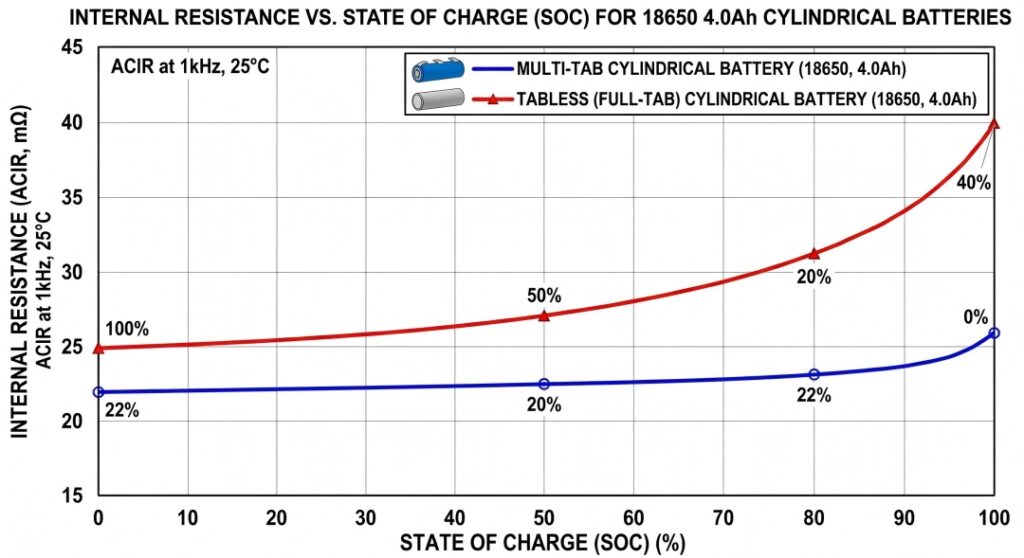
Current generated across the electrode must travel through the current collector toward the tabs.
With a limited number of current-collection points, some parts of the electrode have a longer electrical path.
That creates resistance.
And resistance creates heat.
The basic relationship is:
P_loss = I²R
This simple equation explains much of the industry’s move toward improved tab structures.
If current doubles:
Heat generation can increase approximately fourfold, assuming resistance remains constant.
So as cordless tools became more powerful, simply increasing current through conventional cells became increasingly difficult.
Multi-tab technology addresses this by increasing the number of current-collection paths.
Instead of forcing current toward only a small number of points, multiple tabs reduce the effective current path.
The engineering benefits can include:
Lower effective resistance
↓
Lower voltage drop
↓
Lower localized heating
↓
Better high-rate performance
↓
Better thermal uniformity
This is a meaningful improvement.
And importantly, it can be achieved while preserving much of the mature 18650 manufacturing and pack ecosystem.
That makes multi-tab 18650 an attractive performance-to-cost solution.
3. For Many Cordless Tools, Multi-Tab 18650 Is Already Enough
This is where application segmentation becomes important.
Not every cordless tool needs extreme battery power.
Consider common applications such as:
- Drill/drivers
- Screwdrivers
- Light impact tools
- DIY equipment
- Intermittent professional tools
For these products, the battery is not necessarily operating continuously at its thermal and electrical limits.
The duty cycle may look more like:
Work → Stop → Reposition → Work → Stop
rather than:
Maximum power → Maximum power → Maximum power
In this environment, a mature multi-tab 18650 solution may already provide sufficient:
- Peak current
- Runtime
- Cycle life
- Thermal performance
- Cost efficiency
Moving to a significantly more expensive cell architecture may produce relatively little value for the end user.
This is an important battery-engineering principle:
More performance does not automatically create more customer value.
If an application requires 500W and the existing battery system can reliably deliver the required 500W, designing the battery around 2,000W capability may not improve the customer’s actual experience enough to justify the cost.
The correct battery is not the battery with the maximum specification.
It is the battery whose performance envelope matches the application.
4. Then Why Do We Need Tabless Cells?
Because the situation changes completely as power demand increases.
Imagine a battery pack supplying:
500W at 20V
Current is approximately:
I = P / V
I = 500 / 20 = 25A
Now increase the application to:
2,000W at 20V
Current becomes:
I = 2,000 / 20 = 100A
The power requirement increased 4×.
But because resistive heat approximately follows:
P_loss = I²R
the thermal challenge can increase much faster.
Assume total effective electrical resistance remains constant at:
R = 10mΩ
At 25A:
P_loss = 25² × 0.01 = 6.25W
At 100A:
P_loss = 100² × 0.01 = 100W
Current increased fourfold.
But resistive heat increased 16×.
That is the real engineering problem tabless technology is trying to solve.
5. Tabless Is Fundamentally About Shortening the Current Path
Despite the name, “tabless” does not mean there is literally no electrical connection between the electrode and the terminal.
The engineering concept is to create a much broader distributed current-collection structure instead of relying on a small number of discrete tabs.
Conceptually:
Conventional / Limited Tab
Electrode
↓
Current travels laterally
↓
Discrete tab
↓
Terminal
With a distributed tabless architecture:
Tabless
Electrode
↓↓↓↓↓↓↓↓
Distributed current collection
↓↓↓↓↓↓↓↓
Terminal
This reduces the effective current path and can lower resistance.
The consequences are exactly what high-power systems need:
Lower R → Lower Voltage Sag + Lower Heat
Remember:
ΔV = I × R
and:
P_heat = I²R
Reducing resistance therefore attacks two high-current problems simultaneously.
6. A Small Reduction in Resistance Becomes Extremely Valuable at High Current
Suppose Cell A has an effective resistance of:
15mΩ
and Cell B achieves:
8mΩ
At 10A:
Cell A:
P_heat = 10² × 0.015 = 1.5W
Cell B:
P_heat = 10² × 0.008 = 0.8W
Difference:
0.7W
Useful—but perhaps not revolutionary.
Now operate at 30A.
Cell A:
P_heat = 30² × 0.015 = 13.5W
Cell B:
P_heat = 30² × 0.008 = 7.2W
Difference:
6.3W
At 40A:
Cell A:
P_heat = 40² × 0.015 = 24W
Cell B:
P_heat = 40² × 0.008 = 12.8W
Difference:
11.2W
The higher the current becomes, the more valuable resistance reduction becomes.
This is why tabless technology can look unnecessary in a light-duty drill—but extremely valuable in an angle grinder, rotary hammer or chainsaw.
The technology becomes more valuable as current rises.
7. The Real Enemy of High-Power Batteries Is Often Heat
When discussing high-power batteries, people naturally focus on maximum current.
But from an engineering perspective, I often see the more important question as:
For how long can the battery sustain that current before temperature becomes the limiting factor?
Peak power is relatively easy.
Sustained power is harder.
A cell might deliver very high current for several seconds.
But a professional tool may require repeated high-power operation over many minutes.
That creates a thermal accumulation problem.
The approximate temperature rise can be represented conceptually as:
ΔT ≈ Q / (mCp)
where:
- Q = accumulated heat
- m = thermal mass
- Cp = effective specific heat capacity
And:
Q ≈ I²Rt
Therefore:
Temperature rise is strongly influenced by current, resistance and time.
This is precisely why reducing internal resistance becomes so valuable for heavy-duty applications.
8. This Is Where Tabless Stops Being “Overkill”
Imagine two users.
User A: DIY Drill
The tool runs for several seconds.
Then stops.
The user changes position.
Drills again.
Then stops.
Average thermal load remains relatively low.
A mature multi-tab 18650 battery may already provide everything this customer needs.
Now consider:
User B: Professional Angle Grinder
The tool operates at high load for extended periods.
Current remains high.
Heat accumulates.
Voltage sag increases.
Cell temperature rises.
Eventually the battery or tool may reduce power to protect the system.
In this scenario, reducing internal resistance can directly influence:
- Sustained output
- Runtime under heavy load
- Thermal derating
- Productivity
- Battery life
Now tabless technology is no longer a specification race.
It solves a real operating problem.
9. Professional Tools Are Becoming More Like Industrial Power Systems
Cordless tools have changed dramatically.
The original goal was simple:
Replace the cable.
Today, the goal is increasingly:
Replace the performance of a corded machine—or even a small combustion-powered machine—with a battery system.
That is a much more demanding target.
Applications such as:
- Angle grinders
- Rotary hammers
- Circular saws
- Demolition tools
- Chainsaws
- Concrete-cutting equipment
can impose substantial power requirements.
As these tools become cordless, battery design moves from:
“Can the battery run the tool?”
toward:
“Can the battery maintain professional-level power without thermal throttling?”
That is a completely different engineering requirement.
10. We Can Already See This Segmentation in Commercial Products
This is no longer only a cell-manufacturer technology discussion.
Major professional-tool brands are integrating tabless technology into commercial battery systems.
Bosch, for example, describes its tabless architecture as creating many parallel current paths to reduce internal resistance and heat, and it positions these packs specifically around demanding professional applications. Depending on the pack, Bosch publishes maximum-power figures up to approximately 2.0–2.4 kW under its specified internal test conditions.
Milwaukee has likewise incorporated tabless cell technology into its M18 REDLITHIUM FORGE platform, together with redesigned pack construction, electronics and thermal-management features aimed at high-demand professional applications.
What I find especially important is that the market is not abandoning lower-performance battery classes.
Bosch’s own 18V portfolio, for example, spans lighter conventional packs and higher-performance tabless solutions, with different products positioned around different power/runtime requirements.
That tells us something important.
Battery evolution is becoming segmented—not simply sequential.
11. Multi-Tab and Tabless Are Not Necessarily Direct Competitors
I would divide the market conceptually into three layers.
Layer 1 — Cost-Sensitive / Light-Duty
Typical requirements:
- Moderate current
- Intermittent operation
- Strong price sensitivity
- Mature pack design
Here, conventional or improved multi-tab 18650 cells can remain highly competitive.
Layer 2 — Mainstream Professional
Typical requirements:
- Higher current
- Longer duty cycles
- Better thermal performance
- Strong balance between cost and performance
Here, advanced multi-tab cells and some tabless solutions may compete directly.
Layer 3 — Extreme Power / Emerging Applications
Typical requirements:
- High continuous current
- High pulse power
- Low voltage sag
- Tight thermal limits
- High power-to-weight ratio
Here, tabless architecture becomes much more compelling.
So the market is not necessarily moving:
Technology A → Technology B
It may instead become:
A + B + Application Segmentation
12. And the Opportunity Goes Far Beyond Power Tools
This may be the most important part of the tabless story.
Power tools provide a natural early market because users immediately notice:
- More power
- Less overheating
- Longer sustained operation
But the same physics appears in many emerging applications.
Data Center BBU
A Battery Backup Unit may spend most of its life waiting.
Then suddenly it needs to deliver significant power.
The battery therefore needs:
- Reliable pulse power
- Low resistance
- Predictable voltage behavior
- Good consistency
- Thermal stability
This is a very different optimization target from a consumer battery designed mainly for maximum runtime.
Humanoid Robots
Robots create highly dynamic loads.
Walking may require moderate power.
But:
Standing up
Lifting
Jumping
Recovering balance
Rapid acceleration
can create significant transient current.
A robot battery therefore needs both:
Wh/kg
and:
W/kg
This creates an interesting opportunity for high-power cylindrical cells.
eVTOL and Advanced Aviation
The challenge becomes even more demanding.
An aircraft may require different power levels during:
Vertical takeoff → Climb → Cruise → Transition → Landing
For these applications, battery selection cannot be based on energy density alone.
The system must balance:
- Specific energy
- Specific power
- Voltage stability
- Thermal performance
- Cycle life
- Safety
Again, lower resistance becomes valuable because high current affects both:
ΔV = IR
and:
P_heat = I²R
13. The Future Battery Competition May Be Wh/kg × W/kg
For many years, lithium-ion competition focused heavily on:
Wh/kg
How much energy can we store per kilogram?
That remains extremely important.
But emerging high-performance applications are making another metric equally important:
W/kg
How much power can we safely deliver per kilogram?
A battery with excellent Wh/kg but insufficient W/kg cannot support high-power equipment.
A battery with enormous W/kg but poor energy density may become too heavy.
So the engineering target increasingly becomes a balance:
Energy Density × Power Density × Thermal Stability × Cycle Life × Cost
This is one reason tabless technology matters.
It is part of a broader industry movement from optimizing cells mainly for energy storage toward optimizing them for energy delivery.
14. But Why Doesn’t Everyone Switch to Tabless Immediately?
Because engineering performance is only one part of commercialization.
The other part is:
Cost.
Tabless architectures can require more demanding manufacturing processes, current-collection design, welding/control technologies and quality management.
When production scale is lower, the cell premium can be meaningful.
That premium then propagates into:
- Battery pack cost
- Replacement cost
- Tool system price
For a professional user who earns money with the tool every day, paying more for higher sustained power and lower downtime may make economic sense.
For a casual DIY customer?
Maybe not.
This is why I expect both technologies to coexist for some time.
15. The Correct Economic Metric Is Not Cell Price
This is another important distinction.
Suppose Battery A costs less.
But under heavy-duty operation it:
- Reaches thermal limits earlier
- Requires more cooling time
- Experiences more voltage sag
- Provides less sustained tool power
Battery B costs more but keeps the tool operating longer.
Which one is actually cheaper?
For professional users, a more meaningful equation may be:
TCO = Battery Cost + Charging Cost + Replacement Cost + Downtime Cost
And ultimately:
Cost per Productive Hour = TCO / Productive Operating Hours
This changes the discussion.
A premium tabless battery does not need to become cheaper than a multi-tab battery.
It needs to create enough additional productivity to justify its premium.
16. Short Term: Segmentation, Not Replacement
Over the next few years, I expect the market logic to remain relatively clear.
Multi-Tab 18650
will continue to make sense for:
- DIY tools
- Standard drills
- Screwdrivers
- Moderate-duty professional equipment
- Cost-sensitive battery platforms
because its combination of:
maturity + performance + supply availability + cost
remains difficult to beat.
Meanwhile:
Tabless
will continue expanding in:
- High-end professional tools
- High-power cordless platforms
- BBU
- Robotics
- Other power-dense applications
where reducing resistance creates direct system value.
That is not a failure of tabless adoption.
It is simply rational engineering.
17. Longer Term: Tabless Could Move Down the Product Stack
The interesting question is what happens when manufacturing scale increases.
Technology adoption often follows a familiar pattern:
New Technology
↓
Premium Applications
↓
Manufacturing Scale
↓
Yield Improvement
↓
Cost Reduction
↓
Mainstream Adoption
We have seen this pattern across many battery technologies.
Tabless cells could follow the same trajectory.
Today, their strongest economic argument is in high-power applications.
But as manufacturing matures and the cost premium falls, the performance advantage may become attractive to increasingly mainstream professional products.
Eventually, customers may stop thinking of “tabless” as a premium feature.
It could simply become part of what they expect from a professional high-power battery.
18. Does That Mean Multi-Tab 18650 Will Disappear?
I don’t think that is the most useful way to look at it.
A technology disappears when another technology can satisfy the same requirement with a clearly superior combination of:
- Performance
- Cost
- Reliability
- Manufacturing scale
across most applications.
We are not necessarily at that point.
For moderate-power applications, multi-tab 18650 can still offer an excellent engineering balance.
Its supply chain is mature.
Its manufacturing economics are strong.
Its performance is sufficient for many applications.
There is little reason to remove a mature technology simply because a higher-performance option exists.
Engineering does not reward novelty. It rewards fit.
19. Tabless Is Not “Performance Overkill”—It Is Targeted Engineering
This is the conclusion I keep coming back to.
If you evaluate tabless cells using a light-duty cordless drill, the technology may appear unnecessary.
But that is like evaluating a high-performance engine by driving only through a parking lot.
The advantage appears when the system approaches its limits.
At high current:
Voltage Sag = I × R
At high current:
Heat ≈ I²R
Reduce R, and the benefit grows rapidly as I increases.
That is why tabless technology becomes increasingly relevant for:
Heavy-duty tools
BBU
Robotics
Advanced mobility
and other high-power systems.
The performance is not excessive.
The application has simply changed.
20. Final Thoughts: The Battery Market Is Splitting Into “Enough Power” and “Power-Limited” Applications
For me, the most interesting trend is not whether tabless batteries will “replace” multi-tab 18650 cells.
It is that battery applications are increasingly separating into two categories.
Category A: Enough Power
The existing battery already satisfies the application’s power requirement.
Here, the optimization priorities may be:
Cost + Capacity + Reliability + Availability
Multi-tab 18650 remains highly competitive.
Category B: Power-Limited
Battery resistance and temperature actively restrict system performance.
Here, the priorities become:
Lower Resistance + Higher Current + Better Thermal Behavior + Higher Power Density
This is where tabless technology becomes strategically important.
And as cordless equipment becomes more powerful, robots become more capable, backup systems become more power-dense, and electric mobility expands into new categories, the number of power-limited applications is likely to grow.
That is why I do not see tabless cylindrical cells as a solution searching for a problem.
They are a response to a very clear engineering trend:
We are asking batteries to deliver more power from less mass, with less heat, for longer periods of time.
Multi-tab 18650 cells will continue doing an excellent job where their performance is sufficient.
Tabless cells will expand where resistance and thermal performance become the bottleneck.
So perhaps the future is not:
Multi-Tab → Tabless
It is:
Right Cell Architecture → Right Power Requirement → Right Application
And that is how battery technology should evolve.
Not by replacing everything that came before it.
But by solving the next bottleneck.
#LithiumIonBattery #TablessBattery #18650 #21700 #PowerTools #BatteryTechnology #BatteryEngineering #PowerDensity #Robotics #BBU #EVTOL #EnergyStorage