
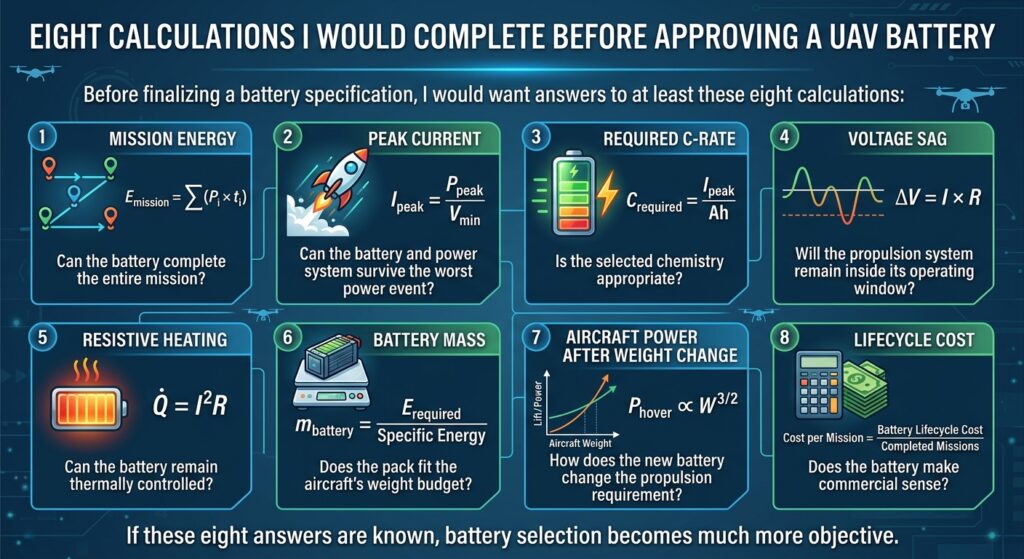
When engineers select a battery for an industrial UAV, the discussion often begins with four numbers:
Voltage. Capacity. C-rate. Weight.
But a drone does not fly on specifications.
It flies on a complete power system.
You can select an excellent motor, optimize the propeller, tune the flight controller, and design an efficient airframe—but if the battery cannot deliver the right voltage, power, usable energy and thermal performance throughout the mission, the aircraft’s real performance ceiling may already be fixed.
This becomes even more important as 400 Wh/kg-class semi-solid batteries begin to expand the design possibilities for long-endurance and heavy-lift UAVs.
The question is no longer simply:
“How much energy can we put into the battery?”
The better engineering question is:
“How much usable energy and power can this battery deliver to this aircraft, under this mission profile, throughout its useful life?”
That is where real UAV battery engineering begins.
1. Start With the Mission, Not the Battery Datasheet
Before selecting battery voltage or capacity, I prefer to understand the aircraft mission.
A battery for a mapping UAV and a battery for a heavy-lift delivery drone may have completely different optimization priorities.
Consider the mission profile of a heavy-lift multirotor:
Takeoff → Climb → Cruise → Hover → Payload operation → Return → Landing
Each stage places a different demand on the battery.
Takeoff may require very high power for a short period.
Cruise may require moderate power for a much longer period.
Hover may create sustained thermal stress.
Wind correction may introduce unexpected transient loads.
Return-to-home may occur when the battery is already at relatively low SOC.
So battery sizing should begin with a:
Time–Power Mission Profile
The mission energy can be estimated as:
E_mission = Σ(Pᵢ × tᵢ)
But this only solves half of the problem.
The battery must simultaneously satisfy:
E_available ≥ E_mission + Reserve
and
P_available ≥ P_peak
In simple terms:
Energy determines whether you can finish the mission.
Power determines whether you can survive the hardest moment of the mission.
A good UAV battery must provide both.
2. Voltage Matching Is About Efficiency, Not Just Compatibility
One of the first questions engineers ask is:
6S? 12S? 14S?
But the right answer should not come from the battery catalog.
It should come from the propulsion system.
The basic relationship is:
P = V × I
For the same required power, increasing voltage reduces current.
Suppose the propulsion system requires 6 kW.
At 25V:
I ≈ 240A
At 50V:
I ≈ 120A
At 100V:
I ≈ 60A
This matters because resistive losses follow:
P_loss = I²R
Reducing current can therefore reduce:
- Cable losses
- Connector heating
- Conductor size
- Power-distribution losses
This is one reason higher-voltage architectures are attractive for larger industrial UAVs.
But there is an important engineering warning:
Higher voltage does not automatically mean higher efficiency.
Higher voltage also changes:
- ESC switching behavior
- Semiconductor requirements
- Insulation design
- DC-DC architecture
- Connector requirements
- Creepage and clearance
- Overall system complexity
So instead of asking:
“What battery voltage should we use?”
I would ask:
“At what voltage does the motor-propeller-ESC combination operate efficiently across the most important parts of the mission?”
Find that operating region first.
Then select the battery S-count.
3. Nominal Voltage Is Not the Voltage the UAV Actually Flies On
A battery labeled:
12S / 44.4V
does not deliver 44.4V throughout the mission.
Its terminal voltage changes continuously with:
- SOC
- Current
- Temperature
- Internal resistance
- Cell chemistry
- Aging
During flight:
Takeoff → Current rises → Voltage sags
Cruise → Current falls → Voltage partially recovers
Climb → Current rises again
Low SOC → Baseline voltage decreases
Cold temperature → Internal resistance increases
This is why designing around nominal voltage alone can be misleading.
The propulsion system should be checked against the worst realistic battery condition.
For example:
Low SOC + Low temperature + High current + aged battery
That is much closer to the actual electrical boundary the aircraft may experience.
4. Why I Don’t Select a UAV Battery by C-Rate Alone
Suppose two suppliers both offer:
12S 30Ah 15C
On paper, they look almost identical.
But put them on the same heavy-lift UAV and their performance may be very different.
Why?
Because C-rate alone does not tell us enough about:
- DC internal resistance
- Voltage sag
- Temperature rise
- Low-SOC power capability
- Cell consistency
- Cold-temperature behavior
- Aging
The aircraft does not fly according to the C-rate printed on the label.
It flies according to:
Actual voltage and power under load.
That distinction matters.
5. Internal Resistance Can Change the Entire Result
A simplified battery model is:
V_load = V_OCV − I × R_internal
Now imagine a 12S battery experiencing a 300A transient.
If two cells differ in internal resistance by only:
1 mΩ
then across a 12S string, the difference in voltage drop becomes:
ΔV = 300 × 0.001 × 12 = 3.6V
That is significant.
A few volts of additional sag can affect:
- Motor RPM
- Available thrust
- ESC operating margin
- Low-voltage protection
- Usable battery capacity
This explains why two batteries with identical:
Voltage + Capacity + C-rate
can behave very differently in the same UAV.
The missing variable may simply be:
Internal resistance.
6. Don’t Ask Only for C-Rate—Ask for Curves
For an industrial UAV project, I would prefer to evaluate actual battery performance curves.
Depending on the application, useful data may include:
- 1C discharge
- 3C discharge
- 5C discharge
- Higher discharge rates where relevant
- Different temperatures
- Different SOC ranges
Then look at four things.
Voltage Sag
What happens immediately when high load is applied?
Voltage Stability
How does the voltage behave during sustained discharge?
Temperature Rise
How much heat is generated under the required mission current?
Usable Energy
How much energy can actually be extracted before reaching the aircraft’s minimum acceptable voltage?
This gives a much better picture than simply comparing:
10C vs. 15C vs. 20C.
7. 400 Wh/kg Sounds Excellent—But Energy Density Is Only Half the Story
This brings us to high-specific-energy batteries.
A 400 Wh/kg-class battery is obviously attractive to UAV engineers.
Why?
Because every kilogram saved from the battery can potentially become:
- Additional payload
- Additional endurance
- More sensors
- Greater reserve
- Redundant systems
But there is a fundamental trade-off:
Energy density and power density are not the same thing.
Depending on cell design, increasing energy density may involve:
- Higher active-material loading
- Thicker electrodes
- High-silicon-content anodes
- High-energy cathode systems
- Reduced inactive material
These approaches can increase Wh/kg.
But they can also create challenges involving:
- Ion transport
- Internal resistance
- Fast charging
- Thermal behavior
- Cycle life
So when I see:
400 Wh/kg
my next question is not:
“How much longer will the drone fly?”
It is:
“At what discharge rate, temperature, cycle life and voltage stability can that 400 Wh/kg actually be used?”
That question is much more important.
8. Why 400 Wh/kg Can Still Change Heavy-Lift UAV Design
Now consider a simplified example.
Suppose a UAV requires:
4 kWh
of nominal battery energy.
At:
250 Wh/kg
the theoretical battery mass is:
16 kg
At:
300 Wh/kg
it becomes:
13.3 kg
At:
400 Wh/kg
it becomes:
10 kg
Moving from 250 Wh/kg to 400 Wh/kg theoretically releases:
6 kg
for the same stored energy.
For a heavy-lift UAV, 6 kg is not a minor improvement.
It can fundamentally change the aircraft design.
That 6 kg could potentially become:
6 kg more payload
or
more reserve energy
or
additional sensors
or
redundant systems
or simply:
a lighter aircraft.
And a lighter aircraft creates another advantage.
9. Battery Weight Reduction Creates a System-Level Feedback Loop
Reducing battery weight does not only reduce battery weight.
For rotorcraft:
Lower battery mass
↓
Lower MTOW
↓
Lower required thrust
↓
Lower propulsion power
↓
Lower mission energy
↓
Potential for further battery reduction
This is an important systems-engineering effect.
The relationship between battery specific energy and flight endurance is therefore not purely linear.
A higher-specific-energy battery can change the aircraft itself.
This is why I believe advanced batteries should increasingly be evaluated through aircraft-level simulation, rather than simply comparing Wh/kg values.
10. But 50% Higher Wh/kg Does Not Automatically Mean 50% More Flight Time
This is a common marketing mistake.
Suppose Battery A is:
250 Wh/kg
and Battery B is:
400 Wh/kg
That is a major improvement in specific energy.
But you cannot automatically conclude:
“Flight time increases by 60%.”
Actual endurance depends on:
- Aircraft mass
- Rotor efficiency
- Aerodynamics
- Payload
- Propulsion efficiency
- Reserve SOC
- Wind
- Mission profile
The correct process is:
Change battery mass → Recalculate MTOW → Recalculate power → Recalculate energy → Recalculate endurance
This is why battery sizing should be iterative.
Not linear.
11. The More Important Metric May Be Usable Mission Energy
Consider two batteries with the same:
2,000 Wh nominal energy
Battery A has low internal resistance and maintains voltage well.
Battery B experiences much greater voltage sag.
The aircraft may reach its low-voltage threshold before Battery B has released all of its nominal energy.
So:
Nominal Energy ≠ Usable Mission Energy
Conceptually, we can think of:
E_usable = E_nominal × Derating Factors
Those derating factors may include:
- SOC reserve
- Temperature
- Power demand
- Aging
- Voltage limits
This is especially important for:
heavy-lift, long-range and cold-weather UAVs.
The battery with the highest nominal Wh/kg may not necessarily provide the highest usable Wh/kg in flight.
12. Thermal Performance Defines the Real Power Boundary
Internal resistance does two things:
It creates voltage sag.
And:
It creates heat.
A simplified approximation is:
Q̇ ≈ I²R
This is why high-current UAV applications can become thermally challenging very quickly.
If current doubles, resistive heat generation can increase dramatically.
For heavy-lift UAVs, thermal stress becomes particularly important during:
- Maximum-payload takeoff
- Long hover
- Aggressive climb
- High-temperature operation
- Repeated missions
So when evaluating a battery, don’t only ask:
“Can it deliver 3C?”
Ask:
“Can it deliver the required current for the required duration while remaining inside the thermal operating window?”
Those are not the same question.
13. Ask for Temperature-Rise Curves, Not Just Maximum Temperature
Suppose a supplier says:
“Maximum operating temperature: 60°C.”
That is useful, but incomplete.
For engineering evaluation, I would also want:
- Ambient temperature
- Starting cell temperature
- Discharge current
- Cooling condition
- Temperature vs. time
- Cell-to-cell temperature difference
A battery that reaches 50°C after three minutes behaves very differently from one that reaches 50°C after 20 minutes.
The maximum number may be identical.
The thermal margin is not.
This is particularly important for industrial UAVs operating in:
- The Middle East
- Desert environments
- High solar exposure
- Long hover missions
- Repeated-flight operations
14. High Energy Density Must Be Evaluated Together With Safety
Semi-solid battery technology is interesting partly because changing the electrolyte architecture can potentially influence thermal and safety behavior.
But one principle should remain clear:
“Semi-solid” is a chemistry description—not a safety certificate.
For UAV applications, safety should be evaluated using actual test evidence.
Depending on the battery architecture and application, this may include:
- Overcharge
- Over-discharge
- External short circuit
- Crush
- Mechanical shock
- Vibration
- Thermal abuse
- Temperature cycling
- Cell-to-cell propagation behavior
For professional UAV programs, test data matters more than terminology.
15. Cycle Life Is Not a Single Number Either
Another battery may be advertised as:
1,000 cycles
But under what conditions?
Cycle life depends heavily on:
- Depth of discharge
- Charge rate
- Discharge rate
- Temperature
- SOC window
- Storage conditions
- End-of-life definition
A battery tested under moderate laboratory conditions may behave very differently in a logistics UAV operating several missions per day.
So instead of asking:
“How many cycles does this battery have?”
I prefer:
“How many mission cycles can this battery deliver under my actual operating conditions?”
That is a much more useful number.
16. For Commercial UAVs, Cost per Mission Matters More Than Battery Price
Imagine two hypothetical batteries.
Battery A
Purchase price: $1,500
Useful mission life: 400 cycles
Battery depreciation:
$3.75 per mission
Battery B
Purchase price: $2,200
Useful mission life: 800 cycles
Battery depreciation:
$2.75 per mission
Battery B is significantly more expensive to purchase.
But potentially cheaper to operate.
Now add:
- Charging cost
- Maintenance
- Replacement labor
- Fleet downtime
- Logistics
- Failed-mission risk
and battery economics becomes much more interesting.
For commercial drone fleets, the KPI should gradually move from:
Battery Price per Pack
toward:
Battery Cost per Completed Mission
That is the metric procurement teams and engineering teams should eventually evaluate together.
17. Battery Shape and Position Are Engineering Parameters Too
Battery selection does not end with:
Weight = 10 kg.
Where those 10 kg are positioned matters.
Rotational inertia can be represented conceptually as:
J = Σmr²
The farther battery mass is located from the aircraft’s rotational axis, the more it influences inertia.
That can affect:
- Pitch response
- Roll response
- Yaw behavior
- Controller tuning
- Motor response requirements
Battery geometry also affects:
- Cooling airflow
- Structural integration
- Connector accessibility
- Serviceability
This is why battery packaging should be considered early in UAV development.
Not after the aircraft has already been designed.
18. High Specific Energy Can Create Value Without Increasing Flight Time
This point is often overlooked.
Suppose the UAV already has enough endurance.
Maybe the customer does not need another 20 minutes.
Instead, higher battery specific energy can reduce battery mass while keeping mission energy unchanged.
That weight can then be reassigned to:
- LiDAR
- EO/IR camera
- Communication equipment
- Cargo
- Parachute
- Redundant avionics
So high-energy batteries should not only be viewed as:
Endurance technology.
They can also be:
Payload-enabling technology.
For many industrial UAV OEMs, that may actually be more valuable.
19. Six Battery-Selection Traps I Would Avoid
From a UAV battery engineering perspective, these are six mistakes worth avoiding.
1. Selecting battery voltage only from the motor’s maximum voltage rating.
Use actual motor-propeller performance data.
2. Selecting discharge capability from C-rate alone.
Check internal resistance, voltage sag and thermal behavior.
3. Calculating capacity only from target flight time.
Build a mission power profile.
4. Choosing maximum energy density without checking peak power.
The battery still has to survive takeoff, climb and wind correction.
5. Validating only a new battery.
Check whether the aircraft can still complete the mission as the battery ages.
6. Treating battery dimensions as an afterthought.
Packaging influences CG, inertia, cooling and maintenance.
Most battery integration problems can be traced back to one of these six areas.
20. A Practical Workflow: From UAV Requirements to Battery Specification
So how should engineers approach battery selection?
I would use four stages.
Stage 1 — Define the Aircraft
Collect:
- Motor quantity
- Motor/propeller performance data
- ESC limits
- MTOW
- Payload
- Required endurance
- Mission profile
- Operating temperature
- Battery installation envelope
Stage 2 — Calculate the Electrical Requirement
Determine:
Voltage Platform
based on propulsion-system efficiency and component limits.
Required Energy
using:
E_mission = Σ(Pᵢ × tᵢ)
plus reserve.
Peak Current
using:
I_peak = P_peak / V_min
Importantly, use the minimum realistic operating voltage, not nominal voltage.
Stage 3 — Estimate Battery Mass and Iterate
The first estimate is:
m_battery = E_required / Specific Energy
But this is only the beginning.
Put the calculated battery mass back into the aircraft model.
Then recalculate:
- MTOW
- Required thrust
- Hover power
- Cruise power
- Mission energy
Then calculate battery mass again.
Battery sizing is an iterative loop.
Stage 4 — Validate With Real Hardware
Request relevant supplier data such as:
- Discharge curves
- DCIR
- Temperature-rise curves
- Cycle-life curves
- Mechanical/environmental test data
Then test the sample on the actual aircraft.
Measure:
Voltage vs. Time
Current vs. Time
Power vs. Time
Temperature vs. Time
Compare those measurements with the original model.
If they do not match, update the model.
That is how a battery specification becomes an aircraft-level engineering decision.
21. Don’t Validate Only Beginning-of-Life Performance
This is particularly important.
A new battery has:
Higher capacity
and generally:
Lower internal resistance
than the same battery after significant aging.
As the pack ages:
Capacity ↓
Internal resistance ↑
which means:
Usable energy ↓
Voltage sag ↑
Heat generation ↑
A UAV that flies perfectly with a brand-new battery may therefore become marginal later in the battery’s service life.
The better question is:
Can the aircraft still complete its mission with the required reserve when the battery approaches its defined end-of-life condition?
If the answer is no, the original battery specification may have been undersized.
22. Where Does 400 Wh/kg Make the Most Engineering Sense?
This brings us back to the original question.
Where is 400 Wh/kg-class semi-solid technology most valuable?
In my view, its strongest value proposition is generally in UAV missions where:
Energy demand is more restrictive than extreme power demand.
Examples may include:
- Long-range mapping
- Pipeline and power-line inspection
- Surveillance
- Logistics
- Fixed-wing UAVs
- VTOL fixed-wing platforms
- Long-endurance industrial multirotors
- Certain heavy-lift platforms
These applications can benefit strongly from reducing battery mass.
By contrast, applications dominated by extreme transient power may choose a different optimization point.
For example:
- FPV
- Racing drones
- Extreme-agility UAVs
- Very high-power short-duration platforms
For those aircraft, sacrificing some Wh/kg to obtain higher power density may make better engineering sense.
23. Why 400 Wh/kg Is More Than Just Another Battery Number
So why am I interested in 400 Wh/kg?
Not because:
400 > 300.
The interesting part is what happens to the aircraft when battery mass falls significantly.
At the same mission energy, higher specific energy can potentially create:
Lower MTOW
↓
Lower required propulsion power
↓
Lower mission energy consumption
↓
More payload / endurance / reserve
That means advanced battery technology can change the aircraft optimization space itself.
This is much more important than simply improving a datasheet.
24. How I Would Evaluate a 400 Wh/kg Battery Before Putting It on a UAV
If I were evaluating a 400 Wh/kg-class battery for an OEM project, these would be some of my first questions:
Is 400 Wh/kg measured at cell level or complete pack level?
At what discharge rate was the value measured?
What is the DCIR at high, medium and low SOC?
What voltage sag occurs at mission peak current?
What is the usable energy at the required discharge rate?
How does it behave at low temperature?
What is the temperature rise during sustained mission current?
How does internal resistance change after aging?
What are the cycle-life test conditions?
What safety and environmental validation data are available?
Only after answering those questions does:
400 Wh/kg
become a meaningful engineering specification.
25. The Future Is Battery–Aircraft Co-Design
The traditional UAV development process often looks like this:
Airframe
↓
Motor
↓
Propeller
↓
ESC
↓
Find a battery that fits
I believe that approach becomes less effective as UAVs become larger and missions become more demanding.
A better process is:
Mission
↓
Aircraft + Propulsion + Battery Co-Design
↓
Simulation
↓
Prototype
↓
Flight Data
↓
Optimization
The battery influences too many aircraft-level variables to leave it until the end.
It affects:
- MTOW
- Payload
- Endurance
- Peak power
- CG
- Thermal design
- Structure
- Safety reserve
- Lifecycle cost
The battery is not simply an energy-storage component.
It is part of the aircraft architecture.
Final Thoughts: Don’t Choose the Battery With the Best Datasheet
For me, the most important principle in UAV battery engineering is simple:
The best battery is not the one with the highest energy density, the highest C-rate or the largest capacity.
It is the battery that can repeatedly complete the required mission inside the aircraft’s:
Electrical limits
Thermal limits
Weight limits
Safety limits
and:
Economic limits.
This is why 400 Wh/kg-class semi-solid batteries are worth serious attention.
Not because every UAV suddenly needs 400 Wh/kg.
And not because higher energy density automatically means proportionally longer endurance.
But because when high specific energy is combined with sufficient:
Power capability + Voltage stability + Thermal performance + Cycle life + Safety
it gives UAV engineers something extremely valuable:
More design freedom.
That freedom can become:
More endurance.
More payload.
Lower MTOW.
More reserve.
More sensors.
Or an entirely different aircraft architecture.
So perhaps the next time we select a drone battery, the first question should not be:
“How many Ah do we need?”
It should be:
“What does this mission require from the battery—and what battery architecture gives the aircraft the best overall system performance?”
Because in the end, UAV battery engineering is not about choosing the biggest number on a datasheet.
It is about turning stored energy into a successfully completed mission.
#DroneBattery #UAVEngineering #BatteryEngineering #IndustrialDrones #SemiSolidBattery #EnergyDensity #HeavyLiftDrone #UAVBattery #DroneTechnology #BatteryTechnology #LongEnduranceDrone #DroneOEM #PowerSystems #EVTOL