
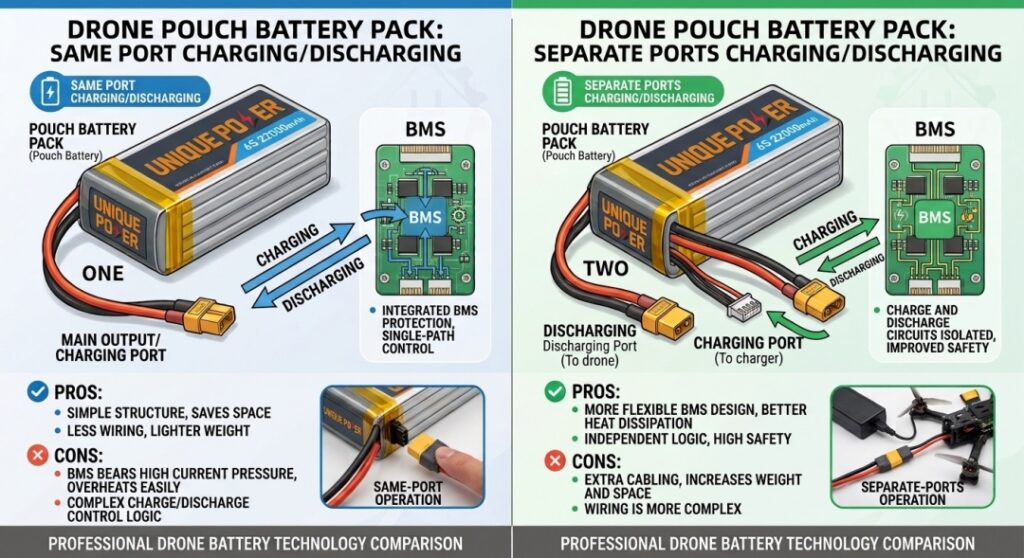
When designing a drone battery pack, engineers usually spend a lot of time discussing:
- Cell chemistry
- Energy density
- Discharge rate
- Capacity
- BMS communication
- Connector current rating
- Charging strategy
But there is another architectural decision that deserves more attention:
Should charging and discharging use the same port or separate ports?
In battery-pack design, these are commonly referred to as:
Common-Port BMS
and
Separate-Port BMS
At first glance, the difference seems simple.
Common port: charging and discharging share the same external power terminals.
Separate port: charging and discharging use different current paths and external terminals.
But for industrial UAV batteries, this choice can influence much more than connector layout.
It can affect:
MOSFET sizing, conduction loss, heat generation, BMS protection strategy, connector weight, charging infrastructure, hot-swap design, maintenance and operational safety.
And because UAV batteries often have a very asymmetric power profile—
High-power discharge + Much lower-power charging
—the engineering trade-off becomes particularly interesting.
1. What Is a Common-Port BMS?
In a typical common-port architecture, the battery uses one main positive and negative power interface for both charging and discharging.
Conceptually:
Charger ↔ Battery ↔ UAV
The same external power terminals handle current in both directions.
Inside the BMS, the charge and discharge switching devices are arranged so that the BMS can control both operating states through the shared current path.
For the UAV operator, this architecture is simple:
One battery. One main power connector.
The same interface can potentially be used for:
- Powering the UAV
- Charging the battery
- Maintenance
- Battery testing
depending on the system architecture.
This simplicity is one of the biggest advantages of common-port design.
2. What Is a Separate-Port BMS?
A separate-port architecture divides charging and discharging into different electrical paths.
Conceptually:
Discharge Port → UAV
while:
Charge Port ← Charger
The discharge path can therefore be optimized specifically for high-power output.
The charging path can be designed around a much lower charging current.
For UAV batteries, this can make sense because the two operating conditions may be dramatically different.
Imagine a battery that experiences:
200A peak discharge
during takeoff,
but is charged at only:
20A
on the ground.
That is a 10:1 difference in current requirement.
Why should both electrical paths necessarily be designed identically?
That is the engineering argument behind separate-port architecture.
3. Why This Question Is Particularly Relevant to UAV Batteries
Industrial UAV batteries have a very different load profile from many consumer batteries.
Consider a heavy-lift drone.
During takeoff:
I_discharge = 200–300A
During cruise:
I_discharge = 80–150A
During charging:
I_charge = 15–30A
The discharge system may therefore need to handle several times—or even more than ten times—the current of the charging system.
This difference affects:
- MOSFET selection
- PCB copper
- Busbars
- Connectors
- Cable gauge
- Thermal design
And this is where the common-port vs. separate-port decision becomes more than a connector question.
It becomes a:
Power Architecture Question.
4. MOSFET Losses Explain Much of the Difference
For a simplified MOSFET conduction model:
P_loss ≈ I² × R_DS(on)
This equation is extremely important for UAV batteries.
Suppose the effective MOSFET path resistance is:
2 mΩ
At 20A charging current:
P_loss = 20² × 0.002 = 0.8W
At 100A discharge:
P_loss = 100² × 0.002 = 20W
At 200A:
P_loss = 200² × 0.002 = 80W
At 300A:
P_loss = 300² × 0.002 = 180W
The exact real-world loss depends on MOSFET configuration, junction temperature, parallel devices, PCB/busbar resistance and switching architecture.
But the principle is clear:
High-current UAV discharge makes every milliohm expensive.
This is one reason high-power drone battery design cannot treat BMS current paths as an afterthought.
5. The Common-Port Advantage: Simplicity
For many UAV systems, common-port architecture has one major advantage:
Operational simplicity.
There is only one main power interface.
That means:
- Fewer external power connectors
- Less wiring
- Less confusion
- Lower risk of using the wrong port
- Easier battery handling
- Potentially easier field replacement
For a drone operator changing batteries many times per day, this matters.
A battery may be removed from the UAV, connected to a charger, charged and returned to service repeatedly.
The simpler the workflow, the lower the chance of human error.
This becomes particularly valuable in:
- Mapping fleets
- Inspection operations
- Agricultural UAVs
- Security UAVs
- Training fleets
where batteries may be handled by multiple operators.
6. Connector Count Is Also a Weight and Reliability Issue
Every additional high-current connector potentially adds:
- Connector mass
- Cable mass
- Mechanical mounting
- Contact resistance
- Waterproofing requirements
- Potential failure points
For stationary energy storage, an extra connector may not matter much.
For a UAV, every gram matters.
And every connector is part of the aircraft’s power chain.
Remember:
P_connector = I² × R_contact
Suppose a connector develops only:
0.5 mΩ
of additional contact resistance.
At 200A:
P_loss = 200² × 0.0005
= 20W
That heat may be concentrated in a relatively small connector area.
This is why connector quality, mating cycles, contamination and contact resistance matter greatly in UAV battery systems.
A simpler external interface can therefore have real reliability advantages.
7. But Common-Port Architecture Can Make High-Power Design More Difficult
Now we reach the other side of the trade-off.
Suppose a UAV battery has:
250A peak discharge
but only:
25A maximum charging current
The discharge current is 10 times the charging current.
In a common current-path architecture, the switching and conduction path must still be designed around the battery’s high-power requirements.
This can require:
- Lower-RDS(on) MOSFETs
- More MOSFETs in parallel
- Larger copper area
- Better heat spreading
- More demanding thermal design
So although common-port architecture can reduce external connector complexity, it does not automatically mean the entire BMS is cheaper.
This distinction is important.
Fewer connectors ≠ Automatically lower total system cost.
At very high power, the internal current-path requirements can dominate the BMS design.
8. Separate-Port Architecture Allows More Targeted Optimization
Now imagine separating the two functions.
Discharge path
Designed for:
250A peak
Charge path
Designed for:
25A
The high-current discharge side can use components optimized for:
- Very low resistance
- High current
- Strong thermal performance
The charging side can use components sized for a much smaller current.
This can avoid overdesigning every part of the charging path around maximum propulsion current.
For high-power UAV batteries, that can offer advantages in:
- Component selection
- PCB layout
- Thermal distribution
- Cost optimization
This is particularly relevant when:
I_discharge >> I_charge
9. Separate Ports Can Also Help Separate Thermal Sources
Thermal management is one of the biggest challenges in high-power drone batteries.
Heat generation can be approximated as:
P_heat = I²R
In a separate-port architecture, charging and discharging use different controlled paths.
That gives BMS engineers more freedom to distribute:
- MOSFETs
- Busbars
- Thermal pads
- Heat spreaders
- Temperature sensors
around the pack.
This can be useful in compact heavy-lift battery packs where PCB space and thermal concentration become limiting factors.
However, separate ports do not eliminate heat.
The high-current discharge path still needs excellent thermal design.
They simply provide more architectural freedom.
10. The Biggest Risk of Separate-Port Design Is Misuse
Separate ports introduce an important operational problem:
The user now has to know which port does what.
Suppose a battery has:
P+/P− — High-current discharge
and:
C+/C− — Charging
What happens if an operator connects the UAV load to the charging port?
Depending on the BMS architecture, several things can happen.
The battery may simply refuse to operate.
But in a poorly designed or misused system, the charging path could experience current far beyond its intended rating.
For example:
Charge-path design current = 20A
but:
UAV demand = 150A
The charging MOSFETs, traces, connector or wiring may not be designed for that load.
This creates potential:
- Overheating
- Voltage drop
- Component damage
- Connector damage
More importantly, depending on the specific BMS topology, current flowing through an unintended path may not receive the same protection behavior expected from the normal discharge path.
Therefore:
Separate-port design requires stronger interface management.
11. Connector Keying Becomes Part of Battery Safety
If separate ports are used on an industrial UAV battery, I would not rely only on labels such as:
CHARGE
and:
DISCHARGE
Human beings make mistakes.
A better system uses physical differentiation.
For example:
- Different connector families
- Different connector sizes
- Different keying
- Different mechanical locations
- Recessed charging connector
- Color identification as a secondary cue
The objective should be:
Make incorrect connection physically difficult—or ideally impossible.
This is especially important for commercial UAV fleets where batteries may be handled quickly in field conditions.
12. Common-Port Design Can Be Attractive for Automated Charging
Now consider an autonomous drone dock.
The aircraft lands.
The system automatically connects to power.
Then the battery is charged without human intervention.
A common power interface can simplify this architecture because the same main electrical interface can potentially support the required power flow strategy, depending on the complete system design.
This may reduce:
- Mechanical contacts
- Alignment requirements
- Connector complexity
For autonomous drone operations, fewer mechanical interfaces can be valuable.
But charging docks introduce another question:
Should the battery be charged inside the aircraft at all?
That depends on the operating model.
13. Separate Ports Can Make Sense for Dedicated Charging Infrastructure
Some industrial UAV fleets use:
- Dedicated charging stations
- Battery cabinets
- Battery swap stations
- Charging trays
- Robotic battery exchange
In these environments, a dedicated charging interface can be advantageous.
The battery may have:
High-current UAV output interface
plus:
Dedicated charging interface
plus possibly:
Communication interface
The charging station can then be designed specifically around:
- Charging current
- Cell balancing
- Battery temperature
- SOC
- SOH
- Battery ID
- Cycle history
For a fleet operation, this can turn the battery from a simple removable component into a:
Managed Energy Asset.
14. Charging Current Is Becoming More Important
Historically, many UAV batteries were discharged much faster than they were charged.
For example:
3C discharge
versus:
0.5C charge
This strongly favors asymmetric current-path thinking.
But the situation is changing.
Commercial UAV fleets increasingly want:
- Faster turnaround
- Opportunity charging
- Automated charging
- High-utilization operations
Suppose a 30Ah battery is charged at:
0.5C → 15A
but a future charging strategy increases this to:
2C → 60A
Suddenly the charging path is no longer a low-current secondary circuit.
This means the correct port architecture should not only consider today’s charging strategy.
It should consider:
Future fleet utilization requirements.
15. Fast Charging Changes the Common-Port vs. Separate-Port Equation
This is particularly important for logistics and autonomous drone operations.
Imagine two battery strategies.
Strategy A
Discharge: 200A peak
Charge: 20A
Current ratio:
10:1
Separate-port optimization can be attractive.
Now consider:
Strategy B
Discharge: 200A peak
Fast charge: 100A
Current ratio:
2:1
The advantage of heavily differentiating the charge and discharge paths becomes smaller.
At the same time, thermal management during charging becomes much more important.
So port architecture should be selected together with:
Charging Strategy
not independently.
16. What About Drone Batteries Without High-Current BMS Switching?
There is another important UAV-specific issue.
Not every high-power drone battery uses the same BMS architecture.
For very high-current propulsion systems, routing the entire propulsion current through semiconductor switching devices can create:
- Additional resistance
- Additional heat
- Additional weight
- Additional failure modes
Some high-power battery architectures may therefore separate:
Monitoring
from:
Main current interruption
or use other protection architectures depending on the system requirements.
This is an important reminder:
“Common port vs. separate port” is only one part of the battery power architecture.
For a 20A battery and a 300A propulsion battery, the correct BMS architecture may be fundamentally different.
17. Dual-Battery UAVs Add Another Layer of Complexity
Many industrial drones use two battery packs.
At first glance, this may appear to provide redundancy.
But two batteries do not automatically create a redundant power system.
Engineers must consider:
- Current sharing
- Pack voltage mismatch
- Reverse current
- Connector sequencing
- Pack isolation
- Failure isolation
- Communication
- SOC mismatch
Suppose Battery A is at:
50.0V
and Battery B is at:
48.0V
If they are directly paralleled without appropriate control, equalization current can flow between the packs.
Conceptually:
I_equalization = ΔV / R_total
If:
ΔV = 2V
and total path resistance is only:
20mΩ
then:
I = 2 / 0.020 = 100A
That illustrates why multi-battery UAV architecture needs much more thought than simply adding another connector.
18. Hot-Swap Makes Port Architecture Even More Important
Now imagine an industrial UAV that supports hot-swappable batteries.
One battery is removed while another continues powering critical systems.
The design now has to manage:
- Reverse current
- Inrush current
- Pre-charge
- Contact sequencing
- Pack isolation
- Voltage matching
- BMS communication
- Fault containment
For these systems, battery connectors are no longer passive pieces of hardware.
They become part of the:
Power Management Architecture.
The common-port vs. separate-port decision should therefore be made together with the aircraft’s:
Redundancy + Hot-Swap + Charging + BMS Strategy.
19. Smart BMS Communication Can Reduce the Risk of Both Architectures
Whether using common or separate ports, modern industrial UAV batteries increasingly benefit from communication between the battery and aircraft.
Typical interfaces may include:
- CAN
- UART
- SMBus
- Other proprietary protocols
Instead of simply reporting:
SOC = 35%
a smart battery can provide:
- Pack voltage
- Current
- Cell voltages
- Cell temperature
- MOSFET temperature
- SOH
- Cycle count
- Fault status
- Charge permission
- Discharge permission
- Maximum allowable current
This allows the aircraft and charger to make better decisions.
For example:
Battery temperature too high → Reduce charging current
or:
Low SOC + high internal resistance → Limit peak propulsion demand
The future of UAV battery protection will increasingly involve both:
Hardware Protection + Intelligent Energy Management
20. How I Would Choose Between Common Port and Separate Port for a UAV Battery
I would not start with the connector.
I would start with seven questions.
1. What is the maximum continuous discharge current?
2. What is the peak discharge current and how long does it last?
3. What is the maximum charging current?
4. What is the discharge-to-charge current ratio?
5. Is the battery manually connected or automatically docked?
6. Does the aircraft require hot-swap or dual-battery redundancy?
7. What happens if the user connects the wrong port?
Once those questions are answered, the architecture becomes much clearer.
21. When I Would Prefer Common Port
Common-port architecture can be attractive when:
- Charging and discharging currents are not extremely asymmetric
- Operational simplicity is important
- Battery weight and connector count must be minimized
- Operators frequently swap batteries manually
- Misconnection risk needs to be minimized
- The same battery is used across multiple platforms
- Automated docking benefits from a simplified interface
For many small and medium industrial UAVs, common port can therefore remain an excellent solution.
Its greatest advantage is not necessarily MOSFET cost.
It is:
System Simplicity.
22. When I Would Consider Separate Ports
Separate-port architecture becomes more interesting when:
- Discharge current is much higher than charge current
- The propulsion system requires very high peak power
- BMS thermal management is difficult
- Charge and discharge circuits benefit from different component ratings
- A dedicated charging station is already part of the ecosystem
- The charging interface can be physically protected against misuse
- Pack size allows the additional connector and wiring
For certain:
- Heavy-lift UAVs
- Logistics drones
- High-power VTOL platforms
- Industrial drone fleets
this architecture may provide useful design flexibility.
But the benefits must be weighed against increased:
Connector complexity + Wiring + Weight + Human-factor risk.
23. A Better Engineering Decision Matrix
Instead of asking:
“Common port or separate port—which is better?”
I would evaluate the architecture this way:
| Engineering Factor | Common Port | Separate Port |
|---|---|---|
| External interface | Simpler | More complex |
| Misconnection risk | Lower | Higher unless keyed |
| Connector count | Lower | Higher |
| Weight potential | Lower | Potentially higher |
| Charge/discharge optimization | More coupled | More independent |
| High-power thermal flexibility | More constrained | Potentially better |
| Dedicated charging station | Possible | Very suitable |
| Field operation simplicity | Strong | Requires management |
| Very asymmetric current | May require more overdesign | Potential advantage |
| Automated fleet integration | Depends on architecture | Depends on charging ecosystem |
There is no universal winner.
The correct solution depends on the complete UAV energy architecture.
24. The Real Design Question Is Bigger Than “Common vs. Separate”
From a UAV battery engineering perspective, I believe the discussion should eventually move beyond:
“Do we need one connector or two?”
The better question is:
“How should energy move safely and efficiently between the battery, aircraft and charging infrastructure?”
That includes:
Cell
↓
BMS
↓
MOSFET / Protection Architecture
↓
Busbar & Cable
↓
Connector
↓
Aircraft Power Distribution
↓
ESC / Avionics / Payload
and on the charging side:
Battery
↕
Charger
↕
Fleet Energy Management
Once viewed this way, the charging port is no longer an isolated connector decision.
It is part of the UAV’s complete energy system.
Final Thoughts
For drone batteries, common-port and separate-port designs are not simply “simple vs. advanced.”
They optimize different problems.
Common Port
prioritizes:
Simplicity + Fewer Connectors + Lower Misconnection Risk + Easier Operation
Separate Port
can prioritize:
Independent Current-Path Optimization + High-Power Flexibility + Thermal Distribution + Dedicated Charging Architecture
For a small UAV with moderate discharge current, adding a second power interface may create complexity without enough benefit.
For a heavy-lift UAV where discharge current is several times higher than charging current, separate-port architecture may deserve serious consideration.
But there is one principle I would keep in mind:
Never select the port architecture only from the battery side.
Look at the complete system:
UAV Power Demand
Battery Current
BMS Protection
Connector & Cable Losses
Charging Strategy
Hot-Swap / Redundancy
Fleet Operation
Only then decide.
Because in an industrial UAV, a battery connector is not simply where two wires meet.
It is where the aircraft, battery and energy infrastructure become one electrical system.
#DroneBattery #UAVEngineering #BMS #BatteryEngineering #IndustrialDrones #PowerElectronics #BatteryManagementSystem #HeavyLiftDrone #DroneTechnology #UAVBattery #ChargingSystem #PowerManagement #DroneOEM