
When choosing an industrial drone, many people start by comparing three specifications:
Flight time. Payload. Price.
These numbers are important.
But once a UAV enters a real project, one of the most expensive mistakes is often not choosing a drone with insufficient specifications.
It is choosing an aircraft architecture that does not match the mission.
Consider inspection as an example.
If the mission is to survey dozens of kilometers of power lines, cruise efficiency and coverage may matter most.
If the mission requires close inspection of equipment inside a substation, hovering capability, low-speed control and positioning accuracy become much more important.
If the operation takes place in mountainous terrain with no runway, but the aircraft still needs to cover a long distance, the platform may need both vertical takeoff and efficient fixed-wing cruise.
These are all “inspection drones.”
But they should not necessarily use the same aircraft architecture.
That is why I believe UAV selection should not begin with:
“Which drone has the best specifications?”
It should begin with:
“What does the mission actually require the aircraft to do?”
Once that question is clear, the differences between the four major UAV architectures become much easier to understand.
1. Start With the Fundamentals: Where Does the Lift Come From?
At the most fundamental level, every UAV has to generate enough lift to support its weight while maintaining controlled motion.
The major difference between common UAV architectures is:
How is that lift generated and sustained?
This fundamental difference affects almost everything else:
- Endurance
- Range
- Hover capability
- Payload
- Takeoff and landing
- Maneuverability
- Energy consumption
- System complexity
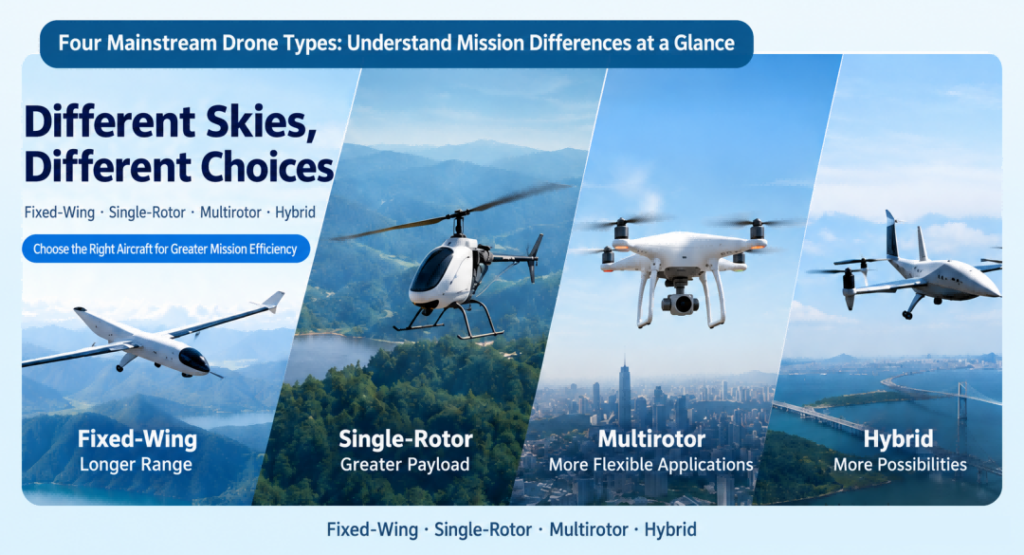
For industrial applications, four architectures are particularly important:
1. Fixed-Wing
2. Single-Rotor
3. Multirotor
4. VTOL Fixed-Wing / Hybrid VTOL
They may all share the same sky.
But they follow very different mission logic.

2. Fixed-Wing UAV: Designed to Cover More Distance Efficiently
A fixed-wing aircraft generates lift through the relative motion between its wings and the surrounding air.
Once the aircraft reaches cruise speed, the wings provide lift efficiently.
The propulsion system mainly needs to overcome aerodynamic drag rather than directly generate all the lift required to support the aircraft.
This gives fixed-wing UAVs a major advantage:
Cruise efficiency.
For missions requiring long distance or large-area coverage, that efficiency can translate into:
- Longer endurance
- Longer range
- Greater area coverage per flight
- Lower energy consumption per kilometer
Typical applications include:
- Large-area mapping
- Long-distance power-line inspection
- Pipeline inspection
- Forestry surveys
- Coastal monitoring
- Environmental surveys
- Large agricultural surveys
If your mission is essentially:
“Cover as much ground as possible in one flight.”
fixed-wing deserves serious consideration.
But this efficiency comes with trade-offs.
Traditional fixed-wing UAVs cannot hover like multirotors.
They also require forward airspeed to generate lift, and some designs need sufficient space or specialized methods for launch and recovery.
So although fixed-wing can be excellent for corridor inspection, it may be poorly suited to inspecting a specific bolt, insulator or structural defect from a stationary position.
This illustrates an important principle:
Long endurance does not automatically mean better inspection capability.
It depends on what kind of inspection needs to be performed.
3. Single-Rotor UAV: When Lift and Heavy Payload Become the Priority
A single-rotor UAV operates much more like a conventional helicopter.
A large main rotor generates most of the lift, while additional control mechanisms manage stability and directional control.
Compared with many smaller multirotor architectures, single-rotor platforms can be attractive when the mission demands:
- Heavy payload
- Strong lift capability
- Longer-duration high-load operation
- Better performance in demanding wind conditions
- Specialized industrial operations
Typical missions may include:
- Cargo lifting
- External-load transportation
- Heavy sensor payloads
- Specialized industrial operations
The large rotor can provide substantial lift efficiently.
But the architecture also introduces additional considerations.
Single-rotor systems may involve greater:
- Mechanical complexity
- Maintenance requirements
- Safety considerations
- Operator training
- Ground-handling requirements
The large rotating system also changes the safety envelope around the aircraft.
So single-rotor UAVs are rarely selected simply because “they can carry more.”
They make the most sense when the mission value of heavy lift justifies the additional system complexity.
4. Multirotor UAV: The Flexible Workhorse of Industrial Drone Operations
If you look across industrial drone applications today, multirotors are everywhere.
There is a good reason.
A multirotor controls its attitude and position by changing the speed and thrust of multiple motors and propellers.
This architecture provides several extremely useful capabilities:
Vertical takeoff
Vertical landing
Hovering
Low-speed flight
Precise positioning
Rapid directional changes
These characteristics make multirotors highly suitable for:
- Infrastructure inspection
- Aerial photography
- Security
- Emergency response
- Agriculture
- Building inspection
- Construction monitoring
- Close-range sensing
Imagine inspecting a transmission tower.
The UAV may need to:
Approach slowly
↓
Stop
↓
Hover
↓
Change camera angle
↓
Move sideways
↓
Inspect another component
↓
Climb several meters
↓
Hover again
This is exactly the type of mission where multirotor architecture excels.
But there is a price for this flexibility.
5. Why Multirotors Usually Pay an Energy Penalty
During hover, a multirotor must continuously use its propellers to generate enough thrust to support its weight.
In simplified terms:
T ≈ W
where:
- T = total thrust
- W = aircraft weight
The propulsion system therefore remains responsible for generating lift throughout the flight.
A fixed-wing aircraft, by comparison, can use aerodynamic lift from its wings during forward flight.
This is one reason multirotors generally have lower long-distance cruise efficiency than fixed-wing aircraft.
For short-range precision work, that may not matter.
For a 50-km corridor mission?
It can become decisive.
This is why a multirotor that is excellent for detailed inspection may be inefficient for large-area coverage.
Again:
There is no universally superior architecture.
The mission determines what “efficient” actually means.
6. VTOL Fixed-Wing: Combining Vertical Takeoff With Efficient Cruise
Now consider a different mission.
The UAV needs to:
- Take off from a small mountain clearing
- Fly tens of kilometers
- Survey a long corridor
- Return
- Land vertically
A conventional fixed-wing aircraft may provide excellent cruise efficiency.
But there is no runway.
A multirotor can take off easily.
But long-distance cruise may consume too much energy.
This is where VTOL fixed-wing, sometimes called hybrid or compound-wing architecture, becomes particularly interesting.
The aircraft combines:
Vertical Takeoff and Landing
with:
Fixed-Wing Cruise
The mission may look like:
Vertical Takeoff
↓
Transition
↓
Fixed-Wing Cruise
↓
Mission
↓
Return Cruise
↓
Transition
↓
Vertical Landing
This architecture is particularly attractive for:
- Mountainous regions
- Islands
- Corridor inspection
- Pipeline monitoring
- Large-area mapping
- Remote operations
- Environments without runways
It solves one of the biggest operational limitations of conventional fixed-wing aircraft.
But there is no free performance.
7. VTOL Capability Adds Complexity
A VTOL fixed-wing aircraft effectively has to satisfy two very different flight conditions.
During vertical takeoff:
Thrust must directly support aircraft weight.
During cruise:
The wing becomes the primary lift-producing surface.
The propulsion and control system therefore has to manage:
- VTOL power demand
- Transition control
- Cruise efficiency
- Multiple propulsion modes
- Energy allocation
- Failure management
Depending on the architecture, the aircraft may also carry propulsion components used mainly during takeoff and landing.
That adds:
- Weight
- Wiring
- ESCs
- Motors
- Structural complexity
So VTOL fixed-wing should not be viewed as:
“Fixed-wing plus all the advantages of multirotor.”
It is better understood as:
A compromise architecture designed for missions that genuinely require both vertical operation and efficient cruise.
When the mission requires both, the compromise can be extremely valuable.
When it does not, the additional complexity may be unnecessary.
8. The Most Useful Comparison Is Mission Capability—not One Specification

Comparing UAVs by only one parameter can be misleading.
For example:
“This drone flies for 120 minutes.”
Interesting.
But can it hover?
“This drone carries 20 kg.”
Useful.
But can it operate safely from the available site?
“This drone flies at 120 km/h.”
Impressive.
But does the mission actually require that speed?
A more useful comparison looks at several dimensions simultaneously.

The point is not to declare a winner.
The point is to identify the architecture whose strengths correspond to the mission.
9. Five Questions That Are Often More Important Than “Flight Time”
When evaluating a UAV platform, I believe five questions deserve more attention.
Question 1: What Is the Actual Mission Radius?
“60-minute endurance” sounds useful.
But what does the aircraft need to accomplish during those 60 minutes?
There is a major difference between:
Inspecting 30 assets within a 2-km area
and:
Following a 40-km pipeline corridor.
For long corridors and large areas, cruise efficiency becomes increasingly important.
For concentrated multi-point operations, deployment, hovering and repositioning may matter more.
So instead of asking:
“How long can it fly?”
ask:
“How much of my mission can it complete per sortie?”
That is a more useful operational metric.
10. Payload Is Not Just About Kilograms
Another common mistake is reducing payload capability to:
Maximum Payload = X kg
But payload behavior matters just as much as payload mass.
Consider four payloads:
Camera
Requires stability and precise positioning.
LiDAR
May require stable trajectories, accurate positioning and sufficient endurance.
Delivery Box
Adds mass and may alter the aircraft’s center of gravity and aerodynamic behavior.
Suspended Cargo
Can introduce pendulum dynamics and significantly change flight-control requirements.
The same 5-kg payload can therefore create very different aircraft requirements.
For payload selection, ask:
- How heavy is it?
- Where is it mounted?
- Does it change during the mission?
- Does it need power?
- Does it need communication?
- Does it affect CG?
- Does it require the aircraft to hover?
Payload mass alone does not define payload integration.
11. Takeoff and Landing Conditions Can Eliminate an Architecture Before Anything Else
This is one of the most practical lessons in UAV selection.
Before comparing endurance or payload, look at the operating site.
Ask:
- Is there a runway?
- Is there open ground?
- Is the aircraft operating from a mountain?
- A forest?
- A rooftop?
- A ship?
- A narrow industrial site?
- An offshore platform?
A fixed-wing UAV may offer excellent endurance.
But if it cannot be safely launched and recovered at the site, that endurance becomes irrelevant.
In many projects:
“Can it safely take off and land here?”
is more important than:
“What is its maximum speed?”
Operational reality should eliminate unsuitable architectures early.
12. Environmental Conditions Are Part of the Mission—not Footnotes
Datasheet performance is usually easier to understand under ideal conditions.
Real operations are not ideal.
Industrial UAVs may face:
- High altitude
- Strong wind
- Low temperature
- High temperature
- Salt spray
- Dust
- Rain
- Electromagnetic interference
These conditions affect different architectures differently.
For example, high altitude reduces air density.
Lower air density affects:
- Rotor thrust
- Propeller performance
- Wing lift
- Cooling
Strong wind can increase power consumption and reduce mission reserve.
Cold temperature can reduce battery power capability and usable energy.
High temperature can increase thermal stress on:
- Batteries
- Motors
- ESCs
- Electronics
So environmental requirements should be included from the beginning.
Not added after platform selection.
13. Battery Requirements Also Change With UAV Architecture
From a battery engineering perspective, this is particularly interesting.
Different aircraft architectures create very different power-vs.-time profiles.
Fixed-Wing
The battery may experience relatively moderate continuous power during efficient cruise.
Therefore, the design may place stronger emphasis on:
Specific Energy — Wh/kg
Long endurance benefits significantly from reducing battery mass while increasing stored energy.
Multirotor
The battery continuously supports the aircraft through rotor thrust.
The system may experience:
- High continuous current
- High takeoff current
- Wind-related power peaks
- Hover thermal load
So the battery must balance:
Wh/kg + W/kg + Voltage Stability + Thermal Performance
Single-Rotor
Heavy-payload applications may create substantial continuous and transient power demand.
Battery design may therefore require careful attention to:
- Peak current
- Continuous current
- Voltage sag
- Thermal management
- Energy reserve
VTOL Fixed-Wing
This architecture creates one of the most interesting battery profiles.
Vertical takeoff may require:
High Power / Short Duration
while cruise requires:
Lower Power / Long Duration
So the battery must satisfy both:
P_available ≥ P_VTOL_peak
and:
E_available ≥ E_total_mission + Reserve
A battery with excellent energy density but insufficient peak power may therefore be unsuitable.
And a very high-power battery with poor energy density may unnecessarily reduce cruise endurance.
This is why battery selection should follow the aircraft mission profile.
14. One Battery Metric Cannot Optimize Four Aircraft Architectures
This also explains why statements such as:
“Higher C-rate is always better.”
or:
“Higher Wh/kg is always better.”
are incomplete.
For a long-endurance fixed-wing UAV, every additional Wh/kg may create significant value.
For a heavy-lift multirotor, reducing internal resistance and maintaining voltage under high load may be equally important.
For a VTOL fixed-wing aircraft, the challenge may be finding the right balance between:
high peak power during takeoff
and:
high usable energy during cruise.
So the correct battery metric depends on the aircraft architecture.
Battery selection and aircraft selection are connected engineering decisions.
15. Real Industrial Operations Often Need More Than One UAV Type
There is another important point.
Organizations often ask:
“Which UAV should we buy?”
But for large-scale operations, the better answer may be:
More than one architecture.
Consider power-grid inspection.
A fixed-wing or VTOL fixed-wing platform could perform:
Long-distance corridor screening
covering many kilometers efficiently.
When the system detects a suspicious location, a multirotor could perform:
Close-range detailed inspection
hovering near the asset and capturing high-resolution data.
For heavy transport, a larger multirotor or single-rotor platform might perform another part of the operation.
So instead of forcing one aircraft to do everything:
Platform A — Wide-area discovery
Platform B — Detailed inspection
Platform C — Specialized intervention
This can be a much more efficient operational architecture.
16. The Future Is Not One UAV Architecture Replacing the Others

Technology discussions often focus on replacement.
Will VTOL replace fixed-wing?
Will multirotors dominate everything?
Will autonomous drones eliminate manually operated systems?
I don’t think that is the most useful way to frame the future.
Each architecture solves a different physical problem.
Fixed-Wing
will continue improving:
- Endurance
- Autonomous routing
- Aerodynamic efficiency
- Long-distance operations
Multirotor
will increasingly integrate:
- Automated docking
- Autonomous charging
- Unattended operation
- AI-based inspection
- Precision navigation
VTOL Fixed-Wing
will improve:
- Transition control
- Energy management
- Propulsion integration
- Autonomous operation
Single-Rotor
will continue providing value where:
- Heavy lift
- High power
- Specialized industrial missions
justify its architecture.
The future is therefore not necessarily:
One Architecture Wins.
It is more likely:
Each Architecture Becomes Better at the Missions It Was Physically Suited to Perform.
17. The Real Competition Is Moving Beyond the Airframe
As UAV technology matures, the airframe itself becomes only one part of the competitive advantage.
Real industrial value increasingly comes from integrating:
Aircraft
Payload
Battery & Energy System
Navigation
Communication
AI / Perception
Data Processing
Fleet Operations
A drone with impressive flight specifications but poor operational integration may create less value than a technically less impressive platform embedded in a well-designed workflow.
This is especially true as UAV operations scale.
At fleet level, operators care about:
- Mission completion rate
- Turnaround time
- Maintenance
- Battery replacement
- Charging
- Personnel requirements
- Data processing
- Regulatory compliance
- Cost per mission
That is where UAV selection becomes a business-system decision rather than simply an aircraft-purchasing decision.
18. Don’t Optimize for Maximum Flight Time—Optimize for Mission Completion
This is perhaps the most important shift.
Suppose UAV A flies for:
120 minutes
while UAV B flies for:
45 minutes
Does UAV A automatically create more value?
No.
If the mission requires hovering beside equipment, UAV A may not even be able to perform the task.
Likewise, if the mission requires surveying 100 km of corridor, UAV B’s excellent hover capability may not compensate for its lower cruise efficiency.
The metric should therefore move from:
Maximum Flight Time
toward:
Mission Completion Efficiency
That means asking:
- How many assets can be inspected per sortie?
- How many square kilometers can be mapped?
- How many kilometers of corridor can be covered?
- How many kilograms can be delivered?
- How many sorties are required?
- How much energy is consumed?
- How many operators are needed?
These questions connect aircraft performance to real operational value.
19. A Practical UAV Architecture Selection Framework
Before choosing the platform, I would define the mission in the following order.
Step 1 — Where Does the Mission Happen?
Define:
- Terrain
- Altitude
- Wind
- Temperature
- Takeoff area
- Landing area
- Obstacles
- Operational radius
Step 2 — What Must the Aircraft Carry?
Define:
- Payload mass
- Payload dimensions
- Power requirement
- Mounting location
- CG impact
- Required stabilization
- Required communication
Step 3 — How Must the Aircraft Move?
Does the mission require:
- Hovering?
- Long-distance cruise?
- Slow inspection?
- High speed?
- Vertical takeoff?
- Precision positioning?
- Heavy lifting?
This question often identifies the most appropriate architecture very quickly.
Step 4 — What Is the Mission Power Profile?
Estimate the power required during:
- Takeoff
- Climb
- Cruise
- Hover
- Payload operation
- Return
- Landing
This helps determine not only aircraft architecture, but also:
Battery architecture.
Step 5 — Evaluate the Complete Lifecycle
Finally, include:
- Aircraft purchase
- Batteries
- Chargers
- Maintenance
- Spare parts
- Training
- Insurance
- Data links
- Regulatory requirements
- Battery replacement
- Downtime
The cheapest UAV to purchase may not be the cheapest system to operate.
20. A Simple Way to Think About the Four Architectures
If I had to summarize the four architectures in one sentence each:
Fixed-Wing
Choose it when efficient coverage and range dominate the mission.
Single-Rotor
Consider it when heavy lift and demanding professional operations justify greater mechanical complexity.
Multirotor
Choose it when hovering, precision and operational flexibility dominate the mission.
VTOL Fixed-Wing
Consider it when you need both runway-independent operation and efficient long-distance cruise.
None of these descriptions means one architecture is technically superior.
They simply represent different optimization priorities.
Final Thoughts: Choosing a UAV Means Choosing a Way to Perform the Mission
Fixed-wing aircraft are excellent at expanding coverage and cruise efficiency.
Single-rotor platforms can emphasize lift and heavy-payload capability.
Multirotors excel at hovering, positioning and precise local operations.
VTOL fixed-wing aircraft try to balance vertical deployment with efficient long-range cruise.
The mature way to select a UAV is therefore not to chase one impressive specification.
It is to answer three questions:
1. Where will the mission take place?
2. What payload must the aircraft carry and operate?
3. How must the aircraft fly to complete that mission safely, reliably and economically?
Once those three questions are clear, the correct architecture often becomes much easier to identify.
And from a battery-system perspective, there is a fourth question worth adding:
What power and energy profile does that architecture create?
Because the aircraft architecture determines how the UAV flies.
The mission determines how much power and energy it needs.
And the battery must support both.
Ultimately, UAV selection is not about finding the aircraft with the highest specifications.
It is about finding the architecture that turns flight capability into mission capability.
#UAV #DroneTechnology #IndustrialDrones #FixedWingUAV #Multirotor #VTOL #DroneInspection #UAVEngineering #DroneBattery #HeavyLiftDrone #DroneMapping #AutonomousDrones #UAVSystems