
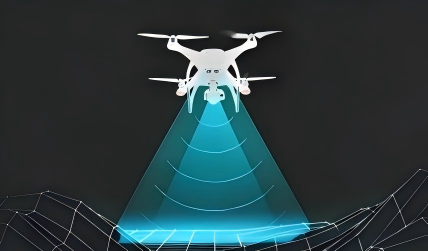
When we talk about drones, we often focus on batteries, flight time, payload, or range. But behind every stable flight is something even more fundamental: sensing systems.
A useful way to understand drone intelligence is to compare it with human perception. Just like humans rely on inner ears, eyes, and touch, drones also rely on a set of “digital senses” to understand themselves and the environment.
Let’s break down the four core sensing systems that keep a drone stable, aware, and controllable.
1. IMU: The Drone’s Inner Ear and Balance System
The IMU (Inertial Measurement Unit) is the most fundamental sensor in a drone.
You can think of it as the drone’s:
- Inner ear (balance)
- Cerebellum (motion coordination)
The IMU does not care about the external environment. Instead, it constantly answers one question:
“How am I moving right now?”
Inside the IMU are:
- Gyroscopes (measuring rotation)
- Accelerometers (measuring acceleration)
These sensors report data to the flight controller hundreds of times per second.
Based on this, the drone can:
- Stabilize its posture
- Maintain hover
- Respond instantly to disturbances
Without IMU, stable flight simply does not exist.
2. Optical Flow Camera: The Drone’s Downward Vision
Even with IMU, small drift is unavoidable.
To solve this, drones use a downward-facing system called the optical flow camera.
It does not recognize objects. Instead, it focuses on surface texture:
- Floor tiles
- Carpet patterns
- Ground details
By tracking how these textures “move” in the camera frame, the drone can determine:
“I am drifting left at 0.5 m/s.”
Then the flight controller immediately compensates using motor adjustments, effectively “pinning” the drone in place.
This is critical for:
- Indoor flight
- GPS-denied environments
- Precision hovering
3. Obstacle Avoidance Sensors: The Drone’s “Touch Sensors”
To move safely through space, drones need a way to detect obstacles.
This is where obstacle avoidance sensors come in—acting like artificial “touch” or “whiskers.”
They can include:
- Ultrasonic sensors (sound waves)
- Infrared sensors (light reflection)
- Stereo vision cameras (depth perception)
Their job is simple but vital:
“Is there something in front of me? How far away is it?”
Once an object enters a safety threshold, the drone will:
- Stop immediately
- Slow down
- Or reroute automatically
This layer is essential for safety in complex environments.
4. GPS and Compass: The Drone’s Map and Direction System
For outdoor operations, drones rely on global positioning and orientation systems.
GPS (Global Positioning System)
Provides:
- Exact geographic coordinates
- Route navigation
- Return-to-home capability
Compass (Magnetometer)
Provides:
- Heading direction
- Orientation relative to Earth’s magnetic field
Together, they allow the drone to:
- Fly to specific coordinates
- Follow predefined routes
- Return accurately to the launch point
Without GPS and compass, drones lose their “sense of direction” in open environments.
Putting It All Together: A Coordinated Sensory System
What makes drones powerful is not any single sensor, but the fusion of multiple sensing systems:
- IMU → stability and motion awareness
- Optical flow → precise local positioning
- Obstacle sensors → safety and collision avoidance
- GPS + compass → global navigation
These systems constantly work together, forming a real-time feedback loop that allows drones to fly autonomously and safely.
Why This Matters for the Drone Industry
For industries like drone logistics, inspection, agriculture, and mapping, sensor reliability directly affects:
- Flight stability
- Mission accuracy
- Safety performance
- Energy consumption (and thus battery demand)
As a drone battery industry professional, one important insight is:
Better sensing leads to more stable flight profiles, which directly improves battery efficiency and cycle performance.
Unstable control systems lead to:
- Higher current spikes
- Faster battery drain
- Increased thermal stress
This is why sensing systems and power systems are deeply connected in real-world UAV design.
Final Thoughts
A drone is not just a flying machine powered by batteries.
It is a coordinated system of “digital senses” that continuously:
- Perceives itself
- Understands its environment
- And adjusts its behavior in real time
IMU, cameras, sensors, and GPS together form the drone’s perception system—its version of eyes, ears, and touch.
And only when all these systems work together does stable, intelligent flight become possible.

