
For many companies importing products into Europe, packaging compliance still sounds like a simple question:
“Which factory made the packaging?”
Under the EU Packaging and Packaging Waste Regulation (PPWR), that may be the wrong question.
The more important questions are:
Who commissioned the packaging? Under whose name or trademark is it placed on the EU market? Who controls the technical documentation? Who is responsible for the applicable EPR obligations?
This matters especially for brand owners, OEM/ODM buyers, importers, distributors and private-label businesses.
Because under PPWR, the company physically manufacturing the packaging is not necessarily the company legally regarded as the manufacturer. (Eur-Lex)
And this creates a major compliance issue for companies that rely heavily on OEM/ODM supply chains.
1. The Biggest Misunderstanding: “We Outsourced Production, So We Outsourced Responsibility”
Many companies operate with a simple supply-chain model:
Brand Owner → OEM Factory → EU Customer
The brand owner designs the product and packaging, the OEM factory manufactures everything, and the finished goods are shipped to Europe.
It is tempting to assume:
“The factory made it, so the factory is responsible.”
But PPWR takes a more nuanced approach.
The European Commission’s 2026 guidance explains that a PPWR manufacturer does not necessarily have to be the company that physically produces the packaging.
Where packaging or a packaged product is designed or manufactured under a company’s own name or trademark, that company can be considered the manufacturer under the PPWR. (Eur-Lex)
This creates a very important principle for OEM businesses:
Manufacturing can be outsourced. Regulatory responsibility cannot automatically be outsourced.
2. Scenario 01: You Manufacture and Sell Under Your Own Brand
Imagine Company A:
- designs the product;
- manufactures the product;
- designs the packaging;
- places its own trademark on the packaging;
- sells the product in the EU.
This is the simplest situation.
The company controls both the manufacturing process and the commercial identity of the product.
It therefore needs to ensure that the packaging placed on the EU market complies with the applicable PPWR requirements.
Under Article 15, manufacturers must carry out the applicable conformity assessment, prepare the required technical documentation and, where compliance has been demonstrated through the applicable procedure, draw up the EU Declaration of Conformity. (Eur-Lex)
3. Scenario 02: OEM/ODM Factory + Your Brand
This is where things become much more interesting.
Imagine:
European Brand → places order → Asian OEM factory → manufactures product + packaging → brand’s trademark appears on packaging
The OEM factory physically produces the packaging.
But the packaging is designed or manufactured under the brand owner’s name or trademark.
According to the European Commission’s 2026 PPWR guidance, the brand owner can therefore be considered the manufacturer for PPWR purposes. (Eur-Lex)
This is one of the most important points for private-label businesses to understand.
The factory may manufacture the packaging.
But:
The brand owner may carry the regulatory manufacturer role.
This means an OEM contract saying:
“Supplier shall be responsible for all product quality.”
does not automatically mean:
“Supplier assumes all PPWR obligations.”
Those are two completely different concepts.
4. Scenario 03: Importer Rebrands the Product
Now consider another common model:
Overseas Manufacturer → EU Importer → New Brand → EU Market
The importer purchases a finished product and then:
- changes the packaging;
- adds its own trademark;
- changes labeling;
- repackages the product;
- places it on the EU market.
Under Article 21, an importer or distributor that places packaging on the market under its own name or trademark—or modifies packaging already placed on the market in a way that could affect compliance—can be considered the manufacturer for PPWR purposes. (Eur-Lex)
So rebranding is not merely a marketing decision.
It can change the company’s regulatory position.
This is particularly relevant for:
- private-label products;
- consumer electronics;
- industrial equipment;
- batteries and energy products;
- drones and robotics;
- tools and machinery;
- automotive components;
- e-commerce products.
5. Scenario 04: Imported and Sold Under the Original Brand
What if the importer does not rebrand anything?
For example:
Chinese Manufacturer → Original Brand → EU Importer → EU Distributor
The original manufacturer remains identifiable.
However, that does not mean the EU importer has no obligations.
PPWR also places responsibilities on importers and distributors, including verification, identification, documentation and cooperation with market-surveillance authorities.
For example, importers must ensure that the packaging they place on the EU market complies with the applicable requirements and that the relevant documentation is available. (Eur-Lex)
So the compliance chain does not simply disappear because the original brand remains unchanged.
6. Manufacturer ≠ EPR Producer
This is another area where companies frequently mix up two different concepts.
PPWR Manufacturer
This role is primarily associated with:
- packaging conformity;
- conformity assessment;
- technical documentation;
- EU Declaration of Conformity;
- identification and traceability;
- ongoing conformity management.
Article 15 specifically requires manufacturers to prepare technical documentation and, where applicable, an EU Declaration of Conformity. For single-use packaging, these records generally need to be retained for five years; for reusable packaging, ten years. (Eur-Lex)
EPR Producer
Extended Producer Responsibility is a separate compliance concept.
It concerns who is responsible for packaging placed on the market in a particular Member State, including applicable:
- registration;
- reporting;
- fee payments;
- authorized representative arrangements;
- national EPR requirements.
Therefore:
Being the PPWR manufacturer does not automatically answer every EPR question.
The same company may have both roles, but the determination should be made from the actual supply-chain structure and applicable national rules.
7. The Technical File Is Becoming a Strategic Asset
One of the biggest changes brought by PPWR is that packaging compliance cannot simply live inside an email inbox.
Manufacturers are expected to maintain technical documentation demonstrating conformity.
That means companies should start treating the packaging technical file as a controlled compliance asset.
A practical technical file may include:
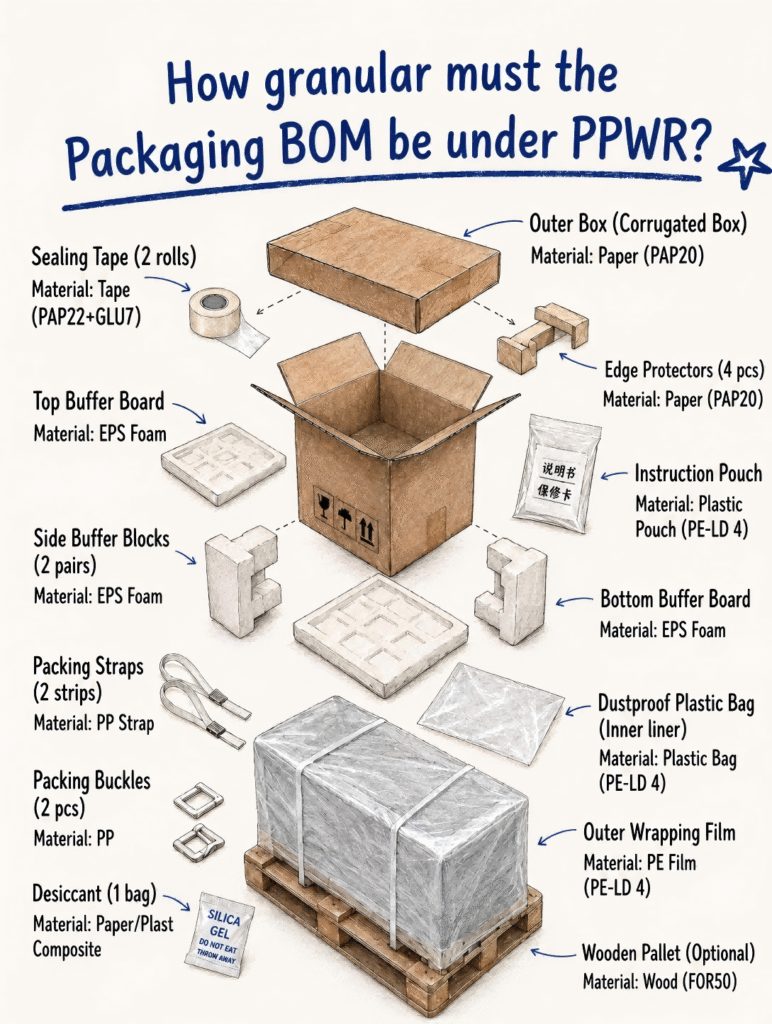
Packaging Bill of Materials
- Paper and cardboard
- Plastics
- Metals
- Glass
- Wood
- Adhesives
- Inks
- Coatings
- Labels
- Closures
- Protective materials
Supplier Documentation
- Material specifications
- Supplier declarations
- Certificates
- Restricted-substance information
- Recycled-content evidence
- Test reports
Packaging Design Records
- Packaging drawings
- Dimensions
- Material weights
- Packaging artwork
- Label versions
- Change history
Compliance Evidence
- Applicable conformity assessment records
- Test results
- Technical calculations
- Declaration of Conformity
- Relevant supplier documentation
This is where OEM relationships become critical.
The brand owner may be the PPWR manufacturer, but the OEM supplier often possesses much of the underlying technical information.
Therefore:
Compliance responsibility and technical information ownership must be connected contractually.
8. Your OEM Contract May Need a PPWR Upgrade
Traditional OEM contracts often focus on:
- product quality;
- delivery dates;
- price;
- tooling;
- intellectual property;
- warranty;
- defects.
Under the new packaging environment, another layer becomes increasingly important:
Packaging Regulatory Responsibility
A stronger OEM agreement should clearly define:
Who designs the packaging?
Who approves the packaging materials?
Who maintains the packaging BOM?
Who provides material declarations?
Who conducts compliance testing?
Who maintains test reports?
Who notifies the customer about material substitutions?
Who controls packaging artwork?
Who updates the technical file?
Who supports the Declaration of Conformity?
Who bears the cost of corrective action?
Who must notify the brand owner before changing a packaging supplier?
These questions may look administrative.
But they can become extremely important when a market-surveillance authority asks for evidence.
9. The Hidden Risk: Supplier Material Substitution
Imagine your packaging was compliant when the product launched.
Six months later, your OEM supplier changes:
Paper supplier → cheaper paper supplier
or:
Plastic material → alternative recycled material
or:
Adhesive → lower-cost adhesive
or:
Ink → different formulation
The packaging may look exactly the same.
But the underlying compliance evidence may no longer match the actual packaging.
This is why PPWR compliance should not be treated as a one-time certification exercise.
It should become a change-management process.
A robust supply chain should require suppliers to notify the brand owner before making changes that could affect packaging conformity.
10. Why This Matters for Drone and Robotics Companies
For companies operating in industrial drones, robotics, batteries and advanced hardware, the issue can become even more complicated.
A single shipment may contain:
- main product packaging;
- battery packaging;
- accessory boxes;
- protective foam;
- plastic bags;
- cable packaging;
- manuals;
- transport packaging;
- pallets;
- labels;
- return packaging.
A drone battery shipment, for example, can involve multiple packaging components and multiple suppliers.
The compliance question therefore becomes much bigger than:
“Is the cardboard box recyclable?”
The real question is:
Can we demonstrate what the packaging is made of, who supplied it, who designed it, who placed it on the market and who is responsible for compliance?
That is a supply-chain governance problem—not simply a packaging problem.
11. A Better Way to Think About PPWR
I believe companies should stop looking at PPWR as a packaging labeling regulation.
It is better understood as a:
Supply Chain Accountability Regulation
The logic is moving toward:
Brand Ownership ↓ Packaging Design & Control ↓ Manufacturing / Supply Chain ↓ Market Placement ↓ Technical Documentation ↓ Declaration of Conformity ↓ EPR & Reporting ↓ Traceability & Market Surveillance
Every step needs a clearly assigned owner.
12. The Four-Pillar PPWR Compliance Framework
For companies using OEM/ODM production, I would recommend thinking about PPWR compliance through four pillars.
Pillar 1 — Market Compliance
Determine whether your packaging meets the applicable requirements relating to:
- restricted substances;
- recyclability;
- minimization;
- labeling;
- recycled content;
- packaging composition;
- reuse requirements where applicable.
Do not assume that today’s packaging specification will remain compliant indefinitely.
Pillar 2 — Technical Documentation
Build a centralized packaging technical file containing:
BOM + Specifications + Supplier Evidence + Test Reports + Artwork + Change Records + Compliance Assessment
The goal is simple:
If an authority asks:
“Show us why this packaging complies.”
you should be able to answer with evidence rather than emails and assumptions.
Pillar 3 — Declaration of Conformity
Where required, prepare the applicable EU Declaration of Conformity based on the relevant conformity-assessment framework.
Importantly, companies should avoid creating unnecessary administrative complexity by assuming that every SKU automatically requires an entirely independent declaration.
Where packaging types can appropriately be covered as a documented packaging family, the compliance structure should reflect the actual technical scope.
Pillar 4 — Continuous Compliance Management
Compliance does not end when the first shipment leaves the factory.
Monitor:
- supplier changes;
- material substitutions;
- packaging redesign;
- new regulations;
- new standards;
- EPR requirements;
- recycled-content evidence;
- testing validity;
- documentation changes.
In other words:
PPWR compliance should be managed like product quality—not like a one-time certificate.
13. The Real Strategic Question for Brand Owners
The biggest mistake is asking:
“Which company should pay for PPWR compliance?”
A better question is:
“Which company controls the decisions that determine whether the packaging is compliant?”
If the brand owner controls:
- the packaging design;
- the trademark;
- the packaging specifications;
- the supplier;
- the market placement;
then simply telling the OEM factory:
“You are responsible for compliance.”
may not be enough.
The contract should instead establish a clear division of responsibilities, while ensuring that the party carrying the PPWR manufacturer role has access to the information and evidence needed to demonstrate conformity.
14. Three Questions Every EU Brand Should Ask Its OEM Supplier
Before launching your next OEM product in Europe, ask your supplier these three questions:
Question 1
Can you provide the complete packaging BOM and material specifications?
Question 2
Can you provide supporting evidence for the packaging conformity requirements applicable to our products?
Question 3
Will you notify us before changing any packaging material, supplier, structure or manufacturing process that could affect compliance?
If the answer to any of these questions is:
“We don’t know.”
you may already have a compliance gap.
15. The Strategic Takeaway
PPWR changes the way companies should think about packaging responsibility.
The old model was:
“The factory makes the packaging, so the factory handles it.”
The new reality is more complicated.
For OEM and private-label businesses, the decisive factors can include:
Who commissioned the packaging? Whose name or trademark is used? Who places it on the EU market? Who controls the technical information? Who is the PPWR manufacturer? Who is the EPR producer in each relevant market?
The European Commission’s 2026 guidance makes clear that the PPWR manufacturer is not necessarily the physical packaging producer, and that brand ownership and control over the design/manufacturing relationship can be decisive. (Eur-Lex)
So the key lesson for brands, importers and procurement teams is simple:
OEM production does not automatically mean outsourced compliance.
Your factory may manufacture the box.
Your brand may own the packaging responsibility.
And your company may ultimately need to prove compliance.
Final Thought
The future of EU packaging compliance will not be determined only by better materials or more recyclable packaging.
It will also be determined by better supply-chain governance.
Companies that clearly define:
Manufacturer → EPR Producer → OEM Supplier → Technical File Owner → DoC Responsibility
will be in a much stronger position than companies that wait until an authority asks for documentation.
The question is no longer simply “Who made the packaging?”
The more important question is:
“Who is legally and operationally accountable for the packaging when it enters the EU market?”
That is the question every OEM, ODM, importer and European brand should be answering before the next shipment leaves the factory.
This article is for general informational purposes and does not constitute legal advice. PPWR obligations can depend on the packaging type, transaction structure, company size and Member State requirements. Companies should obtain professional regulatory advice for their specific supply chain.