
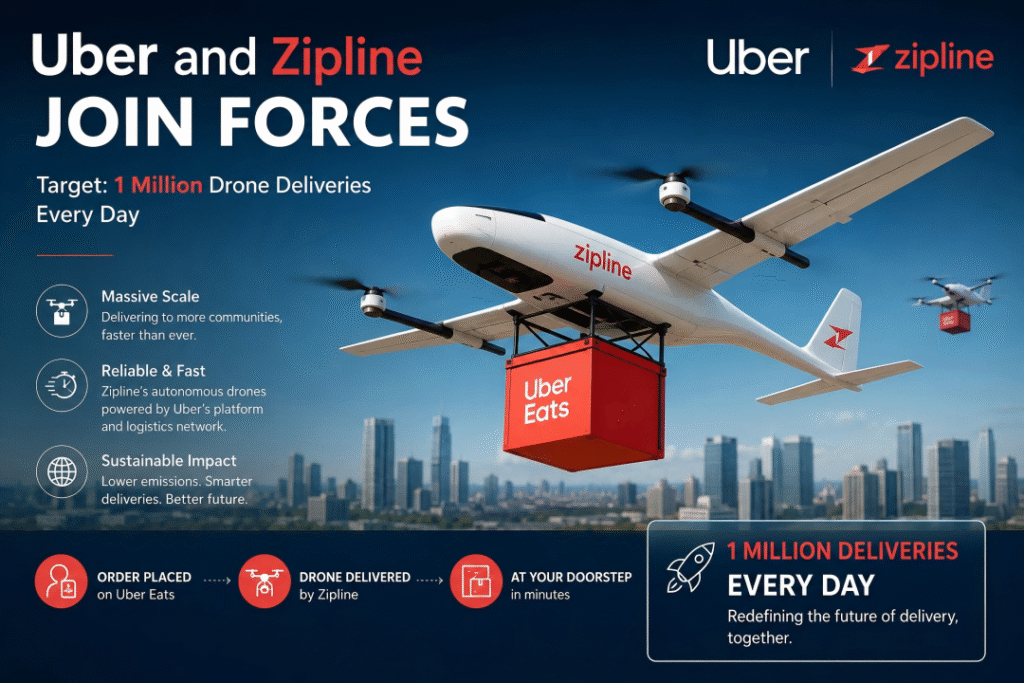
The Sky Is the New Delivery Lane: Why Uber + Zipline Could Change Last-Mile Logistics Forever
For decades, the last mile of delivery has been constrained by one simple physical reality:
Most things still have to travel on roads.
In the United States, there are approximately 5.5 billion home deliveries every year, and most rely on road-based transportation. (Zipline)
A 4,000-pound vehicle may be moving a burrito, a salad, a bottle of medicine or a few household essentials.
The problem isn’t that the vehicle is incapable of doing the job.
The problem is that the infrastructure underneath it is increasingly inefficient for small, urgent deliveries.
Roads are congested.
Labor is expensive.
Delivery distances are increasing.
Customers expect faster service.
And cities cannot simply keep adding roads.
So perhaps the next major delivery lane isn’t another road.
It’s the sky.
The recent partnership between Uber and Zipline may represent one of the clearest signals yet that drone delivery is moving from a technology demonstration into a potential mass-market logistics infrastructure.
The companies announced a strategic partnership and investment on August 17, 2026, with first Uber Eats drone deliveries planned for existing Zipline markets such as Dallas and Houston, followed by expansion into dozens of U.S. cities. Their stated ambition is extraordinary:
1 million drone deliveries per day by the end of 2029. (Zipline)
That number deserves much more attention than another drone industry headline.
Because if it happens, drone delivery stops being a niche application and starts becoming part of the transportation infrastructure of everyday life.
1. The Real Problem Isn’t Delivery Speed. It’s Delivery Infrastructure
Consider a typical food-delivery order.
A restaurant prepares a $15–$30 meal.
Then a vehicle:
- leaves a parking space;
- enters a road;
- waits at intersections;
- encounters traffic;
- searches for parking;
- travels to the customer’s neighborhood;
- and finally delivers a small package.
The delivery vehicle may weigh hundreds or thousands of kilograms.
But the payload may weigh less than 2–3 kg.
From an engineering perspective, this is an unusual transportation model:
We are moving an enormous machine to transport a very small object.
The economics work because roads are shared infrastructure.
But as delivery demand increases, the limitations become obvious.
More orders mean:
More vehicles → more congestion → longer delivery times → higher labor costs → more pressure on the delivery network.
And unlike software infrastructure, road capacity cannot be scaled overnight.
This is where drones introduce a fundamentally different architecture.
Instead of:
Restaurant → Road → Car → Road → Customer
the model becomes:
Restaurant → Drone → Airspace → Customer
The physical distance may be similar.
But the transportation layer is completely different.
2. Why the Uber + Zipline Partnership Is More Important Than Another Drone Pilot
Drone companies have been conducting delivery trials for years.
So why does this partnership matter?
Because it combines two assets that are difficult to build independently.
Zipline brings the autonomous logistics infrastructure.
Zipline has spent roughly a decade developing autonomous delivery operations and has delivered more than 20 million items, with more than 135 million autonomous miles flown, according to the company’s latest announcement. It says its network serves more than 5,000 hospitals and health facilities across four continents. (Zipline)
Uber brings the demand platform.
Uber already has:
- millions of consumers;
- hundreds of thousands of local merchants;
- payment infrastructure;
- order management;
- delivery logistics;
- geographic demand data;
- and an established consumer app.
This is strategically important.
Because the hardest part of drone delivery may not actually be building the drone.
It may be:
Getting enough customers and merchants onto the network.
Uber solves that problem immediately.
Instead of asking consumers to download another drone-delivery application, the service can be integrated into Uber Eats.
That dramatically reduces customer adoption friction. (Axios)
3. From “Drone Delivery” to “Delivery-as-a-Network”
This partnership also reveals something bigger about the future of autonomous logistics.
Uber isn’t trying to replace every delivery vehicle with a drone.
Instead, it is building what it describes as a hybrid delivery network involving:
- human couriers;
- sidewalk robots;
- autonomous vehicles;
- drones.
The objective is to match each order with the most appropriate transportation method. (Uber Investor Relations)
This is a much more realistic model.
A drone doesn’t need to replace the delivery van.
It only needs to be better for certain delivery missions.
For example:
Short-distance, urgent, lightweight delivery
→ Drone
Heavy grocery order
→ Vehicle
Large multi-order route
→ Delivery van
Indoor or sidewalk delivery
→ Robot
Long-distance freight
→ Truck
The future of logistics may therefore not be:
Drone vs. Car
but:
Drone + Robot + Car + Autonomous Vehicle
all operating as one intelligent transportation network.
4. Why 5–10 Minutes Changes the Economics
Zipline says its service can deliver goods in roughly 5–10 minutes. (Zipline)
That isn’t simply a faster delivery time.
It can fundamentally change what businesses can sell.
Imagine a restaurant currently serving customers within a 3-mile radius.
Its delivery radius is constrained by:
- traffic;
- driver availability;
- delivery time;
- food temperature;
- delivery cost.
Now imagine the same restaurant can send lightweight orders directly through the air.
The address is no longer constrained by the road network in the same way.
The business could potentially reach a much larger service area without building a larger fleet of cars.
Zipline itself says businesses using its technology can potentially reach many more customers because of the range and speed of the system. (Zipline)
That means drone delivery is not merely a transportation innovation.
It could become a market-expansion tool for local businesses.
5. The Hidden Advantage: Drones Don’t Need More Roads
This may be the most important economic argument for drone delivery.
If delivery demand doubles, traditional logistics often requires more:
- vehicles;
- drivers;
- parking;
- road capacity;
- warehouses;
- delivery routes.
But the sky doesn’t have the same physical constraints as a road.
Of course, airspace is not unlimited.
It requires:
- traffic management;
- geofencing;
- regulatory approval;
- safe operating procedures;
- reliable navigation;
- detect-and-avoid capabilities;
- communication systems.
But once the regulatory and digital infrastructure is established, air routes can potentially scale much more flexibly than urban road infrastructure.
This is why drone delivery should not be viewed simply as a new type of aircraft.
It is better understood as a potential new layer of transportation infrastructure.
6. The Battery Becomes the Heart of the Business Model
For anyone working in drone technology, this is where the discussion becomes particularly interesting.
A drone delivery network may perform thousands—or eventually millions—of flights every day.
At that scale, the battery is no longer just a component.
It becomes an operating asset.
Every flight consumes energy.
Every landing creates another charging cycle.
Every battery experiences:
- discharge;
- charging;
- temperature changes;
- aging;
- capacity degradation;
- internal resistance growth.
And when the number of flights reaches hundreds of thousands or millions per day, even small improvements in battery performance can have enormous economic consequences.
Consider the parameters that suddenly become critical:
Energy density
Higher Wh/kg can increase payload or range without proportionally increasing aircraft weight.
Power density
Delivery drones frequently need high power during:
- takeoff;
- climbing;
- acceleration;
- wind compensation;
- landing.
Cycle life
A battery used multiple times every day must withstand intensive cycling.
Fast charging
Short turnaround time directly affects fleet utilization.
Thermal management
High-power charging and high-rate discharge generate heat.
Low-temperature performance
Operations in colder regions can suffer from reduced available capacity and increased voltage drop.
Battery consistency
Large fleets require predictable battery performance across thousands of packs.
At scale, battery quality becomes fleet economics.
7. The Next Bottleneck May Be Charging Infrastructure
There is another important question:
What happens after the drone lands?
If a delivery drone needs to return to a centralized base after every mission, its operating radius remains limited.
But distributed charging infrastructure changes the equation.
Imagine a city with hundreds of:
- autonomous drone docks;
- charging stations;
- battery-swap stations;
- rooftop landing platforms;
- restaurant launch points;
- micro-fulfillment hubs.
A drone could potentially:
Deliver → land → recharge → relaunch
without returning to a central warehouse after every mission.
This creates something similar to a distributed network of “air gas stations.”
And this is where battery technology, charging technology and drone infrastructure start converging.
8. One Million Deliveries a Day Changes the Supply Chain
The target of 1 million drone deliveries per day by the end of 2029 is ambitious. (Uber Investor Relations)
But let’s think about the implications rather than simply the headline.
One million deliveries per day means potentially:
1,000,000 flight missions/day
Even if each drone performs only a few missions per day, the required fleet could become enormous.
That creates demand for an entire industrial ecosystem:
Aircraft
Large-scale manufacturing of reliable delivery drones.
Batteries
High-cycle-life, high-rate battery packs.
Chargers
Fast and intelligent charging systems.
Battery management systems
Real-time monitoring of voltage, temperature, current and state of health.
Charging stations
Automated energy replenishment infrastructure.
Spare batteries
Fleet-level battery inventory management.
Maintenance
Motors, ESCs, propellers, landing systems and communication equipment.
Software
Fleet scheduling, route optimization and energy management.
Airspace infrastructure
Traffic coordination and operational management.
Recycling
End-of-life battery collection and material recovery.
In other words:
The drone itself may be only one part of the future drone-delivery industry.
9. The Business Model May Eventually Become “Energy + Aircraft + Software”
The first generation of drone delivery businesses will probably focus heavily on aircraft.
But as fleets scale, the economic model may evolve.
Instead of asking:
“How much does one delivery drone cost?”
operators may ask:
“What is the total cost per completed delivery?”
That number includes:
Aircraft depreciation
Battery depreciation
Electricity
Charging infrastructure
Maintenance
Software
Labor / remote supervision
Insurance
Regulatory compliance
Failed delivery cost
This is why a drone with a slightly higher purchase price could still be economically superior if it offers:
- longer battery life;
- better reliability;
- faster charging;
- fewer maintenance events;
- higher payload efficiency;
- better wind resistance;
- lower energy consumption.
For fleet operators, TCO matters more than aircraft price.
10. This Creates a Huge Opportunity for Battery Suppliers
From a battery supplier’s perspective, the rise of drone delivery is particularly interesting.
The future customer may not simply ask:
“Can you supply a 6S LiPo battery?”
Instead, they may ask for a complete energy solution:
Battery + BMS + charger + communication + thermal management + lifecycle data
The requirements will become increasingly application-specific.
For example:
Food delivery drone
Priorities:
- lightweight;
- high discharge rate;
- fast turnaround;
- high cycle life.
Medical delivery drone
Priorities:
- extreme reliability;
- temperature monitoring;
- redundancy;
- traceability;
- predictable performance.
Long-range logistics drone
Priorities:
- high energy density;
- low self-discharge;
- thermal stability;
- high-efficiency power delivery.
High-frequency urban delivery fleet
Priorities:
- rapid charging;
- cycle life;
- automated charging;
- battery health monitoring;
- fleet-level battery management.
This means the drone battery market is likely to move from:
“Battery as a component”
toward:
“Battery as an operational platform.”
11. The Most Important Metric May Become Battery Cost per Flight
Imagine two battery packs.
Battery A
Lower purchase price
Lower cycle life
Slower charging
Higher degradation
Battery B
Higher purchase price
Higher cycle life
Faster charging
Better thermal performance
If the drone flies several times every day, Battery B may be much cheaper over its operating life.
The relevant calculation becomes:
Battery Cost per Flight = Total Battery Lifecycle Cost ÷ Completed Flight Cycles
And this should be expanded to include:
- charging losses;
- maintenance;
- replacement labor;
- downtime;
- reduced payload caused by battery weight;
- degradation-related mission failures.
For professional drone delivery, the cheapest battery is rarely the battery with the lowest purchase price.
12. Drone Delivery Will Also Create a Battery Recycling Challenge
There is another issue that is easy to overlook.
If drone fleets eventually become massive, thousands or millions of battery packs will eventually reach end of life.
That creates a new question:
Who collects the batteries?
And then:
Who tests them?
And:
Which batteries can be reused?
And:
Which batteries should be recycled?
A mature drone logistics ecosystem may therefore eventually require a complete battery lifecycle:
Manufacturing → Deployment → Charging → Monitoring → Maintenance → Second Life → Recycling
This could create opportunities for specialized companies in:
- battery diagnostics;
- SOH estimation;
- second-life applications;
- automated sorting;
- battery recycling;
- fleet battery management.
13. The Biggest Challenge Is Not the Drone
It is tempting to think the future of drone delivery depends on building a better aircraft.
I don’t think that’s the complete picture.
The real challenge is building a reliable autonomous logistics system.
A successful network must solve multiple problems simultaneously:
Aircraft
Can it fly safely?
Battery
Can it complete the mission with sufficient reserve?
Software
Can the system optimize thousands of flights?
Infrastructure
Where does the drone launch, land and recharge?
Airspace
Can thousands of aircraft operate safely?
Regulation
Can the business operate at commercial scale?
Customer
Will people trust autonomous delivery?
Economics
Can the cost per delivery beat conventional logistics?
Only when all these pieces work together does drone delivery become a real business.
14. Uber + Zipline Could Be a Turning Point
The strategic significance of the partnership is therefore much larger than simply putting food on drones.
Uber has something Zipline needs:
Demand.
Zipline has something Uber needs:
A mature autonomous aerial delivery system.
Together, they can potentially connect:
Customers → Restaurants → Uber Eats → Autonomous Logistics → Drone Fleet → Customer
That is a completely different architecture from traditional food delivery.
And Uber is not merely signing a commercial agreement.
The company is also making a strategic investment in Zipline, signaling that it sees drone delivery as part of its longer-term transportation and delivery strategy. (Uber Investor Relations)
15. The Competitive Race Has Already Started
Zipline is not operating in an empty market.
Companies including:
- Amazon Prime Air
- Wing
- Flytrex
- Manna
- and other autonomous delivery providers
are also working toward scalable drone delivery networks.
Uber itself already has other autonomous delivery partnerships, while companies such as Wing are expanding through retail partnerships. (TechCrunch)
This suggests the next stage of competition will not simply be:
Who builds the best drone?
Instead, it may become:
Who can build the best autonomous delivery ecosystem?
That ecosystem includes:
Aircraft + Battery + Charging + Software + Airspace + Merchants + Customers + Operations
16. From Drone Delivery to “Airborne Infrastructure”
The most important shift may happen in our perception of drones.
Today, people often think:
“A drone is flying.”
In the future, consumers may not even think about the aircraft.
They will simply open an app.
Order food.
And five minutes later:
A package arrives in the backyard.
The drone becomes invisible infrastructure.
Just like people don’t think about:
- fiber-optic cables when watching Netflix;
- cellular towers when sending a message;
- payment networks when buying coffee.
The winning drone-delivery companies may eventually make the aircraft itself almost irrelevant to the customer experience.
What matters is:
Fast. Reliable. Affordable. Autonomous.
17. The Real Question: Can the Sky Become a Highway?
The highway system transformed logistics because it created a standardized transportation network.
The internet transformed communication because it created a standardized digital network.
The next question is whether autonomous aviation can create a similar transformation for short-distance logistics.
If the answer is yes, then drone delivery could eventually change:
- where restaurants locate;
- how warehouses are designed;
- how hospitals receive supplies;
- how retailers manage inventory;
- how consumers order products;
- how cities manage traffic;
- and how companies think about last-mile logistics.
The goal isn’t to put every package on a drone.
The goal is to create a transportation network where the best delivery mode is selected automatically.
Conclusion: The Sky Is Becoming Part of the Supply Chain
The Uber–Zipline partnership is a powerful signal.
Not because one million drone deliveries per day is guaranteed.
It isn’t.
Scaling from today’s operations to that level will require major advances in:
- regulation;
- infrastructure;
- fleet manufacturing;
- battery technology;
- charging;
- airspace management;
- reliability;
- and economics.
But the direction is becoming increasingly clear.
The delivery industry has spent decades optimizing vehicles to navigate roads.
The next generation may optimize aircraft to bypass them.
And once drone delivery becomes a high-frequency commercial operation, the biggest opportunities may not only belong to drone manufacturers.
They may belong to the companies building the infrastructure behind them:
Batteries.
Chargers.
Autonomous docks.
Battery-swap systems.
BMS.
Fleet software.
Airspace systems.
Maintenance.
Recycling.
The drone may be what customers see.
But the energy and infrastructure ecosystem will determine how far the industry can fly.
The future of last-mile delivery may not be faster cars.
It may be fewer cars—and more sky.
What do you think will become the biggest bottleneck in large-scale drone delivery: battery technology, charging infrastructure, regulation, airspace management, or unit economics?
I’d be interested to hear how others in the drone, logistics, robotics and battery industries see it. 👇
#DroneDelivery #Zipline #Uber #DroneTechnology #Logistics #LastMileDelivery #AutonomousDelivery #DroneBattery #BatteryTechnology #Robotics #UAV #Aviation #SupplyChain #LowAltitudeEconomy #FutureOfLogistics