
For years, the solid-state battery race has been defined by one question:
Who can achieve the highest energy density first?
However, the next major breakthrough in battery commercialization may not come from the technology with the most impressive laboratory data. It may come from the technology that can successfully move from prototype validation to stable mass production.
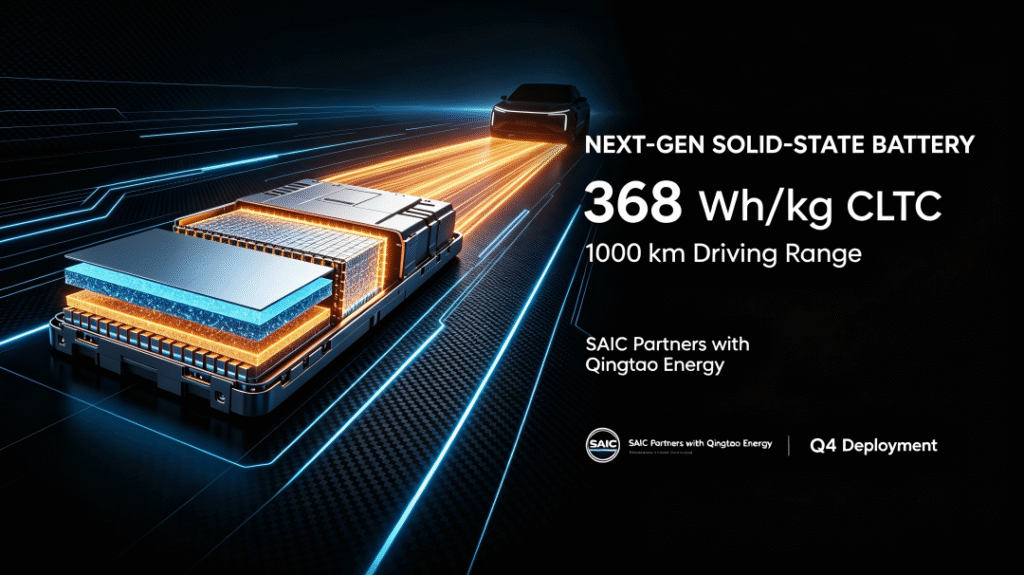
Recently, the cooperation between SAIC Motor and QingTao Energy has attracted significant attention. The companies are preparing to begin vehicle installation verification of an oxide-based solid-state battery in the fourth quarter of this year.
This milestone is important because it represents more than a technology announcement. It is the result of years of cooperation, moving from laboratory samples, to battery cells, to semi-solid battery deliveries, and finally toward real vehicle applications.
The future of solid-state batteries is not only about pushing theoretical limits. It is about answering a more practical question:
Which technology can deliver reliable, safe, and scalable batteries for millions of vehicles?
From Laboratory Breakthroughs to Real Vehicle Applications
QingTao Energy has become one of China’s leading companies in oxide solid electrolyte technology. Its technology originated from research teams associated with the Chinese Academy of Sciences.
Before this latest milestone, QingTao and SAIC had already achieved semi-solid battery deliveries for the MG4 model.
One of the key achievements of this technology is reducing the liquid electrolyte content to approximately 5%, significantly improving safety while maintaining manufacturing feasibility.
The upcoming solid-state battery cell reportedly achieves:
- Energy density: 368 Wh/kg
- CLTC range: over 1,000 km
- Much lower liquid electrolyte content
- A technology path closer to true solid-state batteries
Although the energy density figure may not represent the absolute highest number in the industry, the significance lies in another dimension:
This technology is moving closer to commercial deployment.
In the battery industry, a battery that exists in a laboratory is not the same as a battery that can survive millions of kilometers on real roads.
Why Did SAIC Choose Oxide Instead of Sulfide Solid-State Batteries?
Many people ask:
If sulfide solid-state batteries have higher theoretical performance, why are companies investing in oxide-based technology?
The answer is simple:
Mass production requires more than superior material performance.
It requires:
- Stable manufacturing processes
- High production yield
- Reasonable investment costs
- Long-term reliability
- Supply chain compatibility
Sulfide Solid-State Batteries: Higher Potential, Higher Challenges
Sulfide solid electrolytes are considered one of the most promising next-generation technologies because of their excellent ionic conductivity.
Their advantages include:
- High room-temperature ionic conductivity
- Excellent interface performance
- Strong potential for ultra-high energy density
However, commercial production faces significant challenges.
1. Extremely Sensitive Manufacturing Environment
Sulfide materials react strongly with moisture.
Exposure to water vapor can generate toxic gases such as hydrogen sulfide, meaning production requires:
- Strict dry-room environments
- Advanced equipment
- Higher operational costs
2. Lower Manufacturing Maturity
Compared with traditional lithium-ion battery production, sulfide solid-state manufacturing still faces challenges in:
- Material processing
- Interface stability
- Large-scale consistency
- Production yield improvement
The technology ceiling is high, but the road to commercialization is longer.
Oxide Solid-State Batteries: The Manufacturing-Friendly Route
Compared with sulfide technology, oxide solid electrolytes may have a lower theoretical performance ceiling.
However, they offer several advantages:
1. Better Chemical Stability
Oxide materials are more stable and less sensitive to environmental conditions.
This brings advantages in:
- Safety
- Storage
- Transportation
- Manufacturing control
2. Better Compatibility With Existing Battery Factories
One of the biggest advantages of oxide solid-state technology is that it can reuse many existing lithium battery manufacturing processes.
This means companies can potentially achieve:
- Lower equipment investment
- Faster production ramp-up
- Higher manufacturing reliability
For the automotive industry, this is extremely valuable.
A technology that can reach 90% of its potential while achieving 95% manufacturing reliability may outperform a technology that reaches 100% performance but struggles with commercialization.
The Solid-State Battery Race Is Becoming a Manufacturing Race
Different Chinese battery and automotive companies are choosing different technology paths.
BYD and Chery: Pursuing the Performance Frontier
These companies are focusing on sulfide-based solid-state battery technology, aiming for breakthroughs around 2027 and beyond.
The goal:
Achieve the highest possible energy density and technical advantage.
Dongfeng: Exploring Hybrid Solid Electrolyte Routes
Dongfeng is developing oxide-polymer composite solid-state technology, aiming for earlier commercialization opportunities.
SAIC + QingTao: Prioritizing Early Mass Adoption
SAIC and QingTao are following a different strategy:
Not chasing the highest laboratory number, but focusing on:
- Production feasibility
- Vehicle validation
- Manufacturing maturity
- Commercial deployment
Their target is not just creating a better battery.
Their target is creating a battery that can enter the market.
The Real Winner of Solid-State Batteries Will Be the First to Scale
The history of battery technology shows that commercialization is often determined by more than technical specifications.
Lithium-ion batteries became dominant not because they were the only possible chemistry, but because companies successfully solved:
- Cost reduction
- Manufacturing scale
- Reliability
- Supply chain integration
The same principle applies to solid-state batteries.
The future competition will not only be:
“Who has the highest Wh/kg?”
It will also be:
“Who can produce millions of cells with consistent quality?”
What This Means for the Future of Battery Applications
The commercialization of solid-state batteries will have a major impact beyond electric vehicles.
Higher-performance and safer batteries will accelerate development in:
- Electric vehicles
- Heavy-duty drones
- eVTOL aircraft
- Robotics
- Energy storage systems
- Aerospace applications
For industries where battery weight, safety, and endurance are critical, solid-state technology could become a major turning point.
However, the winners will likely be companies that balance:
Energy density + Safety + Cost + Manufacturing scalability
Final Thoughts
The solid-state battery revolution is entering a new stage.
The first phase was about proving that solid-state technology could work.
The next phase is about proving that it can be manufactured.
SAIC and QingTao’s oxide-based solid-state battery route may not represent the absolute peak of theoretical performance, but it demonstrates something arguably more important:
A realistic path from innovation to industrialization.
In the battery industry, the ultimate winner is not always the company that builds the most advanced prototype.
It is the company that successfully delivers millions of reliable batteries to customers.
The solid-state battery race has officially moved from the laboratory to the production line.
And the next battlefield will be determined by one word:
Scale.