
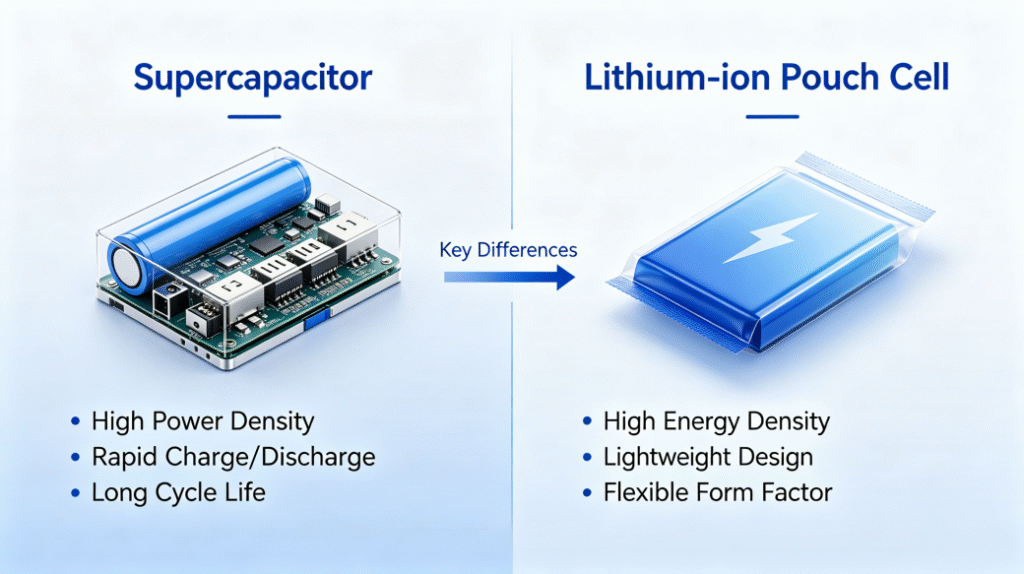
In the world of energy storage, most discussions revolve around lithium batteries: higher energy density, faster charging, longer cycle life.
But there is another technology quietly evolving in parallel — one that does not aim to replace batteries, but instead solves problems batteries struggle with naturally.
That technology is the supercapacitor.
Positioned between conventional capacitors and batteries, supercapacitors possess a unique combination of characteristics:
- Extremely high power density
- Ultra-fast charge/discharge capability
- Exceptional cycle life
- Outstanding low-temperature performance
These traits are enabling new architectures in power electronics, automotive systems, industrial equipment, and increasingly, high-power UAV applications.
The question is no longer:
“Can supercapacitors replace lithium batteries?”
But rather:
“How can supercapacitors and lithium batteries work together to build better systems?”
What Is a Supercapacitor?
Supercapacitors, also known as ultracapacitors, were originally invented in the late 1950s. Unlike lithium batteries, which store energy through relatively slow electrochemical reactions, supercapacitors store energy through rapid ion adsorption and desorption processes.
This allows them to charge and discharge in seconds rather than hours.
Today, supercapacitors are generally divided into three categories:

Among them, EDLCs are currently the most widely used.
Why Supercapacitors Are So Powerful
The core reason lies in their structure.
A traditional capacitor stores charge on conductive plates. A supercapacitor dramatically increases the electrode surface area using porous activated carbon materials.
This enables capacitance values thousands—or even millions—of times larger than conventional capacitors.
Unlike batteries, where ions must diffuse deep into electrode materials, supercapacitors only require surface-level charge movement, making energy transfer incredibly fast.
Supercapacitors vs Lithium Batteries
Although both store energy, they are optimized for very different missions.

This means:
- Batteries are “marathon runners” → optimized for storing large amounts of energy.
- Supercapacitors are “sprinters” → optimized for delivering huge bursts of power instantly.
Why Supercapacitors Excel at Power Delivery
The maximum power capability of a supercapacitor can be approximated as:

Where:
- VVV = operating voltage
- ReqR_{eq}Req = equivalent series resistance (ESR)
Because supercapacitors have extremely low ESR, they can deliver enormous current almost instantly.
This is why they are ideal for:
- Peak power buffering
- Surge suppression
- Rapid acceleration support
- Backup power stabilization
One Major Weakness: Energy Storage
Despite their power advantages, supercapacitors still suffer from relatively low energy density.
A lithium battery can store significantly more energy in the same volume or weight.
Another challenge is self-discharge:
- Batteries may hold charge for months.
- Supercapacitors may lose significant voltage within days.
This makes them unsuitable for long-term standalone energy storage applications.
Temperature Performance: A Huge Advantage
One area where supercapacitors outperform lithium batteries dramatically is low-temperature operation.
Lithium batteries suffer from:
- Increased internal resistance
- Reduced ion diffusion
- Severe power loss below 0°C
Supercapacitors maintain far better performance in cold environments.
For applications like:
- Arctic drones
- High-altitude UAVs
- Winter robotics
- Emergency systems
This becomes extremely valuable.
The Hidden Superpower: Cycle Life
Lithium batteries age through repeated chemical reactions.
Supercapacitors largely avoid this issue.
Typical cycle life comparison:

Even deep discharge causes minimal degradation.
This makes supercapacitors ideal for systems involving:
- Frequent charge/discharge pulses
- Rapid transient loads
- High-frequency power cycling
Supercapacitors in Power Electronics: The SCALDO Concept
One fascinating application is the SCALDO (Supercapacitor-Assisted Low Dropout Regulator).
Traditional linear regulators suffer poor efficiency when input voltage greatly exceeds output voltage.
Example:
- 12V → 5V linear regulator
- Theoretical efficiency ≈ 42%
SCALDO introduces a supercapacitor as a nearly lossless voltage-dropping stage.
The result:
- Much higher efficiency
- Extremely low EMI/RFI
- No inductors required
- Cleaner power delivery
This is particularly attractive for:
- Medical equipment
- Sensitive industrial electronics
- EMI-sensitive systems
And potentially:
- UAV avionics
- Drone communication systems
- High-noise RF environments
Where Supercapacitors Could Transform UAV Power Systems
Now comes the truly interesting part.
Supercapacitors are unlikely to replace drone lithium batteries entirely.
But they may dramatically improve how UAV power systems work.
The Core Problem in Drone Batteries
Modern UAVs face a brutal contradiction:
They need:
- High energy density
- Lightweight systems
- Massive instantaneous power
- Fast charging
- Long cycle life
But lithium batteries struggle to optimize all these simultaneously.
Especially during:
- Takeoff
- Sudden acceleration
- Wind resistance
- Heavy payload lifting
The battery experiences enormous current spikes.
These spikes cause:
- Voltage sag
- Heat generation
- Internal resistance stress
- Faster aging
- Reduced cycle life
Supercapacitors as Peak Power Buffers
This is where supercapacitors become extremely valuable.
Instead of forcing the lithium battery to handle every power spike:
- The battery supplies average cruise power
- The supercapacitor handles transient peak loads
This architecture can:
✅ Reduce voltage sag
✅ Lower battery heat generation
✅ Reduce stress on LiPo cells
✅ Extend cycle life
✅ Improve throttle response
✅ Enhance low-temperature performance
Potential UAV Applications
1. Heavy-Lift Drones
Agricultural drones, logistics UAVs, and industrial platforms often experience huge power spikes during takeoff.
Supercapacitors could absorb these peaks and reduce battery stress dramatically.
2. eVTOL Aircraft
eVTOLs require enormous burst power during:
- Vertical takeoff
- Hovering
- Transition phases
A hybrid lithium + supercapacitor architecture may become increasingly attractive for managing transient loads efficiently.
3. FPV Racing Drones
FPV drones repeatedly experience:
- Rapid throttle changes
- Extreme current spikes
- Aggressive acceleration
Supercapacitors could stabilize voltage and reduce battery sag during intense maneuvers.
4. Cold-Weather UAV Operations
At low temperatures, lithium battery internal resistance rises sharply.
Supercapacitors maintain strong low-temperature power delivery, helping drones maintain stable performance in harsh environments.
Challenges Still Exist
Despite their promise, supercapacitors still face limitations in UAV integration:

The Future May Not Be “Battery vs Supercapacitor”
The future is likely:
Battery + Supercapacitor Hybrid Systems
Much like turbochargers complement engines rather than replace them, supercapacitors may become auxiliary power systems that enhance lithium batteries rather than compete against them.
In many ways, this mirrors trends already seen in:
- Electric vehicles
- Grid stabilization
- Rail transit
- Industrial robotics
And drones may be next.
Final Thoughts
Supercapacitors are not miracle replacements for lithium batteries.
But they solve a problem batteries fundamentally struggle with:
Delivering massive power instantly, repeatedly, and efficiently.
As UAV systems become:
- Heavier
- Faster
- More autonomous
- More power-intensive
Energy systems will likely evolve from “single battery architectures” toward hybrid power ecosystems.
And in that future, supercapacitors may quietly become one of the most important supporting technologies behind next-generation drones.
