
As drone technology advances, battery performance has become the critical factor determining flight time, reliability, and operational safety. One question often arises among UAV operators:
Why is 80% capacity retention widely regarded as the end-of-life (EOL) threshold for lithium batteries?
Let’s break it down—combining consumer expectations, electrochemical behavior, and historical standards—and see how this applies to drone batteries.
🛑 Consumer Perception Meets Capacity Loss
For drone operators, battery life isn’t just a number—it’s flight autonomy, mission reliability, and safety.
- When capacity drops below 80% of nominal, the drone’s effective flight time shrinks significantly, often triggering operational anxiety for pilots who rely on predictable endurance for inspections, deliveries, or mapping.
- In practical terms, a 5,000 mAh battery that falls to 4,000 mAh may still technically function—but its usable flight time is reduced enough to impact mission planning.
From a statistical standpoint, research on battery complaints shows 80% capacity is a clear inflection point: below this, user-reported issues rise sharply.
⚡ The Electrochemical Perspective
The 80% threshold is not arbitrary—it aligns with battery chemistry realities:

Interpretation for drones:
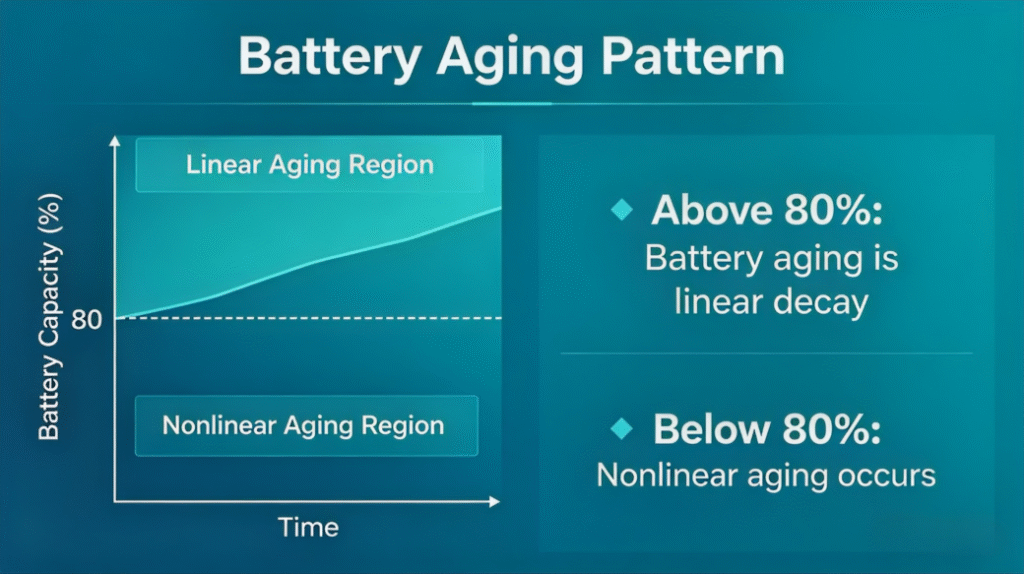
- 100% → 80%: Capacity fades gradually, the internal crystal lattice remains stable, and flight time decreases linearly.
- Below 80%: Non-linear degradation dominates, microcracks proliferate, and the likelihood of sudden capacity loss—or even safety risks—increases.
This is especially critical for UAV softpack batteries, where high discharge currents and compact cell design amplify the effects of internal stress once capacity dips below the 80% mark.
📜 Historical & Regulatory Context
The 80% benchmark is also historically standardized:
- USABC first defined 80% as the “minimum acceptable capacity.”
- IEC adopted this threshold in global standards.
- SAE followed suit for automotive and energy applications.
- GB/T 31484-2015 directly references the USABC definition, marking 80% as end-of-life (EOL).
- Today, it’s a globally recognized performance and safety threshold.
Why this matters for drones:
- Just like EVs, UAV manufacturers often guarantee replacement or service when battery capacity falls below 80%.
- For long-endurance commercial drones used in surveying, delivery, or inspection, maintaining batteries above 80% ensures mission reliability and predictable flight times.
🔧 Practical Implications for Drone Operators
Drone battery management should mirror best practices from automotive and energy storage sectors:
- Mission Planning: Treat batteries approaching 80% capacity as near-EOL—plan shorter missions or avoid high-risk operations.
- Monitoring: Use battery management systems (BMS) or UAV flight controllers to track real-time capacity and internal resistance, as rising IR often signals approaching the 80% threshold.
- Replacement Strategy: Replace or rebuild batteries proactively once the 80% mark is reached to avoid unexpected mid-air failures.
- Lifecycle Visualization: For fleet management, a graph showing capacity vs. cycle count can help pilots predict remaining flight time and schedule maintenance.
- Example Diagram Idea: A simple chart showing:
Capacity %
100 ────────────
90 ────────────
80 ────────▲── End-of-life threshold
70 ────────
60 ────────
- Above 80% → linear fade, predictable flight
- Below 80% → non-linear degradation, higher risk
✈️ Key Takeaways for Drone Batteries
- 80% capacity retention = end-of-life, balancing flight performance, safety, and industry standards.
- Maintaining batteries above 80% ensures reliable flight time, stable power delivery, and lower safety risks.
- Integrating capacity monitoring and lifecycle planning into drone operations prolongs fleet longevity and avoids mission-critical surprises.
For UAV operators managing softpack lithium batteries, 80% is the science-backed line between reliable missions and unpredictable performance.