
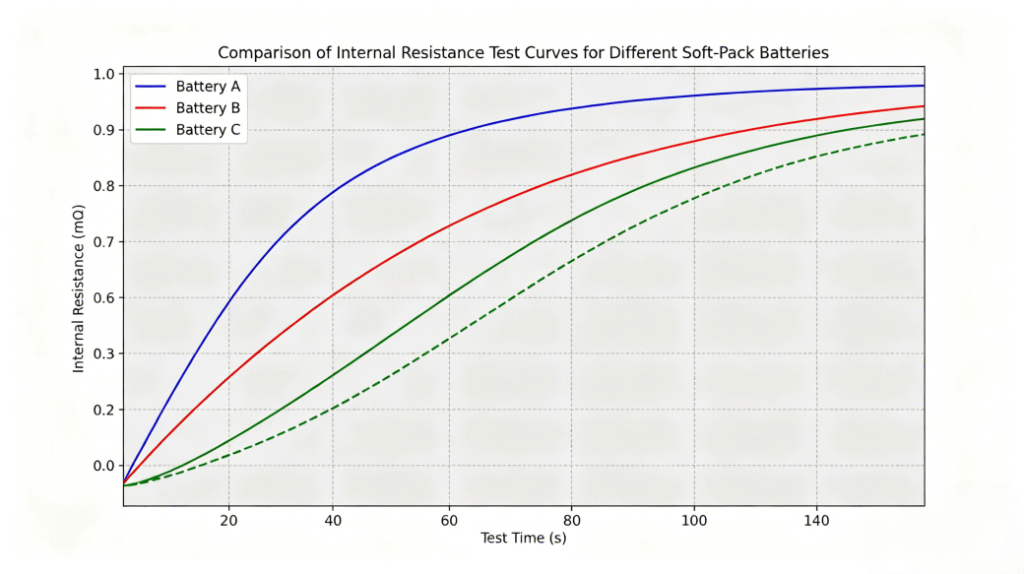
Every day, we rely on lithium batteries—whether in smartphones, laptops, electric vehicles, power banks, drones or home energy storage systems. Yet, few people pay attention to a “hidden killer” inside these batteries: internal resistance (IR).
It’s invisible and untouchable, yet it directly determines a battery’s health, efficiency, and safety.
For example, when your phone drains quickly, your EV struggles uphill, or your power bank no longer holds a charge, most people immediately blame capacity loss, but often the real culprit is elevated internal resistance.
Today, we’ll break down what internal resistance is, its dangers, and how to prevent it—so you don’t waste money replacing batteries prematurely.
🔍 What is Lithium Battery Internal Resistance? (Simplified)
Internal resistance is the “friction” encountered by electrical current passing through a battery, measured in milliohms (mΩ). Think of it like water flowing through a narrow straw: the higher the resistance, the slower the flow—and the more energy is wasted as heat.
For a battery, high IR means energy is lost internally, reducing usable power and performance.
Lithium battery IR has two main components:
- Ohmic resistance: inherent to the battery materials (electrodes, electrolyte, connectors).
- Polarization resistance: arises from chemical reactions during charge/discharge.
Improper usage accelerates IR growth, triggering a chain of performance and safety issues.
⚠️ 4 Major Risks of High Internal Resistance
1️⃣ Rapid Drain & Shrinking Capacity
The most obvious effect is reduced runtime. High IR causes significant voltage drops during operation, meaning less usable energy is delivered.
- A 10,000 mAh power bank might effectively deliver only 7,000 mAh.
- An EV rated for 100 km could barely reach 50 km.
- Drones may experience shortened flight times, inability to carry maximum payloads, or sudden power loss mid-flight.
High IR can also cause “phantom battery levels”—your device may show 30% charge remaining, yet shut down unexpectedly because the battery cannot sustain the current draw.
2️⃣ Slower Charging & Excessive Heat
High IR impedes charging current, wasting energy as heat:
- Phones charge slower than new.
- EV batteries heat up significantly during fast charging.
According to Joule’s Law (Q = I²Rt), heat generation rises with current and resistance. Prolonged heat accelerates electrolyte decomposition, electrode aging, and thickening of the SEI layer, forming a vicious cycle:
High temperature → Increased IR → More heat → Faster degradation
For drones using softpack lithium batteries, this is especially concerning: high IR leads to:
- Reduced power output during takeoff or aggressive maneuvers
- Rapid temperature spikes in tight battery compartments
- Potential thermal runaway, which could damage sensitive electronics and flight controllers
Low temperatures exacerbate the issue: IR can rise 3–5×, making charging inefficient and potentially harming internal cell structures.
3️⃣ Insufficient Power, Devices Struggle
The maximum power output of a battery is limited by its IR: higher resistance means less peak current, making devices underperform.
- EVs: slow acceleration, poor hill climbing
- Laptops: stuttering under high load, crashes
- Drones: failure to lift, sudden alarms mid-flight, or inability to hover with payload
For drones, elevated IR in softpack cells can manifest as:
- Reduced thrust under load, causing instability during takeoff or in windy conditions
- Shorter flight time under nominal battery percentages
- Voltage sag, triggering BMS protection and preventing full performance output
4️⃣ Safety Risks: Swelling, Fire, Explosion
High IR causes localized overheating. When temperature exceeds safe limits:
- Electrolyte decomposition occurs
- Cells may swell (“puff up”)
- Thermal runaway and fire risk increase
For large battery packs in EVs, energy storage, or drones:
- One high-IR cell can trigger the “weakest link” effect, lowering pack performance and risking chain reactions
- In drones, overheating softpack batteries can damage electronics, compromise flight stability, or cause catastrophic failures mid-air
🛠 How to Detect & Prevent Elevated Internal Resistance
Signs your battery may have high IR:
- Runtime drops >30% compared to new
- Excessive heat during charging or use
- Power issues under high load: sudden shutdowns, voltage drops, or stuttering
Best practices to slow IR growth:
- Avoid extreme charge/discharge: don’t fully drain or constantly keep batteries at 100%
- Maintain optimal temperature: 15–35°C is ideal; avoid sub-zero or high-heat conditions
- Limit high-current use: reduce fast charging and aggressive acceleration or load cycles
- Regular maintenance & checks: for drones, EVs, and storage batteries, inspect IR annually; replace if performance declines
For drone softpack batteries, additional precautions include:
- Avoid overloading the drone with heavy payloads
- Monitor cell temperatures during flight
- Prefer balanced charging for multi-cell packs
✅ Key Takeaway
Internal resistance is the true “health bar” of a lithium battery.
- Low IR → healthy, efficient, long-lasting, safe
- High IR → poor performance, shortened life, and hidden safety hazards
By understanding IR and adopting proper usage habits, you can maximize battery longevity, maintain device performance, and prevent accidents—whether for your smartphone, EV, or drone fleet.
At Unique Power, we deliver complete drone power solutions built on quality(batteries with low internal resistance and high consistency), testing, and precision. Our commitment to UAV innovation ensures that your drones stay powered, connected, and mission-ready.