

The Future is Already Here, Just Not Everywhere Yet.
While we still fret over ground traffic congestion, flying cars are shifting from sci-fi to reality—but they face three critical questions that demand answers.
At the Low-Altitude Economy exhibition of the fifth China International Consumer Products Expo, impressive demonstrations captured everyone’s attention: stable hovering in strong winds, clear in-cabin conversations without headphones, and real-time dynamic positioning with centimeter-level accuracy. With leading companies showcasing their innovations, a revolution in low-altitude mobility is moving from the exhibition floor into the real world.
As flying cars gradually approach mass adoption, consumers are most concerned about three core questions: Is it safe? Is it noisy? Is it affordable? Let’s dive into these fundamental issues.
1. Is It Safe? Dual Approaches in Technology and Testing
Safety remains the top priority in transportation. On September 16, 2025, during a rehearsal for the Changchun Airshow, two eVTOLs (electric Vertical Take-Off and Landing aircraft) from Xpeng Aeroht made contact during a formation drill, resulting in one aircraft catching fire upon landing.(find details: https://www.linkedin.com/feed/update/urn:li:activity:7373953350670700544/)
This incident serves as a reminder that exploring low-altitude mobility involves risks.
However, the industry is addressing these concerns with technology. China Automotive Institute Intelligent Connected Technology Co., Ltd., in collaboration with China Automotive Engineering Research Institute Co., Ltd., has applied for a patent for evaluating eVTOL occupant safety in crash scenarios. This system will, for the first time, enable precise quantitative analysis of passenger safety after a crash—essentially performing a “full-body CT scan” of the flying car.
In terms of structural safety, Sanhe Aviation’s self-developed eVTOL prototype has successfully passed an extreme axial compression test. Data showed that the airframe remained intact without structural damage even under 150% of the design limit load.
Axial compression testing is one of the most rigorous assessments in aircraft structural validation, directly related to structural integrity during vertical take-off and mode transition.
Beyond passive safety, active safety technologies are also advancing. Xpeng Aeroht’s “Land Aircraft Carrier” features an intelligent flight control system that continuously monitors and maintains safe flight attitudes, whether in manual or autonomous mode.
2. Is It Noisy? Noise Control Beyond Expectations
Traditional helicopters are notoriously loud, leading to concerns about flying car noise. But eVTOLs have made groundbreaking progress.
At the Consumer Expo, Wang Zhao, COO of EHang Intelligent Equipment (Guangzhou) Co., Ltd., stated, “Passengers can clearly see the landscape below while barely hearing any noise inside the cabin.” The cabin is designed for noise reduction, allowing normal conversation, and ground-level noise remains minimal even at altitudes of tens of meters.
Model A, a flying car developed by Musk-backed Alef, features a revolutionary hidden propeller system with multiple small electric fans concealed within the body for vertical take-off and landing. This design keeps noise below 65 decibels—equivalent to a household vacuum cleaner.
Compared to traditional flying cars with exposed propellers—which often generate noise pollution up to 90 dB, pose safety risks, and struggle with urban airworthiness—the new generation of eVTOLs has achieved a qualitative leap in noise control.
This means eVTOLs can truly integrate into urban low-altitude spaces as “flying taxis” without significantly impacting city living environments.
3. Is It Affordable? A Pricing Path from Luxury to Mass Market
When flying cars first emerged, their prices were staggering. For example, an electric “flying car” developed by a California startup cost around $300,000 (approximately RMB 2.2 million).
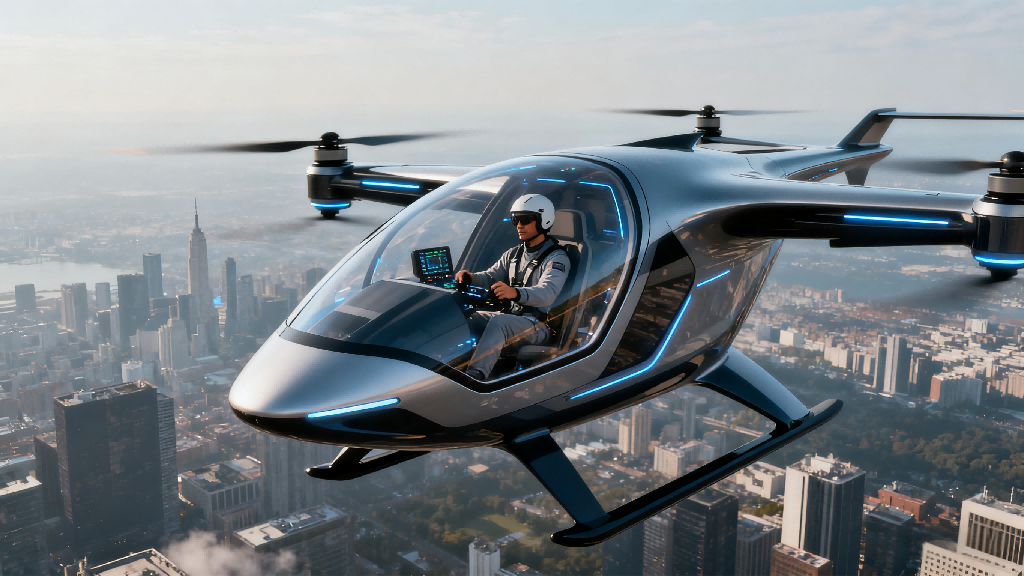
However, as technology matures and production scales, prices are dropping. Musk-backed Alef has adopted a “premium-first, then mass-market” strategy. Its Model A is priced at RMB 2.14 million, aiming to set a technological benchmark. The upcoming Model Z is expected to cost just RMB 250,000, targeting the middle-class market.
Xpeng Aeroht received 260 new orders for its flagship product at the 2023 Shanghai Auto Show, bringing total orders to over 4,000 units. Growing market scale will further drive down costs, creating a virtuous cycle.
Compared to traditional private helicopters (around RMB 20 million) and business jets (hundreds of millions), flying cars already represent a significant breakthrough in affordability. As more companies enter the market and scale production, prices are expected to become even more accessible.
The Future Is Here: Application Scenarios for Flying Cars
Flying cars are not just technologically feasible—they are already finding practical applications.
Hainan has launched a demonstration project to become a “Flying Car Application Island,” partnering with Xpeng Aeroht to promote the adoption of flying cars across the province. Xpeng has already begun verification practices in Hainan, including flight tests, urban road tests for ground modules, and partnerships with over 40 flight camps.
Application Scenarios Table:
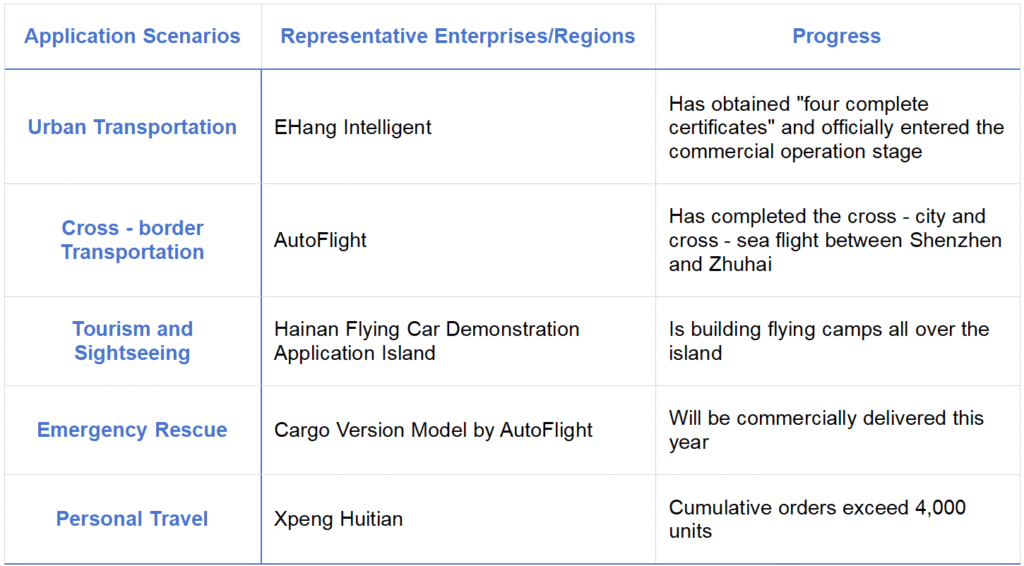
Not Just Hainan: Nationwide Push for eVTOL Air Mobility in Low-Altitude Economy Policies
It’s not just Hainan—multiple regions across China have incorporated eVTOL air mobility into their low-altitude economy policies and planned related routes. For example:
Beijing has proposed establishing eVTOL commuter routes connecting Daxing Airport with Xiong’an New Area, and Capital Airport with Tianjin and Langfang.
Inner Mongolia and other regions are planning dedicated zones for eVTOL air transportation.
Guangdong aims to build low-altitude air corridors covering major areas of the Guangdong-Hong Kong-Macao Greater Bay Area.
Conclusion: Embracing a New Era of Three-Dimensional Mobility
The development of flying cars is at a critical juncture. Safety is improving through continuous innovation and testing, noise control has seen groundbreaking advances, and prices are shifting from luxury to affordability.
From patent applications by China Automotive Institute and axial compression tests by Sanhe Aviation to Xpeng Aeroht’s special flight certification overseas—these technological breakthroughs are paving the way for the future.
The future is already here, just not everywhere yet. When we ask who should be responsible for the safety of flying cars—manufacturers, regulators, or third-party testing agencies? The answer lies in a collaborative effort across all these sectors.
Technological progress will ultimately turn flying cars from science fiction into reality. Are you ready for this mobility revolution?
