
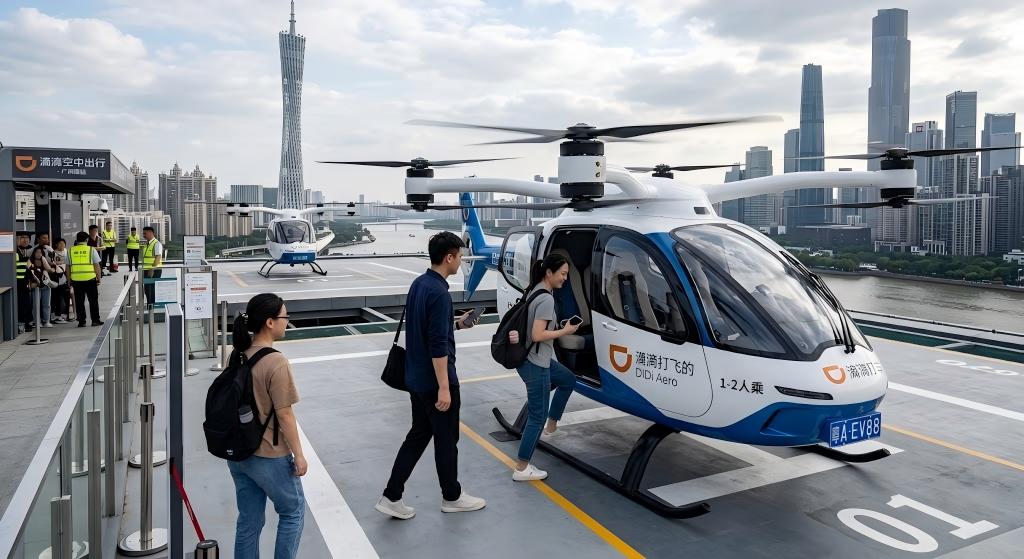
China’s low-altitude economy is entering a new stage.
For years, the industry conversation focused mainly on aircraft manufacturers: who could build the best drone, who could certify the first eVTOL, who could achieve the longest range, and who could raise the most capital.
Now, another type of player is arriving.
Mobility platforms.
The establishment of Beijing Didi Low-Altitude Technology Co., Ltd. in October 2025 sent a clear signal: low-altitude transportation is beginning to attract companies whose real strengths are not aircraft manufacturing, but traffic platforms, user demand, dispatching algorithms, digital payments, and large-scale mobility operations.
That changes the competitive landscape.
Didi may not want to build the aircraft.
It may want to build the platform that allows people to call one.
And if that model works, the future of low-altitude mobility could look much more like ride-hailing than traditional aviation.

Didi Is Not Trying to Become an Aircraft Manufacturer
One of the most interesting aspects of Didi’s low-altitude strategy is what it appears not to be doing.
Its newly established low-altitude technology business reportedly focuses on areas such as:
- Technology development
- AI application software
- Software platforms
- Digital services
rather than aircraft manufacturing itself.
This fits naturally with Didi’s existing strengths.
Its core capabilities are already built around:
- Matching supply with demand
- Real-time vehicle dispatching
- Route optimization
- Dynamic pricing
- Driver and fleet management
- Payment infrastructure
- Large-scale user acquisition
In traditional mobility, Didi did not need to manufacture cars to become one of the most important companies in the transportation ecosystem.
The same logic could eventually apply to eVTOLs.
Instead of owning every aircraft, a future low-altitude mobility platform could aggregate:
Aircraft manufacturers + operators + vertiports + passengers + maintenance providers + airspace services
into one digital ecosystem.
The aircraft becomes the transportation asset.
The platform becomes the operating system.
The Strategic Logic Is Easy to Understand
Didi has already explored cooperation with eVTOL manufacturer EVE Air Mobility Technology / EVTol-related partner EHang? and other industry participants as the low-altitude sector develops.
The broader logic is clear:
If urban air mobility becomes a meaningful part of future transportation, then today’s ground-mobility platforms cannot afford to ignore it.
Imagine a journey ten years from now:
You open one mobility application.
The system calculates your route.
For the first five kilometers, an autonomous vehicle takes you to a vertiport.
An eVTOL flies you across the city.
Another vehicle completes the last mile.
The user does not care which company owns each transportation asset.
The user cares about:
- Travel time
- Cost
- Safety
- Convenience
- Reliability
Whoever controls this integrated mobility interface could become extremely powerful.
That is why Didi’s entry looks less like an experimental investment and more like strategic positioning for the next transportation platform.
Didi Is Not Alone — China’s Giants Are Building Different Pieces of the Low-Altitude Ecosystem
The low-altitude economy is already attracting companies from very different backgrounds.
And each one is entering from its own strongest capability.
DJI: Aircraft + Dock + Cloud Platform
DJI has gradually expanded from consumer drones into industrial applications such as:
- Power inspection
- Public safety
- Mapping
- Urban management
Its model increasingly combines:
Aircraft + Automated Dock + Cloud Management
This is effectively creating autonomous drone infrastructure.
Meituan: Building an Urban Drone Delivery Network
Meituan has been one of China’s most aggressive investors in drone delivery.
Its ambition is not simply to operate individual delivery drones.
The larger objective is to build a low-altitude logistics network connecting:
- Distribution centers
- Drone stations
- Communities
- Commercial districts
The real asset is the network.
SF Express / Phoenix Wings: Heavy Logistics
SF’s drone subsidiary Phoenix Wings has focused more heavily on industrial and intercity logistics.
This is a very different market from food delivery.
Instead of transporting a few kilograms over several kilometers, these aircraft target:
- Larger payloads
- Longer routes
- Mountainous regions
- Islands
- Cross-city logistics
This represents another layer of the low-altitude logistics infrastructure.
AutoNavi: The “Map” of the Sky
If aircraft are going to move through cities at scale, they need something similar to road navigation.
That creates opportunities for companies such as AutoNavi.
Future low-altitude navigation systems may need to understand:
- Three-dimensional routes
- Temporary restrictions
- Weather
- Vertiport availability
- Building obstacles
- Airspace authorization
- Traffic density
Traditional digital maps may evolve into three-dimensional air mobility operating maps.
Geely + CaoCao Mobility: Integrating Ground and Air Transport
CaoCao Mobility’s cooperation with Geely-backed eVTOL companies represents another interesting model.
Instead of treating aviation and ground transportation as separate industries, the goal is increasingly:
Ground Mobility + Air Mobility = One Transportation Network
This may eventually become the dominant operating logic for urban air mobility.
Why Are Mobility and Technology Giants Entering Now?
Because the low-altitude economy is no longer viewed simply as a drone manufacturing opportunity.
It is becoming an infrastructure and services economy.
Aircraft manufacturing is only one layer.
Around every aircraft, an entire ecosystem must exist:
- Vertiports
- Charging infrastructure
- Battery swapping
- Flight planning
- Maintenance
- Insurance
- Air traffic management
- Navigation
- Data services
- Fleet management
- Emergency response
- Passenger platforms
This means the value created by low-altitude transportation may eventually be distributed across a much larger ecosystem than aircraft manufacturing itself.
That is exactly where internet and mobility giants have an advantage.
A Trillion-Yuan Market — But With Two Very Different Temperatures
The enthusiasm surrounding China’s low-altitude economy is undeniable.
Capital is entering.
Local governments are building industrial clusters.
eVTOL companies are raising significant financing rounds.

Drone applications are expanding rapidly.
But underneath the excitement, the industry is experiencing two completely different realities.
At the top of the market:
- Leading companies receive large financing rounds
- Government-backed funds provide support
- Strategic investors compete for exposure
- Demonstration projects receive strong policy support
But in the middle of the market:
- Many companies struggle to obtain financing
- Commercial revenue remains limited
- Certification is expensive
- Customer demand is fragmented
- Hardware margins are under pressure
This creates an important distinction:
The low-altitude economy is growing quickly, but not every low-altitude company will grow with it.
A booming industry does not guarantee that every participant will survive.
For Small and Medium-Sized Companies, the Opportunity Has Not Disappeared — It Has Changed
When giants enter a market, smaller companies often ask the same question:
Is there still room for us?
In the low-altitude economy, the answer is yes.
But competing directly with giants may no longer be the smartest strategy.
Trying to build “another DJI” or “another eVTOL manufacturer” requires enormous resources:
- Aircraft engineering
- Certification
- Manufacturing
- Supply chain
- Brand
- Sales channels
- Capital
For most small companies, a better opportunity lies elsewhere.
Path 1: Stop Building Aircraft — Build Services
A company does not necessarily need to manufacture drones to participate in the low-altitude economy.
In fact, many of the most scalable opportunities may exist in services.
Examples include:
- Drone maintenance
- Battery maintenance
- Aircraft inspection
- Pilot training
- Flight testing
- Fleet operation
- Infrastructure inspection
- Drone cleaning services
- Mapping services
- Emergency response
- Low-altitude logistics operations
Instead of investing millions in developing another aircraft platform, companies can purchase certified aircraft and focus resources on solving customer problems.
This is a classic light-asset strategy.
The aircraft becomes the tool.
The service becomes the business.
Path 2: Own a Small but Valuable Vertical Market
Large companies naturally pursue large markets.
That leaves thousands of smaller markets underserved.
The low-altitude economy contains many specialized niches:
- Solar panel inspection
- Wind turbine inspection
- Building façade cleaning
- Agricultural monitoring
- Forestry
- Environmental monitoring
- Island logistics
- Mountain logistics
- Drone shows
- FPV sports
- Training
- Maintenance
- Scientific research
Each individual market may be too small for a technology giant.
But for a specialized SME, even a small market can become highly profitable if the company develops:
- Expertise
- Customer relationships
- Operating experience
- Data
- Local reputation
The future of the drone industry will not consist only of billion-dollar giants.
It will also contain thousands of profitable specialized companies.
Path 3: Become the Regional Expert
Low-altitude operations are highly local.
Every region has different:
- Airspace conditions
- Regulations
- Geography
- Industrial structure
- Customer demand
- Government relationships
- Infrastructure
This creates natural advantages for local companies.
A national technology giant may have stronger capital and software.
But it may not understand the operating realities of one specific province, port, industrial zone, mountain region, or island network.
A local company that understands:
- Regulators
- Customers
- Terrain
- Weather
- Infrastructure
can develop a powerful regional moat.
Low-altitude transportation may therefore become one of those industries where local execution remains extremely valuable even in the age of digital platforms.
The Biggest Opportunities May Exist Behind the Aircraft
Consider what happens when the day finally arrives when a passenger can open an app and call an eVTOL.
The user sees one button.
Behind that button is an enormous industrial chain.
Who builds the vertiport?
Who supplies the charger?
Who manages the batteries?
Who replaces degraded battery packs?
Who maintains the aircraft?
Who monitors flight health?
Who handles emergency recovery?
Who inspects propulsion systems?
Who manages insurance?
Who trains technicians?
Who operates the ground infrastructure?
Who manages passenger safety?
The platform may belong to a giant.
But thousands of specialized companies may operate underneath it.
This is why Didi’s entry should not automatically be interpreted as bad news for smaller companies.
In many ways, large platforms can expand the entire ecosystem.
What This Means for the Battery Industry
From my perspective working in batteries for drones, robots, AGVs, RGVs, and AMRs, the development of the low-altitude economy creates another interesting opportunity.
As operations become more commercialized, customers will stop buying batteries simply based on:
Voltage + Capacity + C-rate
They will increasingly evaluate batteries based on operational economics.
For example:
- How many flights can the battery support?
- How quickly can it recharge?
- Can it support opportunity charging?
- How accurately can the BMS predict remaining energy?
- How does the battery perform under high-temperature summer conditions?
- How much capacity remains after 500 or 1,000 cycles?
- Can batteries be managed at fleet level?
- How much does each flight actually cost?
For future air mobility operators, the most important battery metric may eventually become:
Cost per safe flight hour.
That is very different from simply asking for the cheapest battery pack.

eVTOL Commercialization Could Transform Battery Requirements
If mobility platforms such as Didi eventually operate large eVTOL networks, aircraft utilization will need to increase dramatically.
A privately owned aircraft may fly a few times per day.
A commercial air taxi may need to operate continuously.
That changes battery priorities.
Future commercial eVTOL batteries may need:
- Very high energy density
- High takeoff power
- Ultra-fast charging
- Excellent thermal management
- Accurate SOC and SOH prediction
- Very high consistency
- Strong cycle life
- Full traceability
- Predictive maintenance
Battery management may become deeply integrated into fleet dispatching.
For example:
An aircraft with 32% SOC may automatically be assigned a shorter mission.
An aircraft with higher battery temperature may be routed to charging later.
A pack showing abnormal internal resistance may be removed before failure.
In other words:
The battery will become part of the mobility platform’s scheduling algorithm.
That may be one of the most important transformations in future electric aviation.
Giants Will Build Platforms — Specialists Will Build the Ecosystem
Didi’s biggest advantages are obvious:
- User traffic
- Platform scale
- AI
- Dispatch algorithms
- Mobility data
- Payment systems
Those are formidable strengths.
But low-altitude transportation is much more complicated than ride-hailing.
A car can pull over when something goes wrong.
An aircraft cannot.
Low-altitude mobility also involves:
- Certification
- Airspace management
- Weather
- Maintenance
- Energy infrastructure
- Safety redundancy
- Emergency systems
These difficult operational layers create opportunities for specialized companies.
The industry may eventually develop an interesting division of labor:
Large companies build platforms.
Aircraft companies build vehicles.
Infrastructure companies build the network.
Specialized SMEs solve thousands of operational problems.
Final Thoughts: The Sky Is Big Enough
Didi’s entry makes China’s low-altitude economy more competitive.
But competition is not necessarily bad news.
It often means that an industry is becoming real.
When internet giants entered e-commerce, thousands of companies emerged around:
- Warehousing
- Logistics
- Payments
- Marketing
- Software
When EVs expanded, entire ecosystems appeared around:
- Batteries
- Charging
- Thermal management
- Power electronics
- Testing
- Recycling
The same thing is likely to happen in low-altitude mobility.
One day, perhaps we really will open an app and press:
“Call an Air Taxi.”
But behind that single button will be:
Aircraft manufacturers.
Battery suppliers.
Vertiport operators.
Maintenance companies.
Navigation platforms.
Charging infrastructure.
Airspace services.
Insurance providers.
And thousands of specialized businesses that most passengers will never see.
The giants may build the stage.
But they will not perform every role.
For smaller companies, the question is no longer:
“How do we compete with Didi?”
The better question is:
“What part of the ecosystem can we become indispensable to?”
In a trillion-yuan low-altitude economy, there will be room for giants.
There will also be room for companies that are small, specialized, and exceptionally good at solving one real problem.
The sky is large enough for both.
#LowAltitudeEconomy #eVTOL #UrbanAirMobility #AdvancedAirMobility #DroneIndustry #UAV #BatteryTechnology #DroneBattery #ElectricAviation #SmartMobility #AirTaxi #Robotics #FutureMobility #ChinaTech
