
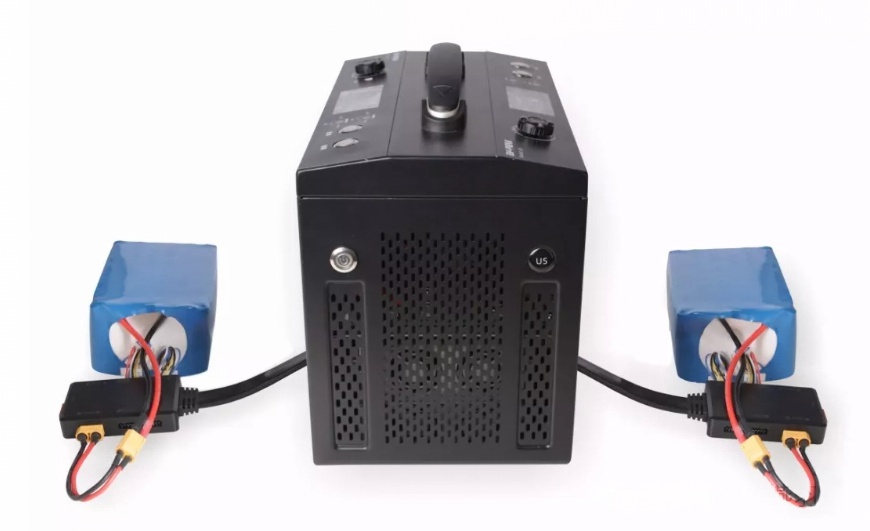
Drone batteries are mostly lithium polymer (LiPo) or lithium-ion (Li-ion) batteries, characterized by being lightweight and high-energy-density, but they require careful handling.
I. Detailed Steps for Charging Drone Batteries
Pre-Charging Preparation
- Ensure charger compatibility: Use the original or officially certified charger. Different drone models have different voltage and current parameters; using the wrong charger may cause overvoltage/overcurrent damage.
- Check device status:
Connecting the Charger and Battery
- Plug in the power: Insert the charger plug into a stable power outlet (preferably a wall socket to avoid overloading a power strip) and observe whether the charger indicator lights up (usually red, indicating standby).
- Connect the battery

Starting the Charge
- Once the charger and battery are successfully connected, the indicator light will turn solid red (indicating charging).
- Some smart chargers display real‑time battery level (e.g., LED bars corresponding to percentage) or sync charging status via an app.

Monitoring During Charging
- Do not leave unattended: Always have someone present while charging; never leave the battery charging unattended for extended periods (to prevent overcharging or accidents).
- Watch for abnormalities: Immediately disconnect power and stop charging if any of the following occurs:
Completing the Charge
- When the indicator turns solid green (or the app shows “100%”), the battery is fully charged. Disconnect the charger from the power outlet and from the battery immediately.
- Avoid overcharging: Do not leave the battery connected to the charger after it is fully charged (overcharging lithium batteries raises internal pressure, which can cause swelling or fire).
Post‑Charge Handling
- Remove the battery from the charger and place it in a dry, ventilated area away from direct sunlight.
- For long‑term storage (more than 1 month), charge the battery to about 50% capacity (to extend battery life) and perform a charge‑discharge cycle every 2‑3 months (to maintain battery activity).
II. How to Choose a “Matching” Charger
A compatible charger is critical for drone battery safety and longevity. It must strictly meet the following core parameters:
- Voltage matching: The nominal voltage of the drone battery (e.g., “3S” for a LiPo battery means 3 cells in series, nominal voltage 11.1 V) must exactly match the charger’s output voltage. For example, if the battery is rated at 11.1 V (3S), the charger output must be 11.1 V (some chargers support “auto‑voltage detection,” but compatibility must still be confirmed).
- Current matching: The charger’s output current must be ≥ the battery’s charge rate (C‑rating) × battery capacity (mAh) ÷ 1000 (in A). For instance, if the battery capacity is 5000 mAh and the charge rate is 1C (i.e., 5 A), the charger output current should be ≥5 A (a 1C‑2C current, e.g., 5‑10 A, is recommended; avoid excessive current that may damage the battery).
- Connector type matching: The physical interface of the charger (e.g., DC barrel jack, USB‑C) must be fully compatible with the battery’s charging port, including outer/inner diameters and pin definitions. For example, many DJI drone batteries use a dedicated barrel connector (5.5 mm outer diameter, 2.5 mm inner diameter) and require the corresponding charger interface – do not substitute with other connectors.
- Charging protocol matching (essential for smart batteries): If the battery supports a smart charging protocol (e.g., “balance charging protocol” for LiPo batteries), the charger must support that protocol to enable cell‑balancing (preventing individual cells from overvoltage). For instance, some “smart batteries” require a charger that supports the “DJI Battery Protocol”; otherwise, the balancing function will not activate, shortening battery life.
- Safety certification matching: Prioritize chargers with 3C (China), UL (USA), or CE (EU) certifications. These certifications ensure that the charger meets safety standards (e.g., overvoltage, overcurrent, and short‑circuit protection). Avoid uncertified low‑quality chargers, which may have design flaws that cause overheating, short circuits, or fires.
Drone batteries are the “lifeline” of flight safety. Proper charging not only extends battery life but also helps prevent accidents. Share this with your fellow pilots and fly safely together!
