
As the low-altitude economy gains momentum, many people are hearing the term eVTOL (electric Vertical Take-Off and Landing aircraft) for the first time.
In promotional videos, they look like flying electric cars.
At industry conferences, they’re often called “air taxis.”
And judging by some headlines, it almost seems as if urban air mobility is only one step away from becoming part of our daily commute.
Naturally, one question keeps coming up:
If eVTOLs can also take off and land vertically, will they eventually replace helicopters?
In the short term, probably not.
And the more realistic answer is even more interesting:
Helicopters and eVTOLs are likely to coexist, each serving different missions within the future low-altitude ecosystem.
Because low-altitude transportation is not simply an aircraft problem—it is a system problem.
Different Power Systems, Different Engineering Logic
Traditional helicopters rely primarily on piston engines or turboshaft engines, which transmit power through complex mechanical gearboxes and rotor systems.
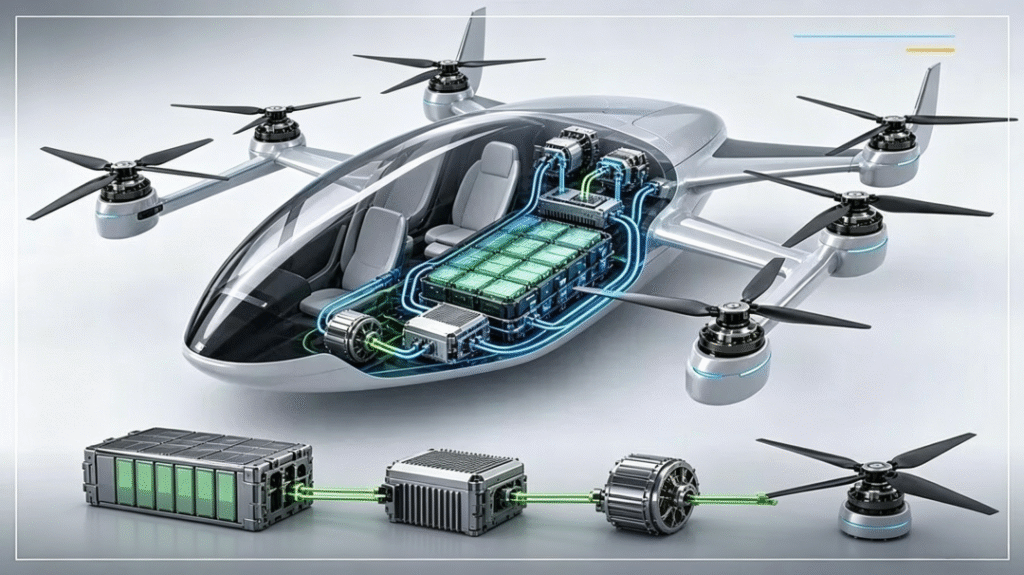
Most eVTOL aircraft, on the other hand, use electric propulsion systems consisting of:
- Multiple electric motors
- Distributed propellers or rotors
- Different aerodynamic configurations for vertical takeoff and cruise
This is far more than simply replacing fuel with batteries.
Electric propulsion offers several advantages:
✅ Flexible architecture
✅ Fast power response
✅ Lower noise potential
✅ Reduced mechanical complexity
✅ Lower maintenance requirements
However, the challenges are equally significant:
- Battery energy density
- Payload limitations
- Flight range
- Charging efficiency
- Thermal management
- System redundancy
- Certification requirements
In other words, switching from fuel to electricity changes the entire engineering tradeoff.
Helicopters burn fuel.
eVTOLs consume electricity.
It sounds like an energy difference, but in reality, it represents two fundamentally different design philosophies.
Different Missions, Different Strengths
Helicopters have been proving themselves for decades in demanding environments.
Their applications include:
🚁 Emergency medical services
🚁 Offshore platform transportation
🚁 Firefighting operations
🚁 Search and rescue missions
🚁 Police aviation
🚁 Mountain rescue
🚁 Heavy-lift cargo operations
These missions require much more than simply flying from point A to point B.
Behind every helicopter operation lies:
- Mature aircraft platforms
- Pilot training systems
- Maintenance infrastructure
- Operational procedures
- Regulatory frameworks
- Decades of safety experience
eVTOLs, meanwhile, are more likely to begin with relatively controlled environments, such as:
Urban and Regional Air Mobility
- Airport-to-city transportation
- Short-distance passenger commuting
- Campus and industrial park shuttles
- Fixed-route logistics operations
Their ideal scenario is characterized by:
- High frequency
- Short distances
- Standardized routes
- Predictable operating conditions
Not immediate replacement of helicopters in disaster response or complex rescue missions.
In many ways:
Helicopters are proven tools forged through decades of real-world challenges.
eVTOLs are emerging tools that are still progressing toward maturity.
Their missions may overlap, but they are unlikely to replace each other outright.
The Hardest Problem Isn’t Building the Aircraft
Many people focus entirely on the aircraft itself.
But advanced air mobility is fundamentally a systems challenge.
Success depends on much more than the flying machine.
Questions that matter include:
Infrastructure
Where will vertiports be located?
Noise Management
Can communities accept increased air traffic?
Airspace Integration
How will flight corridors be organized?
Weather Operations
What happens during heavy rain or poor visibility?
Energy Support
How will charging and maintenance be handled?
Traffic Management
How will hundreds—or thousands—of low-altitude vehicles communicate, navigate, and avoid conflicts?
Emergency Procedures
How will failures and unexpected events be managed?
Organizations such as NASA and the FAA have repeatedly emphasized that Advanced Air Mobility (AAM) is not merely about developing a new aircraft.
It is about building an entirely new ecosystem.
Cool Designs Alone Are Not Enough
When evaluating any low-altitude mobility project, three questions matter far more than futuristic renderings:
1. Is There a Clear Certification and Safety Path?
Without airworthiness certification, commercialization remains theoretical.
2. Is There a Real Operating Scenario?
Technology without practical use cases rarely succeeds.
3. Is Supporting Infrastructure Available?
Aircraft cannot scale without charging networks, vertiports, maintenance systems, and traffic management.
Beautiful designs alone are not enough.
Why Batteries Will Play a Critical Role
As someone working in the drone battery industry, I believe the future of eVTOL is ultimately tied to energy technology.
The biggest constraint facing eVTOL today is not aerodynamics—it is energy.
To unlock widespread adoption, future batteries must deliver:
🔋 Higher energy density
🔋 Faster charging capability
🔋 Superior thermal management
🔋 Longer cycle life
🔋 Improved safety
🔋 Greater reliability and redundancy
Advances in:
- Semi-solid-state batteries
- Solid-state batteries
- High-voltage platforms
- Smart BMS systems
- Fast-charging technologies
may ultimately determine how quickly eVTOL moves from demonstration flights to large-scale commercial operations.
eVTOL Isn’t Here to Replace Helicopters
Perhaps the biggest misconception surrounding the low-altitude economy is the idea that one aircraft type must eliminate another.
History suggests otherwise.
Commercial jets didn’t replace helicopters.
High-speed trains didn’t eliminate airplanes.
Electric vehicles haven’t made internal combustion vehicles disappear overnight.
Likewise, eVTOLs are unlikely to replace helicopters.
Instead, they will become a new member of the low-altitude transportation ecosystem.
The future of mobility is not about one winner.
It’s about building a diverse, efficient, and sustainable network where different platforms perform the missions they do best.
Because low-altitude mobility isn’t about flying everywhere.
It’s about making flight safe, organized, and sustainable.
A question for everyone:
If air taxis eventually become part of everyday life, what would concern you most?
🚨 Safety?
💰 Price?
🔇 Noise?
Or something else entirely?