
.
When a drone suddenly loses power in flight, most operators immediately blame the battery.
But here’s an uncomfortable truth:
In more than 50–70% of battery-related failures, the root cause is not the lithium cells themselves.
Instead, the issue often originates from:
- Battery Management System (BMS) logic
- Voltage sampling errors
- Cell balancing failures
- Connector resistance
- Wiring harness issues
- Assembly quality
- Environmental stress
Only a smaller percentage of failures are actually caused by catastrophic cell damage such as:
- Internal short circuits
- Severe swelling
- Thermal runaway
- Mechanical deformation
As drones become larger, heavier, and more expensive, understanding the real source of battery failures becomes increasingly important.
A battery issue in an electric scooter may leave you walking home.
A battery issue in a drone can result in:
- Aircraft loss
- Payload destruction
- Mission failure
- Property damage
- Safety incidents
Let’s examine the most common drone battery pack failures and what they usually indicate.
The Drone Battery Pack Is More Than Just Cells
A modern UAV battery pack consists of several interconnected subsystems:
Battery Cells
The energy source.
BMS
The battery’s brain.
Voltage Sampling Harness
Allows the BMS to monitor every cell.
Power Connectors
Carry high current to the ESCs.
Communication Module
Transfers battery status to the flight controller.
Thermal Management Components
Temperature sensors, heat dissipation structures, and protection circuits.
A failure in any one of these components can appear to be a “battery problem.”
Failure #1: Battery Immediately Shuts Down After Power-On
This is surprisingly common in industrial drones.
Many operators assume the battery is dead.
In reality, the most common causes are:
Cell-Related Issues
- One cell voltage abnormally low
- One cell voltage abnormally high
- Cell connection resistance increase
- Internal micro-short circuit
- Self-discharge imbalance
Harness-Related Issues
- Loose balance lead
- Broken sampling wire
- Poor solder joints
Sensor Issues
- Temperature sensor failure
- Current sensor abnormality
BMS Failure
Possible, but statistically less common.
In most cases the BMS is functioning correctly by detecting an abnormal condition.
Failure #2: Drone Suddenly Loses Power During Flight but Recovers After Landing
This is one of the most dangerous UAV battery symptoms.
Typical scenario:
The drone is flying normally.
A high-power maneuver occurs.
The aircraft suddenly enters low-voltage protection or emergency landing mode.
After resting for several minutes, the battery appears normal again.
Most Common Cause
Cell aging and increased internal resistance.
During high-current discharge:
Voltage sag becomes excessive.
One weak cell reaches the low-voltage cutoff first.
The BMS triggers protection.
Once the load is removed:
Voltage rebounds.
Everything appears normal again.
Other Possible Causes
- Loose terminal connections
- High-resistance weld joints
- Cell inconsistency
- Aging balance harnesses
In large agricultural and logistics drones, this failure mode is especially common after 300–500 cycles.

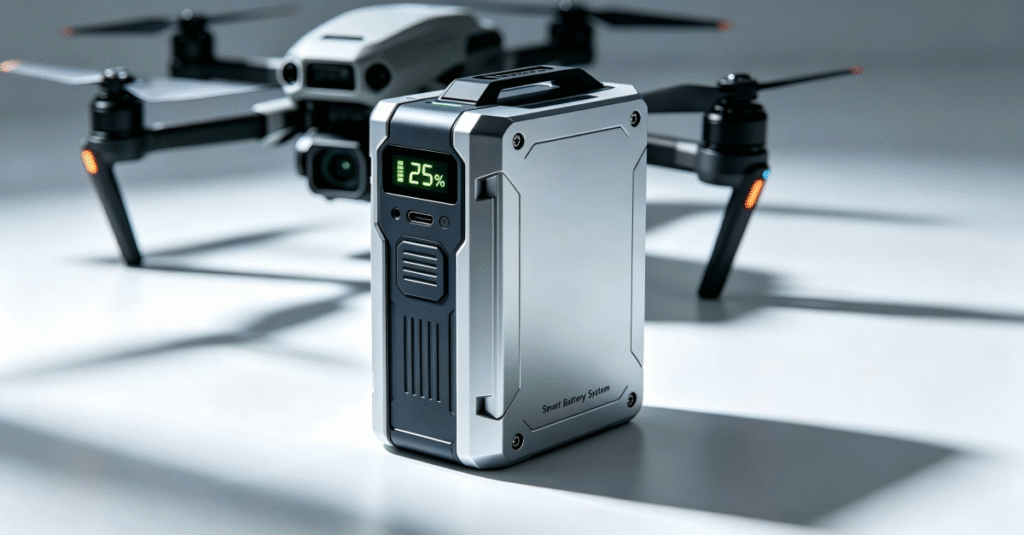
Smart drone batteries made by UniquePower for agricultural field strictly use high-consistency cells. The casing features a specially designed grille structure to enhance battery heat dissipation. With an IP68 protection rating, the batteries are better protected against damage caused by humidity, corrosion, and other hazards.
Failure #3: Battery Refuses to Charge
Another frequent issue in UAV operations.
Possible causes include:
Cell-Related
- One cell already reached over-voltage threshold
- Cell internal resistance increased dramatically
- Cell degradation causing abnormal charging behavior
Environmental
- Charging temperature too low
- Charging temperature too high
Charger Issues
- Incorrect charging profile
- Voltage mismatch
BMS Issues
Approximately 20–30% of cases involve:
- Charging MOSFET failure
- Charging path damage
- Protection circuit malfunction
Failure #4: Battery Charges Normally but Immediately Trips Under Load
This is extremely important for drone operators.
The battery may appear fully charged.
However:
The moment the motors spool up, protection activates.
Potential Cell Causes
- Excessive internal resistance
- Voltage collapse under load
- Weak parallel groups
- Aging cells
Potential BMS Causes
- Overcurrent threshold too conservative
- Current sensor drift
- MOSFET degradation
- Sampling circuit errors
Unlike consumer electronics, UAVs demand very high burst currents.
A battery that seems healthy at rest may fail completely during takeoff.

Failure #5: Drone Battery Gets Extremely Hot
Excessive heat should never be ignored.
Cell-Related Causes
- Internal micro-short circuit
- Localized cell damage
- Self-discharge abnormalities
- Aging cells with high internal resistance
Assembly Causes
- Poor welding quality
- Connector oxidation
- Undersized cables
- High contact resistance
Drone-Specific Factors
Many UAV batteries operate in:
- Direct sunlight
- High ambient temperatures
- Sealed battery compartments
Poor thermal management can accelerate degradation dramatically.
If a drone battery becomes too hot to comfortably touch after flight, further investigation is necessary.
Failure #6: Battery Voltage Looks Normal but Cannot Deliver Power
This situation often confuses operators.
The battery reports:
✔ Correct voltage
✔ Correct state of charge
Yet flight time drops dramatically.
Common Causes
- Increased cell resistance
- Connector oxidation
- Loose terminals
- Aging cells
Voltage alone does not indicate battery health.
Power delivery capability matters far more.
Failure #7: Voltage Collapses the Moment a Load Is Applied
This symptom is often a near-certain indicator of cell degradation.
Typical signs:
- Battery appears fully charged
- Voltage instantly drops during takeoff
- Aircraft reports low-voltage warnings
In more than 90% of cases:
The issue originates from the cells themselves.
Usually:
- Internal resistance growth
- Capacity loss
- Weak cell groups
Rather than the BMS.
Failure #8: Random Protection Events
Sometimes a battery behaves unpredictably:
One flight is normal.
The next flight triggers protection.
Then everything works again.
Possible Causes
Cell Side
- Loose balance wires
- Oxidized connectors
- Sensor intermittency
BMS Side
- Faulty protection IC
- Electromagnetic interference
- Reference voltage instability
Industrial UAVs operating near power infrastructure frequently experience this type of challenge.
Failure #9: Water Exposure and Moisture Damage
This is becoming increasingly common in:
- Agricultural drones
- Maritime drones
- Inspection UAVs
Moisture can damage both the cells and the BMS.
Cell Side
- Corrosion
- Increased self-discharge
- Internal shorts
BMS Side
- MOSFET failure
- PCB corrosion
- Sensor malfunction
- Communication errors
Many batteries survive the initial exposure but fail weeks later due to corrosion.
When Is the BMS Definitely the Problem?
Certain symptoms strongly indicate BMS failure.
MOSFET Short Circuit
Battery remains permanently connected.
Excessive heat appears immediately.
Protection IC Failure
Battery constantly enters protection.
Or protection never activates at all.
Sampling Reference Failure
Voltage readings become wildly inaccurate.
All cells appear abnormal.
Gate Driver Failure
MOSFETs cannot switch properly.
Battery neither charges nor discharges.
PCB Damage
- Burn marks
- Broken traces
- Severe corrosion
These are clear signs of BMS hardware failure.
Why Drone Battery Packs Are More Vulnerable Than EV Packs
Unlike electric vehicles, drones experience:
Constant Vibration
Loosens connections over time.
High Current Peaks
Takeoff and maneuvering create extreme stress.
Frequent Fast Charging
Accelerates aging.
Temperature Extremes
Summer operations can exceed 60°C battery temperatures.
Harsh Environmental Exposure
Dust, moisture, chemicals, and UV exposure.
As a result, UAV battery packs often age faster than many ground-based battery systems.
The Most Overlooked Problem: Lack of Preventive Maintenance
The biggest difference between drones and automobiles is not technology.
It is maintenance culture.
Vehicle owners expect regular inspections.
Drone operators often do not.
Many battery failures could be prevented through simple periodic checks:
✔ Internal resistance measurement
✔ Cell voltage consistency analysis
✔ Connector inspection
✔ Balance lead verification
✔ Thermal performance monitoring
✔ BMS diagnostic review
A battery should be treated as a critical flight component—not a disposable accessory.
Final Thoughts
When a drone battery pack fails, the cells are not always to blame.
In fact, the majority of field failures involve:
- Cell imbalance
- Connector degradation
- Wiring issues
- Sensor faults
- BMS configuration problems
- Poor assembly quality
True cell failures such as swelling, thermal runaway, and internal shorts are serious, but they are only part of the picture.
For UAV operators, manufacturers, and fleet managers, the key takeaway is simple:
Don’t ask whether the battery failed.
Ask:
Which part of the battery system failed?
Because a drone battery pack is no longer just a collection of cells.
It is a complete energy management system where cells, electronics, software, and mechanical design must work together perfectly.
And in aviation, reliability is never determined by the strongest component.
It is determined by the weakest one.