
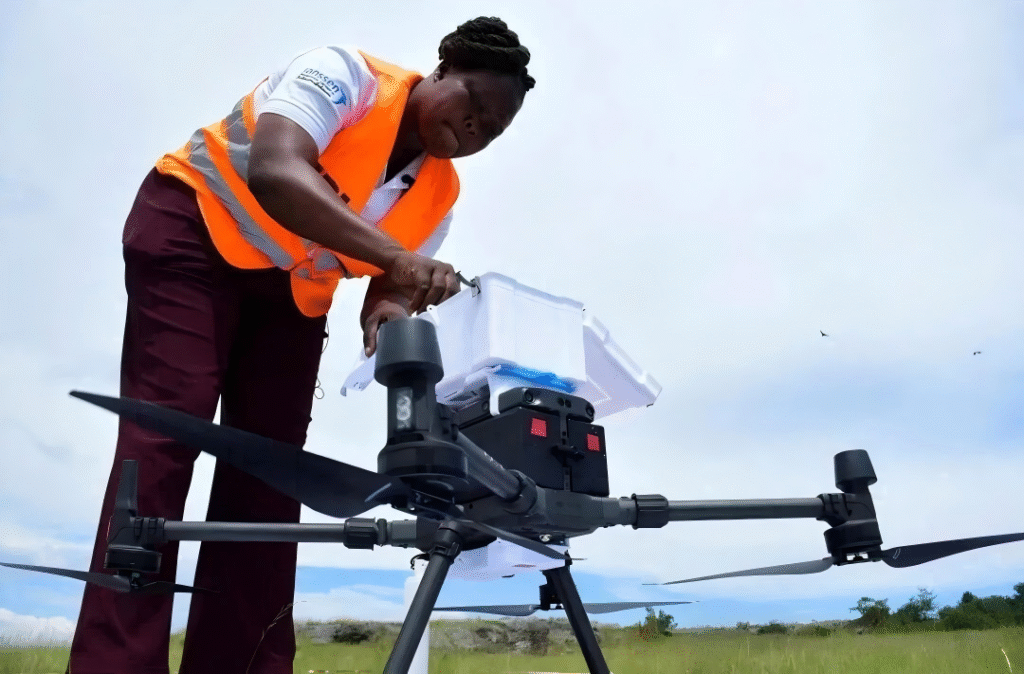
In recent weeks, global attention has once again turned to the Democratic Republic of Congo (DRC), where a new Ebola outbreak has escalated into a serious public health emergency.
By late May, hundreds of suspected cases and more than 200 suspected deaths had been reported. Even more concerning, infections had already crossed borders into neighboring Uganda.
But beyond the tragic health implications, this outbreak highlights something the drone industry has been discussing for years:
When roads fail, infrastructure collapses, and human access becomes dangerous, drones stop being a convenience—and become critical infrastructure.
The Real Challenge Isn’t Just the Virus
When people hear “Ebola,” they often think of a deadly virus.
However, in many outbreak zones, the virus is only part of the problem.
The larger challenge is logistics.
Many affected regions face:
✔ Poor or non-existent road networks
✔ Seasonal flooding and destroyed transportation routes
✔ Security threats and armed conflict
✔ Limited healthcare infrastructure
✔ Long distances between villages and laboratories
✔ Shortages of trained personnel
In these environments, even basic public health operations become incredibly difficult.
Delivering a box of medical supplies may require hours—or days—of travel.
Transporting a blood sample to a testing laboratory can take so long that the sample degrades before analysis.
By the time a diagnosis is confirmed, valuable containment time has already been lost.

Where Drones Make the Difference
Most people associate drones with aerial photography or package delivery.
In reality, humanitarian and medical operations may become one of the most important long-term applications of UAV technology.
1. Contact-Free Medical Supply Delivery
During outbreaks of highly infectious diseases, minimizing human contact is critical.
Drones can transport:
- Personal protective equipment (PPE)
- Medical supplies
- Diagnostic kits
- Emergency medications
- Blood products
- Vaccines (when available)
directly to remote clinics without exposing drivers, healthcare workers, or local communities to unnecessary infection risks.
Every successful drone delivery removes a potential transmission pathway.
2. Rapid Transport of Diagnostic Samples
One of the most valuable yet often overlooked applications is reverse logistics.
Suspected Ebola cases require laboratory confirmation.
Traditionally, blood samples may travel by motorcycle, boat, or off-road vehicle.
In remote regions, this can take several days.
Drone transport can reduce delivery times from days to hours.
Faster testing means:
- Faster diagnosis
- Faster isolation
- Faster contact tracing
- Faster outbreak containment
In infectious disease management, speed saves lives.
3. Situational Awareness in High-Risk Areas
Some affected areas are inaccessible—not because of disease, but because of security concerns.
Drones can provide critical aerial intelligence, including:
- Population movement patterns
- Gathering hotspots
- Infrastructure damage assessments
- Road accessibility analysis
- Environmental monitoring
These insights help humanitarian organizations make better operational decisions without exposing personnel to unnecessary risk.

4. Supporting Broader Public Health Operations
Although Ebola itself is not mosquito-borne, outbreak zones often face multiple simultaneous health challenges.
Drone-based spraying systems can assist with:
- Vector control programs
- Sanitation support
- Environmental monitoring
- Emergency response operations
The result is a more resilient public health system capable of addressing multiple threats simultaneously.
Why Africa May Become One of the Most Important Drone Markets
This may sound counterintuitive, but some of the world’s most challenging environments may also become the strongest use cases for drone technology.
In highly developed cities, drones often compete against mature transportation networks.

In remote parts of Africa, drones are not competing with trucks.
They are competing with:
- Dirt roads
- Motorcycles
- Canoes
- Foot travel
Or sometimes, no transportation infrastructure at all.
This creates a unique reality:
The weaker the ground infrastructure, the stronger the value proposition of drones.
For humanitarian organizations, NGOs, healthcare providers, and governments, the question is no longer:
“Can drones fly?”
The question is:
“Can drones reliably deliver critical supplies where nothing else can?”
What This Means for Industrial Drone Companies
For UAV manufacturers and system providers, humanitarian logistics is becoming a proven and scalable market opportunity.
However, success requires a shift in thinking.
Stop Selling Aircraft. Start Selling Capability.
Healthcare organizations do not buy drones because they have the longest flight time.
They buy solutions that guarantee delivery.
The winning offering is often:
- Aircraft
- Cargo module
- Launch and recovery system
- Fleet management software
- Operator training
- Maintenance support
combined into a complete logistics solution.
Cargo Design Matters More Than Many People Think
Transporting blood samples is very different from transporting agricultural chemicals.
Medical logistics requires:
- Temperature control
- Shock protection
- Biosecurity compliance
- Fast loading and unloading
The cargo system often becomes more important than the aircraft itself.

Hybrid Logistics Networks Are Emerging
A particularly promising model is the combination of:
Fixed-Wing UAVs
- Long-range transport (50–100+ km)
and
Multirotor UAVs
- Final delivery to clinics and villages
This “hub-and-spoke” architecture has already demonstrated operational feasibility in multiple humanitarian missions.
The Battery Perspective: The Hidden Enabler
As someone working in the drone battery industry, I believe these missions highlight a reality that is often overlooked.
A drone is only as reliable as its energy system.
Medical logistics missions require batteries capable of:
✔ High reliability
✔ Long cycle life
✔ Rapid charging
✔ Wide-temperature operation
✔ Safe transportation
✔ Predictable performance under heavy payloads
Unlike commercial photography flights, humanitarian operations cannot simply be postponed because of battery performance limitations.
When a drone carries blood samples, emergency medication, or critical medical equipment, battery reliability becomes a mission-critical requirement.
This is why advances in:
- High-energy-density lithium batteries
- Semi-solid-state batteries
- Smart BMS systems
- Fast-charging technologies
- Cold-weather battery solutions
will play a major role in the future of humanitarian aviation.
Looking Ahead
The latest Ebola outbreak is a reminder that technology often finds its greatest purpose in the world’s most difficult environments.
In places where roads are destroyed, infrastructure is fragile, and human access is dangerous, drones are no longer experimental tools.
They become lifelines.
While much of the drone industry continues to debate urban air mobility, drone taxis, and last-mile consumer delivery, remote regions across Africa are already demonstrating something powerful:
When people cannot reach the destination, flight becomes infrastructure.
And in those moments, drones are not simply machines.
They become part of the healthcare system itself.
