
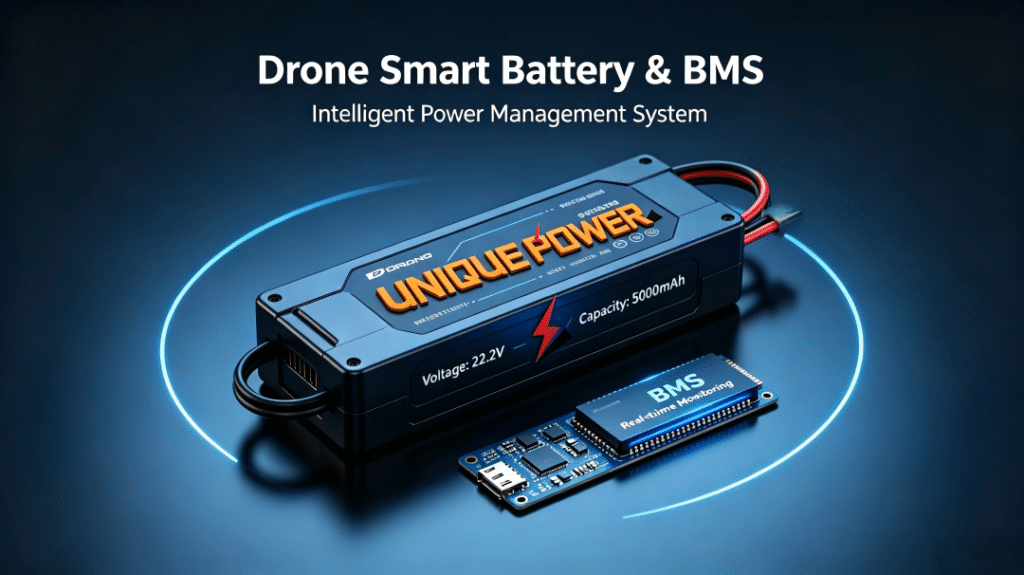
When people discuss drone batteries, the conversation usually revolves around:
- Energy density
- Flight time
- Charging speed
- Cycle life
- Cell chemistry
Rarely does anyone ask a more important question:
How intelligent is the battery?
Because no matter how advanced a lithium battery cell may be, without an effective Battery Management System (BMS), it is merely stored energy without protection, optimization, or intelligence.
In reality, many cases of battery swelling, thermal runaway, unexpected shutdowns, and even battery fires can be traced back not to the cells themselves, but to failures in battery management.
As drone platforms become larger, more powerful, and more mission-critical, the BMS is evolving from a supporting component into the true “brain” of the battery system.
What Is a Drone Battery BMS?
BMS stands for Battery Management System.
Think of it as the nervous system of the battery pack.
While lithium cells provide energy, the BMS continuously monitors, analyzes, protects, and controls how that energy is stored and delivered.
A modern drone battery BMS performs four essential functions:
✅ Monitoring
✅ Protection
✅ Balancing
✅ Communication
Without these capabilities, even the highest-quality cells can become safety risks.
We had talked BMS before, click to know more:
1. Real-Time Monitoring: The Foundation of Battery Intelligence
The first job of a BMS is knowing exactly what is happening inside the battery at all times.
Modern drone BMS platforms continuously measure:
Voltage Monitoring
Individual cell voltages and total pack voltage are sampled at high frequency.
This allows the system to detect:
- Over-voltage conditions
- Under-voltage conditions
- Cell imbalance
- Abnormal voltage behavior
High-end systems can achieve measurement accuracy within ±2–5mV.
Current Monitoring
Using Hall-effect sensors or precision shunt resistors, the BMS measures:
- Charging current
- Discharging current
- Instantaneous power consumption
- Total energy throughput
This data forms the foundation for power management and flight endurance calculations.
Temperature Monitoring
Multiple NTC temperature sensors are strategically placed throughout the battery pack.
Typical monitoring locations include:
- Cell surfaces
- Internal pack structure
- High-current connection points
When temperature thresholds are exceeded, protective actions are triggered automatically.
For many drone battery systems, temperatures above 60°C require intervention.
State of Charge (SOC)
SOC estimation determines how much usable energy remains in the battery.
Accurate SOC prediction is critical because:
A drone pilot’s flight decisions are only as good as the battery information available.
Modern systems typically maintain SOC estimation errors within 5%.
State of Health (SOH)
SOH evaluates battery aging over time.
Parameters include:
- Cycle count
- Capacity degradation
- Internal resistance growth
- Historical operating conditions
This allows operators to identify batteries approaching end-of-life before they become safety risks.
2. Safety Protection: The Most Critical Function
Monitoring alone is not enough.
The BMS must act when danger appears.
Modern drone BMS systems include multiple protection mechanisms.
Overcharge Protection
Prevents cells from exceeding safe voltage limits.
Without this protection:
- Electrolyte decomposition accelerates
- Gas generation increases
- Thermal runaway risk rises dramatically
Over-Discharge Protection
Prevents cells from falling below safe minimum voltage.
Deep discharge can permanently damage cell chemistry and significantly reduce cycle life.
Overcurrent and Short-Circuit Protection
During abnormal current spikes, the BMS can disconnect the battery within milliseconds.
Protection systems typically rely on MOSFET switching networks capable of rapid response.
Temperature Protection
Both high-temperature and low-temperature protection are essential.
High temperatures increase safety risks.
Low temperatures reduce lithium-ion mobility and can cause lithium plating during charging.
Cell Voltage Difference Protection
Large voltage differences between cells indicate imbalance and potential failure.
The BMS continuously monitors these deviations and initiates corrective action when necessary.
Why BMS Protection Matters More in Drones
Unlike electric vehicles, drones operate in a three-dimensional environment.
A battery failure doesn’t simply stop the vehicle.
It can cause:
- Mission failure
- Equipment loss
- Property damage
- Safety hazards
For industrial drones carrying LiDAR systems, inspection equipment, medical supplies, or logistics payloads, battery reliability is mission-critical.
3. Cell Balancing: Extending Battery Life
No two lithium cells age identically.
Even when manufactured in the same batch, small differences eventually appear.
Over time these differences lead to:
- Capacity mismatch
- Voltage imbalance
- Reduced usable energy
- Increased safety risks
The BMS addresses this through cell balancing.
Passive Balancing
The most common method.
Excess energy from higher-voltage cells is dissipated as heat through resistors.
Advantages:
- Simple
- Reliable
- Low cost
Disadvantages:
- Energy loss
- Slower balancing speed
Active Balancing
A more advanced approach.
Energy is transferred directly from higher-voltage cells to lower-voltage cells.
Advantages:
- Higher efficiency
- Better energy utilization
- Improved pack longevity
Disadvantages:
- Higher cost
- Increased system complexity
As drone battery capacities continue to increase, active balancing is becoming increasingly attractive.
4. Communication: Connecting the Battery to the Aircraft
Modern drone batteries are no longer isolated power sources.
They are intelligent networked devices.
The BMS communicates continuously with the flight controller.
Common communication protocols include:
CAN Bus
The dominant solution for industrial and commercial UAVs.
Advantages:
- High reliability
- Fast communication
- Excellent noise immunity
SMBus
Common in intelligent battery systems.
Designed specifically for power management applications.
UART
Low-cost and simple implementation.
Frequently used in smaller drone platforms.
I2C
Widely used in compact battery systems and embedded electronics.
Bluetooth Low Energy (BLE)
Enables wireless monitoring through:
- Smartphones
- Tablets
- Ground control stations
This improves maintenance and battery diagnostics.
How a Drone BMS Actually Works
The operation of a BMS can be summarized in four steps:
Step 1: Data Collection
Sensors continuously gather voltage, current, and temperature data.
Step 2: Intelligent Analysis
Algorithms estimate:
- SOC
- SOH
- Remaining flight time
- Fault conditions
Step 3: Protection Decisions
If abnormal conditions are detected, protective actions are executed.
Examples include:
- Current limitation
- Battery isolation
- Emergency shutdown
Step 4: Communication Feedback
Information is transmitted to the flight controller, enabling real-time flight decisions.
This creates a closed-loop energy management system.
Why BMS Is Becoming More Important Than Ever
The drone industry is rapidly moving toward:
- Higher voltages (12S, 14S, 18S, 24S)
- Larger battery capacities
- Higher discharge rates
- Heavier payloads
As performance increases, risk increases as well.
A modern drone battery is no longer simply a collection of lithium cells.
It is an integrated electro-mechanical-electronic system.
The BMS is what makes this system safe and usable.
The Future of Drone Battery Management
AI-Powered Predictive BMS
The next generation of BMS will not simply react to problems.
It will predict them.
Machine learning algorithms can analyze:
- Historical usage patterns
- Temperature trends
- Resistance growth
- Flight profiles
to forecast failures before they occur.
Some early deployments have already demonstrated:
- 25% longer battery life
- 20% higher fleet efficiency
- 40% reduction in battery-related failures
High-Voltage Integration
Future drone batteries will continue moving toward:
- 12S
- 14S
- 18S
- 24S systems
This requires:
- Faster sampling
- Higher precision monitoring
- Better insulation design
- Advanced fault diagnosis
Cloud-Based Fleet Battery Management
Industrial drone operators increasingly manage hundreds or thousands of batteries simultaneously.
Cloud-connected BMS platforms enable:
- Battery lifecycle tracking
- Predictive maintenance
- Fleet-level analytics
- Automated health reporting
Battery management is evolving from single-pack intelligence to fleet-wide intelligence.
Final Thoughts
In the early days of drones, battery cells were the primary focus.
Today, cell technology is gradually becoming standardized.
Many manufacturers can source similar lithium cells.
The real differentiation is increasingly shifting elsewhere.
It is shifting toward software.
Toward algorithms.
Toward intelligence.
Toward BMS.
As the low-altitude economy expands and drone operations become more demanding, the Battery Management System will no longer be viewed as an accessory.
It will become one of the most important factors determining:
✔ Flight safety
✔ Battery lifespan
✔ Operational efficiency
✔ Fleet reliability
✔ Commercial viability
Because in modern drones, lithium cells may provide the energy—
but the BMS decides how intelligently that energy is used.